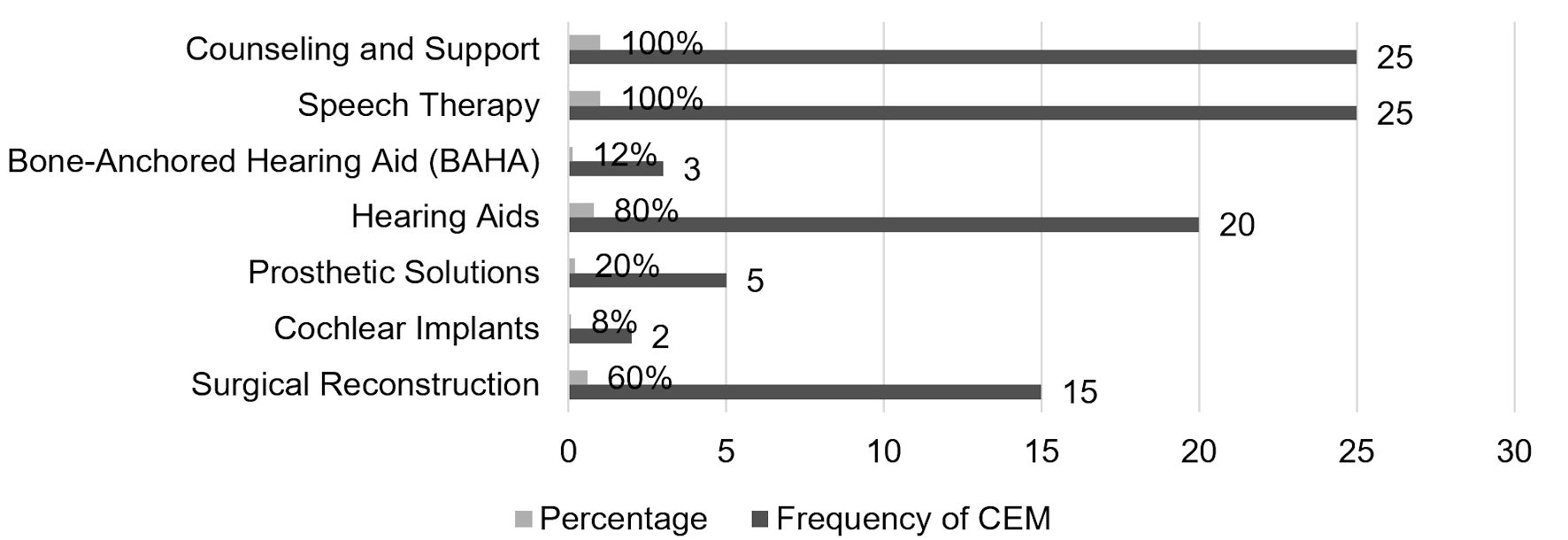
↓ Figure 1. Graphical presentation of the level
of medical care. CEM: congenital ear malformation.
| Journal of Clinical Medicine Research, ISSN 1918-3003 print, 1918-3011 online, Open Access |
| Article copyright, the authors; Journal compilation copyright, J Clin Med Res and Elmer Press Inc |
| Journal website https://jocmr.elmerjournals.com |
Original Article
Volume 17, Number 7, July 2025, pages 386-397
Risk Factors in the Formation of Congenital Malformations of the Ear: Microtia and Atresia of the External Auditory Canal
Figure
Tables
| Variables | Without CEM | With CEM | Incidence rates |
|---|---|---|---|
| CEM: congenital ear malformation. | |||
| Male | 484 (97.38%) | 13 (2.62%) | 26.86 cases per 1,000 males |
| Female | 466 (49.05%) | 12 (50.95%) | 25.75 cases per 1,000 females |
| Age (days) | 1.2 ± 0.5 | 1.3 ± 0.6 | - |
| Weight (kg) | 3.2 ± 0.4 | 2.8 ± 0.6 | - |
| Comorbidities | 910 (98.48%) | 14 (1.52%) | - |
| Total | 950 (97.44%) | 25 (2.56%) | 26.30 cases per 1,000 persons |
| Characteristics | Without CEM | With CEM | P value | ||
|---|---|---|---|---|---|
| N | % | N | % | ||
| CEM: congenital ear malformation. | |||||
| Sex | |||||
| Male | 484 | 97.38 | 13 | 2.62 | 0.385 |
| Female | 466 | 49.05 | 12 | 50.95 | |
| Parental consanguinity | |||||
| No | 760 | 98.45 | 12 | 1.55 | 0.001 |
| First degree | 120 | 92.31 | 10 | 7.69 | |
| Second degree and more | 70 | 95.89 | 3 | 4.10 | |
| Maternal employment | |||||
| No | 930 | 97.48 | 24 | 2.5 | 0.050 |
| Yes | 20 | 95.24 | 1 | 4.765 | |
| Dysmorphia | |||||
| No | 930 | 97.38 | 25 | 2.62 | 0.550 |
| Yes | 20 | 100 | 0 | 0.0 | |
| Maternal smoking | |||||
| No | 785 | 98.13 | 15 | 1.88 | 0.344 |
| Yes | 165 | 94.29 | 10 | 5.71 | |
| Maternal alcohol consumption | |||||
| No | 944 | 97.82 | 21 | 2.176 | 0.020 |
| Yes | 10 | 71.43 | 4 | 28.571 | |
| Premature birth | |||||
| No | 650 | 97.6 | 16 | 2.402 | 0.270 |
| Yes | 300 | 97.09 | 9 | 2.913 | |
| Cesarean section | |||||
| No | 610 | 97.76 | 14 | 2.244 | 0.000 |
| Yes | 340 | 96.87 | 11 | 3.134 | |
| Stillbirth | |||||
| No | 930 | 97.89 | 20 | 2.105 | 0.005 |
| Yes | 20 | 80 | 5 | 20 | |
| Iron supplementation during pregnancy | |||||
| No | 150 | 96.77 | 5 | 3.226 | 0.179 |
| Yes | 800 | 97.56 | 20 | 2.439 | |
| Calcium intake during pregnancy | |||||
| No | 200 | 95.69 | 9 | 4.306 | 0.213 |
| Yes | 750 | 97.91 | 16 | 2.089 | |
| Vitamin supplementation | |||||
| No | 820 | 97.39 | 22 | 2.613 | 0.333 |
| Yes | 130 | 97.74 | 3 | 2.256 | |
| Medication during pregnancy | |||||
| No | 810 | 98.18 | 15 | 1.818 | 0.002 |
| Yes | 140 | 93.33 | 10 | 6.667 | |
| Level of treatment | Treatment method | Frequency of CEM | Percentage |
|---|---|---|---|
| CEM: congenital ear malformation. | |||
| Surgical | Surgical reconstruction | 15 | 60% |
| Cochlear implants | 2 | 8% | |
| Non-surgical | Prosthetic solutions | 5 | 20% |
| Hearing aids | 20 | 80% | |
| Bone-anchored hearing aid (BAHA) | 3 | 12% | |
| Speech therapy | 25 | 100% | |
| Counseling and support | 25 | 100% | |
| Dependent variable | Independent variables | OR | 95% CI | P value | R2 |
|---|---|---|---|---|---|
| For each dependent variable (e.g., CEM, stillbirth, Apgar score, etc.), the corresponding independent variables (such as parental consanguinity, maternal alcohol consumption, medication during pregnancy, etc.) have been retained and clearly displayed. CEM: congenital ear malformation; OR: odds ratio; CI: confidence interval. | |||||
| CEM | Parental consanguinity | 4.56 | 0.84, 3.10 | 0.087 | 0.11 |
| Maternal alcohol consumption | 12.73 | 1.81, 46.73 | 0.005 | ||
| Medication during pregnancy | 22.84 | 1.19, 10.42 | 0.002 | ||
| Stillbirth | CEM | 16.21 | 1.67, 19.79 | 0.003 | 0.12 |
| Cesarean section | 4.56 | 0.90, 3.00 | 0.048 | ||
| Abortions | 7.18 | 1.19, 2.10 | 0.003 | ||
| Apgar score | Number of live children | 1.13 | 0.05, 0.20 | 0.004 | 0.02 |
| Maternal smoking | 0.65 | -0.66, -0.12 | 0.010 | ||
| Vitamin supplementation | 1.36 | 0.19, 0.79 | 0.009 | ||
| Iron supplementation during pregnancy | 1.51 | 0.04, 0.63 | 0.034 | ||
| Parental consanguinity | 0.77 | 0.74, 0.01 | 0.050 | ||
| Child weight | Maternal smoking | 0.85 | -310.91, -149.57 | 0.002 | 0.03 |
| Caesarean section | 0.78 | -126.72, -10.30 | 0.001 | ||
| Cranial perimeter | Dysmorphia | 4.15 | 0.74, 1.199 | 0.005 | 0.05 |
| CEM | 1.22 | 0.05, 0.020 | 0.006 | ||
| Abortions | 0.71 | -0.63, -0.05 | 0.010 | ||
| Maternal smoking | 0.84 | -0.41, -0.01 | 0.034 | ||
| No. | Theme | Sub-themes |
|---|---|---|
| CEM: congenital ear malformation. | ||
| 1 | Physical challenges | Discomfort in ears |
| Hearing difficulties | ||
| Energy levels | ||
| 2 | Emotional impact | Self-consciousness |
| Anxiety | ||
| Frustration | ||
| 3 | Social interactions | Peer acceptance |
| Participation in social activities | ||
| Friend support | ||
| 4 | Functional limitations | Difficulty with specific tasks |
| Activity limitations | ||