Journal of Clinical Medicine Research, ISSN 1918-3003 print, 1918-3011 online, Open Access
Article copyright, the authors; Journal compilation copyright, J Clin Med Res and Elmer Press Inc
Journal website https://jocmr.elmerjournals.com

Original Article

Volume 18, Number 5, May 2026, pages 301-312


Optimizing Rituximab Maintenance Therapy: Outcomes of Extended-Interval Dosing in Multiple Sclerosis and Neuromyelitis Optica Spectrum Disorder

Figures

↓  Figure 1. Flowchart demonstrating patients that were included and excluded in the study. *Three AQP4-IgG-seropositive NMOSD patients receiving rituximab were not recruited in the study because they had received rituximab at intervals shorter than 24 weeks due to persistently elevated CD19 levels 24 weeks after each infusion. AQP4-IgG+ NMOSD: aquaporin-4 immunoglobulin G seropositive neuromyelitis optica spectrum disorder.
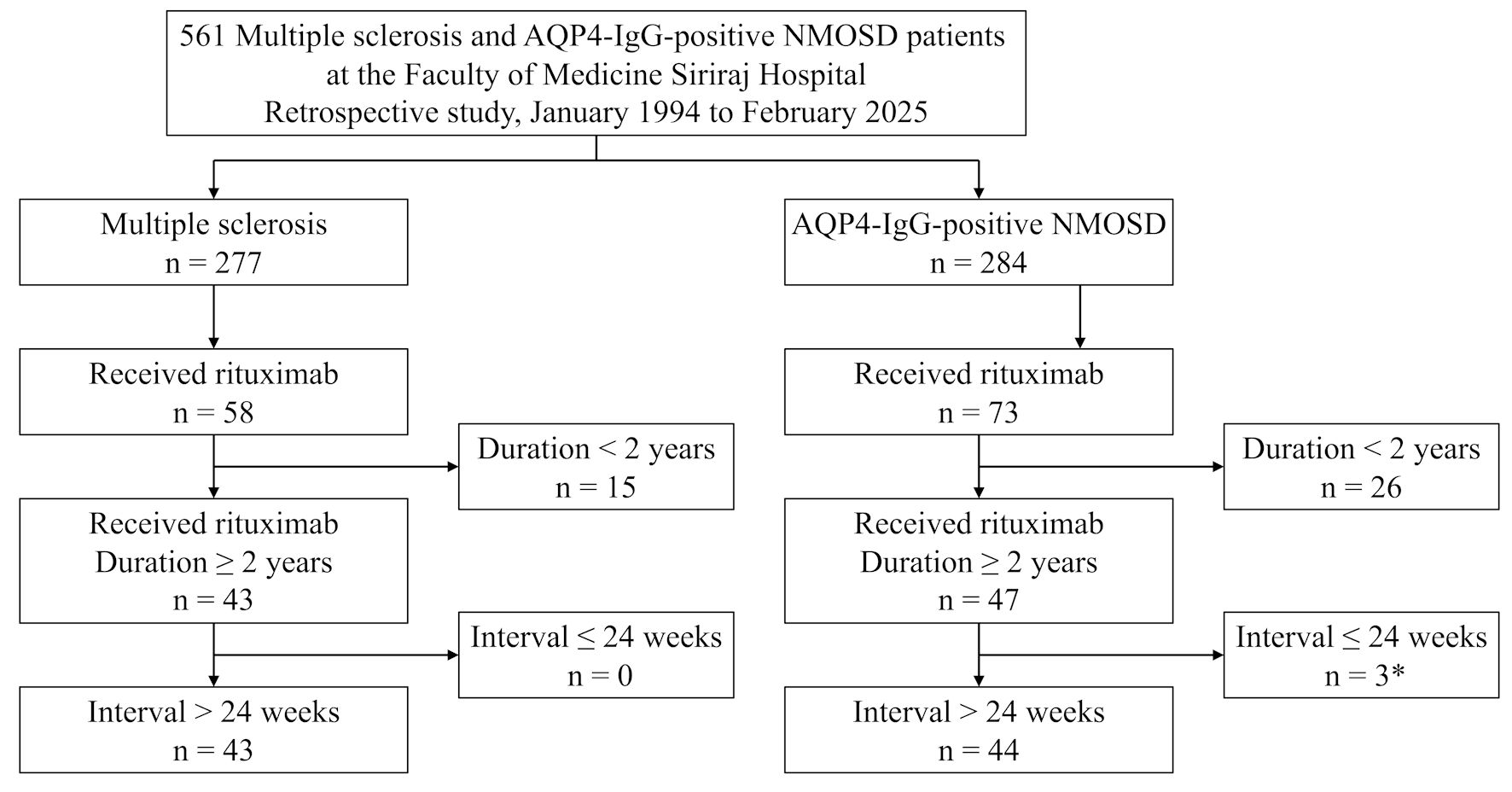
Figure 1.
↓  Figure 2. Annualized relapse rate pre- and post-treatment. (a) Multiple sclerosis. (b) AQP4-IgG-seropositive neuromyelitis optica spectrum disorder. AQP4-IgG: aquaporin-4 immunoglobulin G.
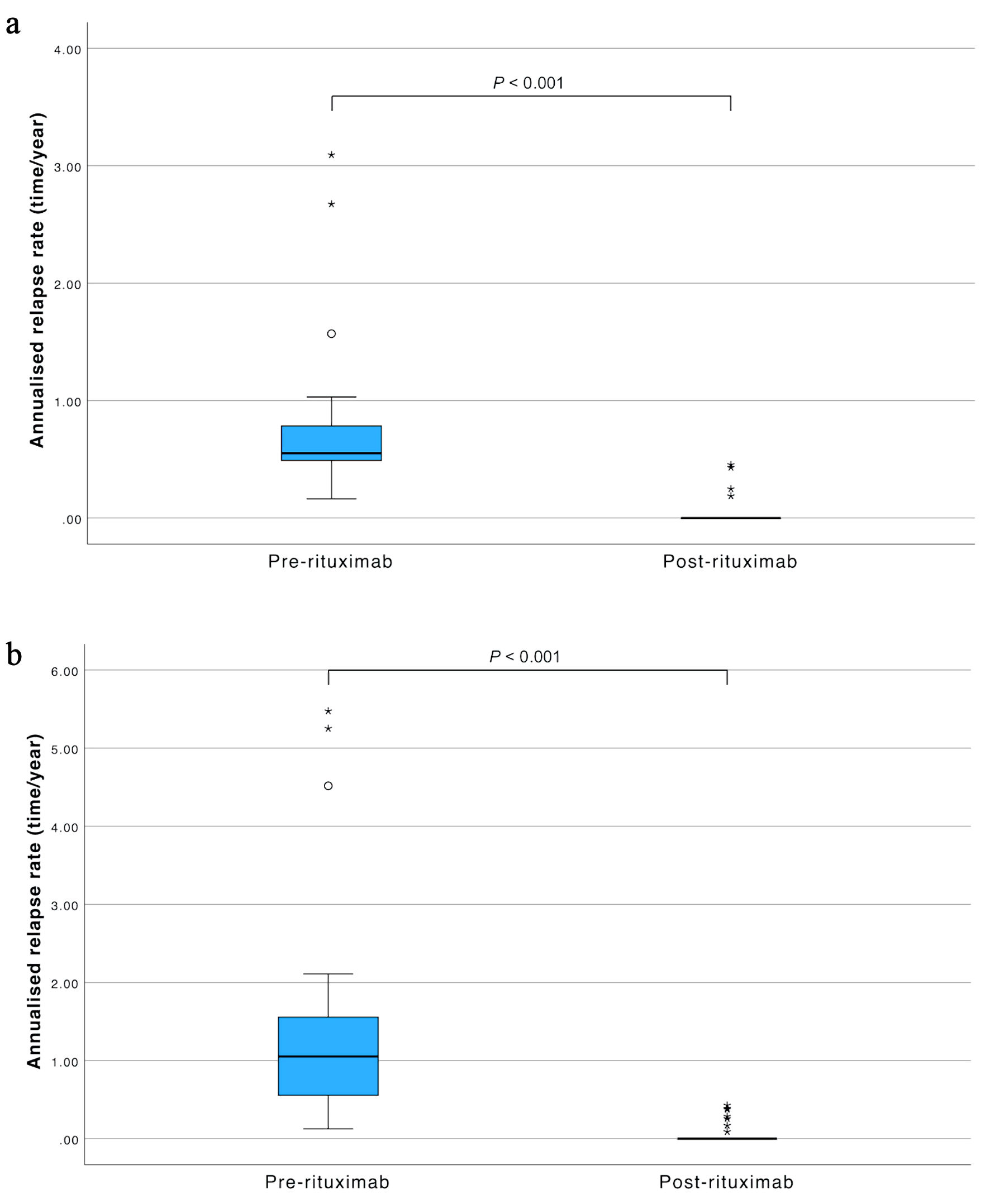
Figure 2.
↓  Figure 3. Kaplan–Meier curve demonstrating the proportion of relapse-free patients at the cutpoint of 32 weeks. (a) Multiple sclerosis. (b) AQP4-IgG-seropositive neuromyelitis optica spectrum disorder. CI: confidence interval; AQP4-IgG: aquaporin-4 immunoglobulin G.
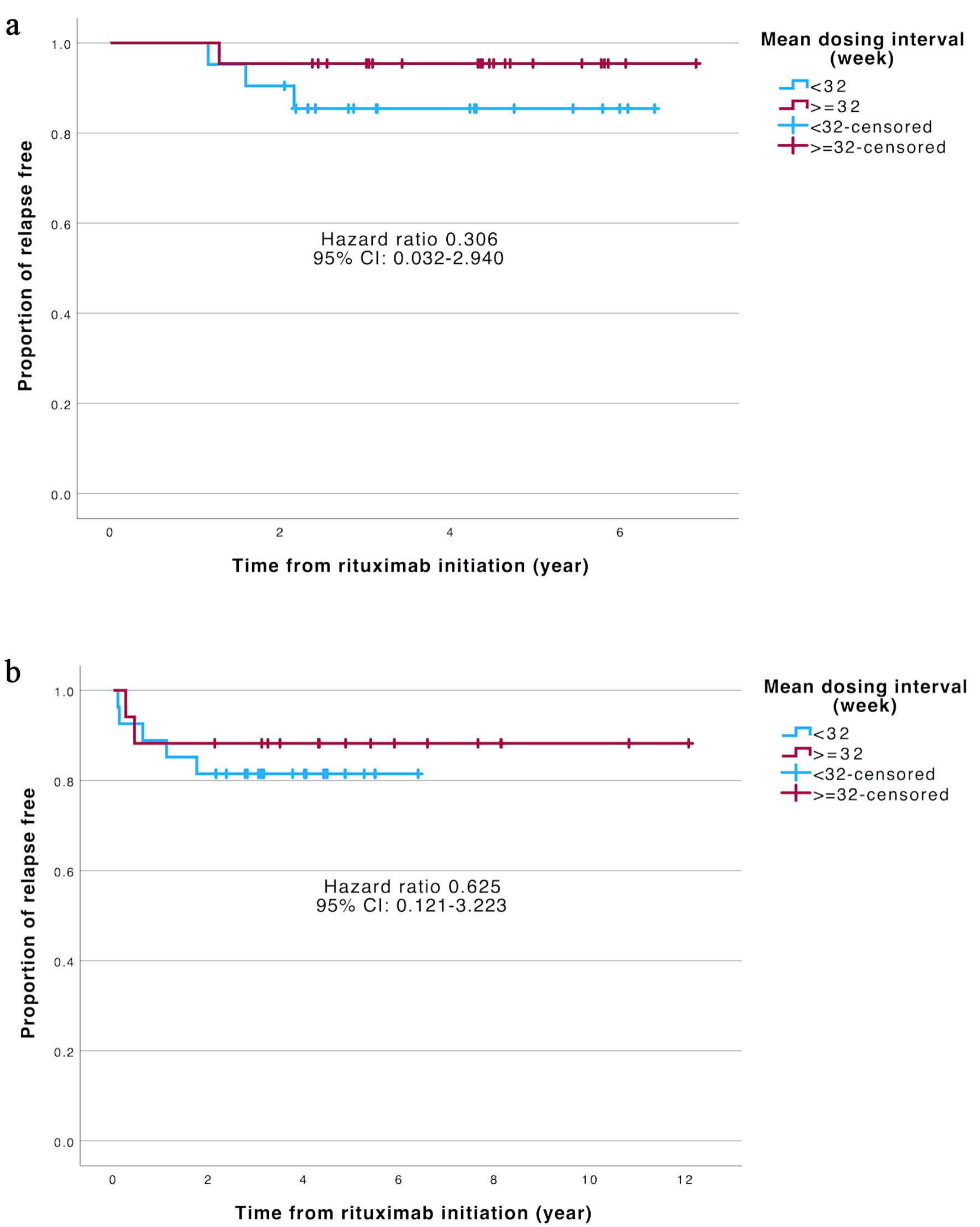
Figure 3.
↓  Figure 4. Kaplan–Meier curve demonstrating the proportion of relapse-free in treatment-naive and treatment-experienced patients. (a) Multiple sclerosis. (b) AQP4-IgG-seropositive neuromyelitis optica spectrum disorder. AQP4-IgG: aquaporin-4 immunoglobulin G.
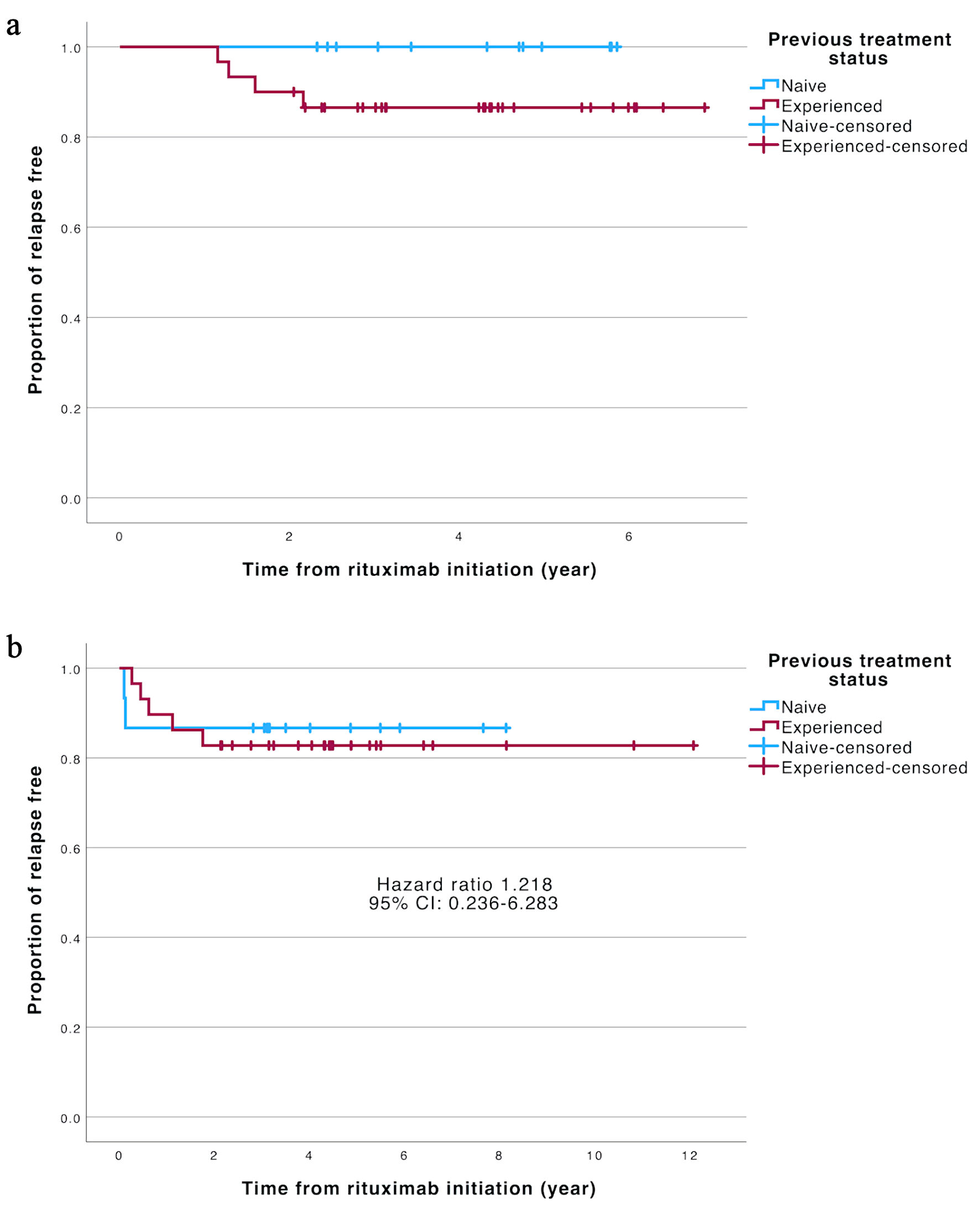
Figure 4.

Tables

↓  Table 1. Baseline Characteristics of Multiple Sclerosis and Neuromyelitis Optica Spectrum Disorder
 
Total (n = 87)MS (n = 43)NMOSD (n = 44)
aData are presented as mean ± standard deviation. bData are presented as median (IQR). cInitial dosing interval refers to the dosing interval of the first cycle immediately after induction. NMOSD: neuromyelitis optica spectrum disorder; MS: multiple sclerosis; RTX: rituximab; SD: standard deviation; IQR: interquartile range.
Female sex68 (78.2)31 (72.1)37 (84.1)
Age at onset (years)a33.99 ± 15.5226.63 ± 10.4841.35 ± 16.33
Age at RTX initiation (years)a39.28 ± 15.1132.34 ± 10.9846.23 ± 15.59
Age at enrolment (years)a43.56 ± 15.4736.28 ± 11.2650.83 ± 15.79
Duration since onset to RTX initiation (years)b3.28 (0.76–8.04)5.10 (1.49–8.05)2.18 (0.62–7.70)
Treatment status, n (%)
  Treatment-naive27 (31.0)13 (30.2)14 (31.8)
  Treatment-experienced60 (69.0)30 (69.8)30 (68.2)
    Azathioprine50 (57.5)23 (53.5)27 (61.4)
    Mycophenolate29 (33.3)11 (25.6)18 (40.9)
    Methotrexate1 (1.1)1 (2.3)0 (0.0)
    Mitoxantrone1 (1.1)0 (0.0)1 (2.3)
    Cyclophosphamide1 (1.1)0 (0.0)1 (2.3)
    Interferon-beta3 (3.4)2 (4.7)1 (2.3)
    Teriflunomide2 (2.3)2 (4.7)0 (0.0)
    Fingolimod1 (1.1)1 (2.3)0 (0.0)
RTX indication, n (%)
  Treatment ineffectiveness45 (75.0)23 (76.7)22 (73.3)
  Treatment adverse effects15 (25.0)7 (23.3)8 (26.7)
RTX regimen
  Initial dosing interval (weeks)c
    Mean ± SD31.98 ± 8.0130.98 ± 6.8532.95 ± 8.97
    Median (IQR)27.71 (26.57–37.43)27.71 (26.43–34.29)28.00 (26.61–39.07)
  Mean dosing interval (weeks)
    Mean ± SD33.25 ± 7.0432.61 ± 4.8733.87 ± 8.67
    Median (IQR)30.38 (28.57–36.67)32.25 (29.03–35.89)29.44 (27.87–40.92)
RTX duration (years)
  Mean ± SD4.52 ± 1.964.10 ± 1.424.92 ± 2.32
  Median (IQR)4.34 (3.10–5.51)4.32 (2.81–5.46)4.45 (3.16–5.52)


↓  Table 2. Disease Activity and Disability Outcomes of Multiple Sclerosis and Neuromyelitis Optica Spectrum Disorder
 
Efficacy outcomesTotal (n = 87)MS (n = 43)NMOSD (n = 44)
aData are presented as median (IQR). NMOSD: neuromyelitis optica spectrum disorder; EDSS: EDSS: Expanded Disability Status Scale; Gd: gadolinium-enhanced; MS: multiple sclerosis; RTX: rituximab; T2w: T2-weighted; IQR: interquartile range.
Relapse
  Number of relapses11 (12.6)4 (9.3)7 (15.9)
  Relapses within 6 months after RTX, n (%)4 (4.6)0 (0)4 (9.1)
  Time to first relapse after RTX (years)a1.12 (0.27–1.60)1.44 (1.18–2.02)0.45 (0.20–0.87)
EDSS
  EDSS before RTXa4.0 (2.0–5.8)2.0 (0.0–4.5)4.5 (4.0–6.5)
  EDSS after RTXa2.0 (0.0–4.0)0.0 (0.0–2.0)4.0 (2.0–5.0)
  EDSS changea1.0 (0.0–2.0)0.0 (0.0–2.0)1.0 (0.0–2.9)
Radiological activity, n (%)
  New T2w lesions0/40 (0.0)0/26 (0.0)0/14 (0.0)
  New Gd lesions0/40 (0.0)0/26 (0.0)0/14 (0.0)
Safety outcomes, n (%)
  RTX adverse effects33 (37.9)14 (32.6)19 (43.2)
  Infusion-related14 (16.1)7 (16.3)7 (15.9)
  Infection18 (20.7)6 (14.0)12 (27.3)
  Leukopenia5 (5.7)2 (4.7)3 (6.8)
  Hypogammaglobulinemia1/27 (3.7)0/12 (0.0)1/15 (6.7)


↓  Table 3. Comparison of Clinical and Laboratory Outcomes Between Pre- and Post-RTX
 
Pre-RTXPost-RTXP value
All data are presented as median (interquartile range). NMOSD: neuromyelitis optica spectrum disorder; ARR: annualized relapse rate; CD19: cluster of differentiation 19; EDSS: Expanded Disability Status Scale; MS: multiple sclerosis; RTX: rituximab.
MS (n = 43)
  Number of relapses (times)3 (2–4)0 (0–0)< 0.001
  ARR (times/year)0.55 (0.47–0.84)0.00 (0.00–0.00)< 0.001
  EDSS2.0 (0.0–4.5)0.0 (0.0–2.0)0.006
  %CD1913.58 (9.11–18.25)1.45 (0.95–2.56)< 0.001
NMOSD (n = 44)
  Number of relapses (times)3 (2–6)0 (0–0)< 0.001
  ARR (times/year)1.15 (0.54–1.72)0.00 (0.00–0.00)< 0.001
  EDSS4.5 (4.0–6.5)4.0 (2.0–5.0)< 0.001
  %CD1915.14 (12.25–23.38)2.08 (0.89–5.39)< 0.001


↓  Table 4. Subgroup Analysis in Patients With and Without Other Treatments Prior to RTX
 
Pre-RTXPost-RTXP value
All data are presented as median (interquartile range). NMOSD: neuromyelitis optica spectrum disorder; EDSS: Expanded Disability Status Scale; MS: multiple sclerosis; RTX: rituximab.
MS
  Treatment-naive (n = 13)
    Number of relapses (time)2 (1–3)0 (0–0)0.001
    EDSS2.0 (0.0–4.8)0.0 (0.0–2.0)0.012
  Treatment-experienced (n = 27)
    Number of relapses (time)3 (2–5)0 (0–0)< 0.001
    EDSS2.0 (0.0–4.0)2.0 (0.0–3.0)0.106
NMOSD
  Treatment-naive (n = 10)
    Number of relapses (time)1 (1–2)0 (0–0)0.001
    EDSS4.5 (2.8–6.0)2.0 (0.8–5.1)0.011
  Treatment-experienced (n = 24)
    Number of relapses (time)4 (2–8)0 (0–1)< 0.001
    EDSS4.5 (4.0–6.5)4.0 (2.1–4.0)0.005