| Journal of Clinical Medicine Research, ISSN 1918-3003 print, 1918-3011 online, Open Access |
| Article copyright, the authors; Journal compilation copyright, J Clin Med Res and Elmer Press Inc |
| Journal website https://jocmr.elmerjournals.com |
Review
Volume 18, Number 7, July 2026, pages 421-436
Disease-Modifying Therapies for Transthyretin Amyloid Cardiomyopathy: Current Evidence and Emerging Strategies
Figures


Tables
| Study | Trial name | Design | Sample size | Duration | Primary endpoint | Key outcome |
|---|---|---|---|---|---|---|
| Cardiovascular hospitalizations (CV hosp) refer to hospital admissions for cardiovascular causes, including worsening heart failure, arrhythmias, acute coronary syndromes, or other cardiac events requiring hospitalization. ATTR-CM: transthyretin amyloid cardiomyopathy; RCT: randomized controlled trial; HR: hazard ratio; CI: confidence interval; RR: relative risk; NYHA: New York Heart Association. | ||||||
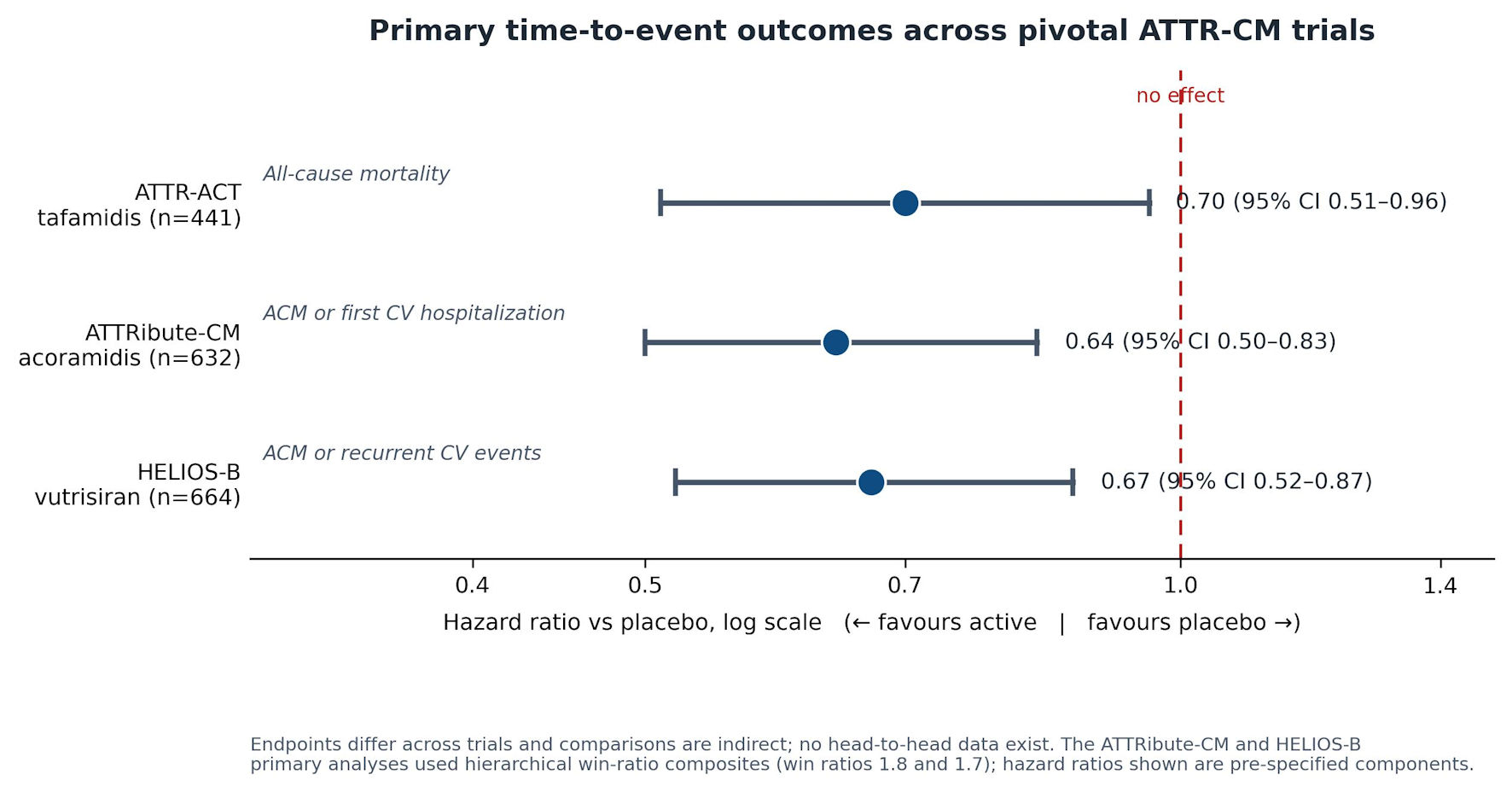
| Maurer et al, 2018 [12] | ATTR-ACT | Phase 3 RCT | 441 | 30 months | Composite of all-cause mortality and cardiovascular hospitalizations | Tafamidis reduced all-cause mortality (HR 0.70; 95% CI, 0.51–0.96) and decreased the annual rate of cardiovascular hospitalizations (0.48 vs 0.70 per year; RR 0.68, 95% CI, 0.56–0.81) compared with placebo |
| Damy et al, 2020 [14] | ATTR-ACT open-label extension | Open-label extension | 400+ | 50+ months | Long-term survival | Continuous tafamidis from baseline was associated with longer median survival; median survival was not reached in the continuous group versus 35.8 months with delayed initiation |
| Elliott et al, 2023 [15] | NYHA III post-hoc analysis of ATTR-ACT | Post-hoc analysis | 142 | About 5 years | All-cause mortality | In patients with NYHA class III symptoms at baseline, continuous tafamidis reduced mortality risk by 36% compared with delayed treatment (HR 0.64; 95% CI, 0.41–0.99) |
| Study | Trial name | Design | Sample size | Duration | Primary endpoint | Key outcome |
|---|---|---|---|---|---|---|
| Cardiovascular hospitalizations (CV hosp) refer to hospital admissions for cardiovascular causes. RCT: randomized controlled trial; HR: hazard ratio; CI: confidence interval; NT-proBNP: N-terminal pro-B-type natriuretic peptide; ATTR-CM: transthyretin amyloid cardiomyopathy. | ||||||
| Gillmore et al. [18] | ATTRibute-CM | Phase 3 RCT | 632 | 30 months | Hierarchical composite endpoint | Acoramidis improved the hierarchical composite endpoint (all-cause mortality, cardiovascular hospitalizations, NT-proBNP change, and 6-min walk distance) versus placebo (win ratio, 1.8; 95% CI, 1.4–2.2); all-cause mortality or first cardiovascular hospitalization occurred less frequently with acoramidis (HR, 0.64; 95% CI, 0.50–0.83) |
| Judge et al, 2025 [12] | ATTRibute-CM open-label extension | Open-label extension | 600+ | 42 months | Composite of all-cause mortality and cardiovascular hospitalizations | Long-term treatment with acoramidis reduced the risk of all-cause mortality or first cardiovascular hospitalization (HR, 0.57; 95% CI, 0.46–0.72) and maintained functional capacity measured by 6-min walk distance and quality of life over 42 months |
| Endo et al, 2026 [19] | Japanese phase 3 acoramidis study | Phase 3 open-label | 25 | 30 months | Safety and efficacy | In Japanese patients with ATTR-CM, acoramidis showed favorable safety with no deaths reported over the 30-month study period and improvements in functional status and quality-of-life measures |
| Study | Trial name | Agent | Route | Dosing | Sample size | Duration | Key outcome |
|---|---|---|---|---|---|---|---|
| ATTR-CM: transthyretin amyloid cardiomyopathy; IV: intravenous; SC: subcutaneous; HR: hazard ratio; CI: confidence interval; NT-proBNP: N-terminal pro-B-type natriuretic peptide. | |||||||
| Maurer et al, 2023 [22] | APOLLO-B | Patisiran | IV | Every 3 weeks | 360 | 12 months | Patisiran attenuated the decline in 6-min walk distance versus placebo (treatment effect about 15 m) and preserved health-related quality of life, with favorable trends in cardiac biomarkers including NT-proBNP and high-sensitivity troponin T |
| Fontana et al, 2025 [9] | HELIOS-B | Vutrisiran | SC | Every 3 months | 664 | 30 months | Vutrisiran improved the hierarchical composite endpoint with win ratio of 1.7 (95% CI, 1.4–2.1), reducing the risk of all-cause death or recurrent cardiovascular events by approximately 33% (HR, 0.67; 95% CI, 0.52–0.87) |
| Coelho et al, 2023 [26] | NEURO-TTRansform | Eplontersen | SC | Monthly | 168 | 18 months | Eplontersen slowed neuropathy progression; exploratory cardiac analyses showed reductions in NT-proBNP and stabilization of global longitudinal strain and left ventricular wall thickness |
| Study | Trial name | Antibody | Target | Phase | Sample size | Key finding | Status |
|---|---|---|---|---|---|---|---|
| TTR: transthyretin; MRI: magnetic resonance imaging; NT-proBNP: N-terminal pro-B-type natriuretic peptide; GLS: global longitudinal strain. | |||||||
| Garcia-Pavia et al, 2023 [36] | NI006 phase 1 | NI006 (ALXN2220) | Aggregated TTR | 1 | 41 | Monthly NI006 infusions (up to 60 mg/kg) were well tolerated. At doses ≥ 10 mg/kg, cardiac imaging demonstrated substantial reductions in myocardial amyloid burden with decreases in NT-proBNP and high-sensitivity troponin T | Phase 2/3 ongoing |
| Richards et al, 2024 [37] | PRX004 phase 1 dose-escalation | PRX004 (coramitug, NNC6019-0001) | Misfolded TTR | 1 | 26 | PRX004 was well tolerated with dose-proportional pharmacokinetics. Exploratory analyses suggested stabilization or improvement in global longitudinal strain and neuropathy impairment scores over 9 months | Phase 2 ongoing (NCT05442047) |
| Study | Trial name | Population | Sample size | Dose | TTR reduction | Duration | Key outcome | Safety |
|---|---|---|---|---|---|---|---|---|
| CRISPR: clustered regularly interspaced short palindromic repeats; TTR: transthyretin; ATTRv-PN: hereditary ATTR with polyneuropathy; ATTR-CM: transthyretin amyloid cardiomyopathy; NT-proBNP: N-terminal pro-B-type natriuretic peptide; GLS: global longitudinal strain. | ||||||||
| Gillmore et al, 2021 [38] | NTLA-2001 phase 1 ATTRv-PN | Hereditary ATTR with polyneuropathy | 36 | 0.3–1.0 mg/kg | Up to 93% | 12 months | Single-dose NTLA-2001 achieved up to about 93% sustained reduction in serum TTR at 12 months | Well tolerated; mild to moderate infusion-related reactions were the most common adverse events |
| Fontana et al, 2024 [39] | Nexiguran ziclumeran phase 1 ATTR-CM | ATTR cardiomyopathy | 36 | 0.7–1.0 mg/kg | Up to 90% | 24 months | Single-dose nex-z produced up to about 90% sustained TTR reduction over 24 months with improvements or stabilization in functional capacity and cardiac biomarkers | Mild infusion reactions; well tolerated with no drug-related serious adverse events |
| Agent | Mechanism class | Highest phase in ATTR-CM | Regulatory status (ATTR-CM) | Primary endpoint type | Mortality or CV-hospitalization benefit demonstrated |
|---|---|---|---|---|---|
| Status reflects ATTR-CM unless otherwise noted and varies by jurisdiction and date. HR: hazard ratio; CV: cardiovascular; ATTRv-PN: hereditary ATTR with polyneuropathy; GLS: global longitudinal strain; TUDCA: tauroursodeoxycholic acid; NSAID: nonsteroidal anti-inflammatory drug; EGCG: epigallocatechin-3-gallate; FDA: Food and Drug Administration; EMA: European Medicines Agency; PMDA: Pharmaceuticals and Medical Devices Agency; RCT: randomized controlled trial; siRNA: small interfering RNA; CRISPR: clustered regularly interspaced short palindromic repeats; ATTR-CM: transthyretin amyloid cardiomyopathy. | |||||
| Tafamidis | Tetramer stabilizer | Phase 3 (ATTR-ACT) | Approved (FDA, EMA, PMDA) | Finite composite of all-cause mortality and CV hospitalization | Yes; all-cause mortality HR 0.70 (0.51–0.96) |
| Acoramidis | Tetramer stabilizer | Phase 3 (ATTRibute-CM) | Approved (FDA 2024; other regions vary) | Hierarchical win-ratio composite | CV outcome benefit; all-cause mortality alone not independently significant |
| Patisiran | siRNA gene silencer | Phase 3 (APOLLO-B) | Approved for ATTRv-PN; not approved for ATTR-CM | 6-min walk distance (continuous) | No mortality benefit shown in ATTR-CM |
| Vutrisiran | siRNA gene silencer | Phase 3 (HELIOS-B) | Approved for ATTR-CM (FDA 2025) | Hierarchical composite | Yes; all-cause mortality or recurrent CV events HR 0.67 (0.52–0.87) |
| Eplontersen | Antisense oligonucleotide gene silencer | Phase 3 ongoing (CARDIO-TTRansform) | Approved for ATTRv-PN; ATTR-CM under study | Hard clinical endpoints (pending) | Pending |
| Inotersen | Antisense oligonucleotide gene silencer | Phase 3 in ATTRv-PN (NEURO-TTR) | Approved for ATTRv-PN; not for ATTR-CM | Neuropathy endpoints (not cardiac) | Not established in ATTR-CM; use limited by safety |
| Doxycycline plus TUDCA | Fibril disruption | Phase 3 (DOXY-TUDCA) | Not approved | Survival | No; negative phase 3 trial |
| NI006 (ALXN2220) | Anti-amyloid monoclonal antibody | Phase 1 complete; phase 3 ongoing | Investigational | Imaging and biomarker (phase 1) | Not yet; outcome trials ongoing |
| PRX004 (coramitug) | Anti-amyloid monoclonal antibody | Phase 1 complete; phase 2 ongoing | Investigational | Exploratory (GLS, biomarkers) | Not established |
| NTLA-2001/nexiguran ziclumeran | CRISPR-Cas9 gene editing | Phase 1 complete; phase 3 ongoing | Investigational | TTR knockdown; clinical endpoints pending | Not yet established |
| Diflunisal | Tetramer stabilizer (NSAID) | RCT in ATTRv-PN; observational in ATTR-CM | Not approved for ATTR-CM (used off-label) | Neuropathy endpoint (PN trial) | No cardiac RCT; not established |
| EGCG (green tea) | Fibril-formation inhibitor (polyphenol) | Small observational studies only | Not a recognized drug indication | Imaging surrogate | No; uncontrolled data only |
| Treatment category | Drugs | Mechanism of action |
|---|---|---|
| TTR: transthyretin; siRNA: small interfering RNA; mRNA: messenger RNA; TUDCA: tauroursodeoxycholic acid; CRISPR: clustered regularly interspaced short palindromic repeats. | ||
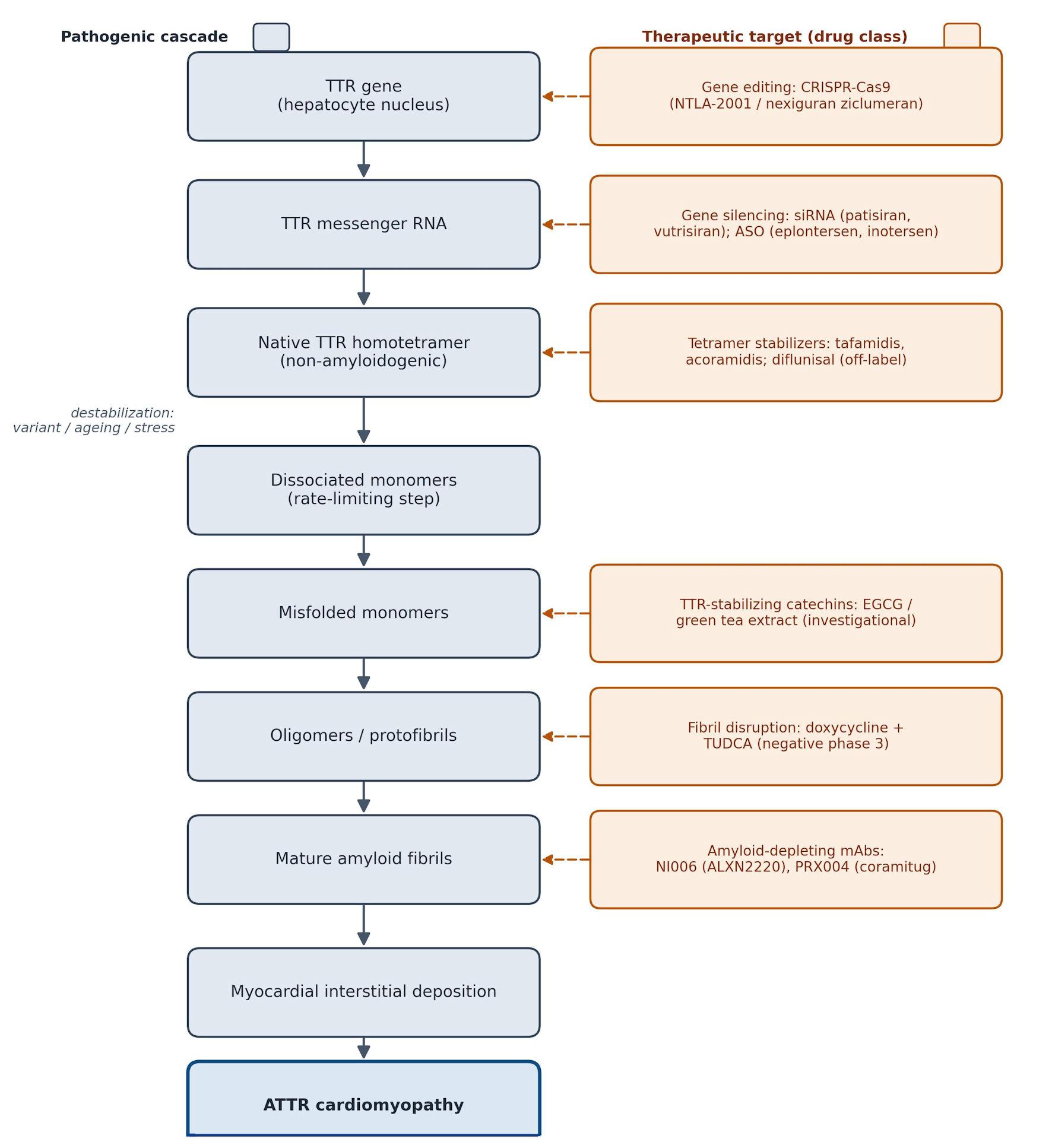
| TTR stabilization | Tafamidis, acoramidis | Stabilize TTR tetramer by binding to thyroxine-binding sites, preventing tetramer dissociation and reducing the rate-limiting step in fibril formation [7, 8, 12] |
| Gene silencing | Patisiran, vutrisiran, eplontersen | Reduce hepatic TTR synthesis through RNA interference (siRNA) or antisense oligonucleotide mechanisms, inducing degradation of TTR mRNA and achieving profound reductions in serum TTR levels [9, 22, 26] |
| Fibril disruption | Doxycycline-TUDCA | Disrupt amyloid fibril formation and exert cytoprotective effects (not currently recommended as evidence-based therapy following negative phase 3 trial results) [30] |
| Amyloid depletion | NI006, PRX004 | Remove deposited amyloid via monoclonal antibodies that bind specifically to misfolded or aggregated TTR; antibody-amyloid complexes are recognized and cleared by phagocytic immune cells [36, 37] |
| Gene editing | NTLA-2001, nexiguran ziclumeran | Permanent TTR gene inactivation using CRISPR-Cas9 in vivo gene editing; single-dose administration creates insertions or deletions in the chromosomal TTR gene, disrupting gene function and producing durable reductions in serum TTR [38, 39] |