Journal of Clinical Medicine Research, ISSN 1918-3003 print, 1918-3011 online, Open Access
Article copyright, the authors; Journal compilation copyright, J Clin Med Res and Elmer Press Inc
Journal website https://jocmr.elmerjournals.com

Short Communication

Volume 18, Number 7, July 2026, pages 489-495


Retinal Artery Occlusion and Incident Dementia in the All of Us Research Program: Detection Bias Calibration with Prespecified Negative-Control Outcomes

Figure

↓  Figure 1. Hazard ratios (HRs) for primary and negative-control outcomes. Forest plot of HRs with 95% confidence intervals, log scale, with a vertical reference line at HR = 1. (a) Primary dementia outcomes: all-cause dementia unmatched 0.81 and matched 1.33; vascular dementia unmatched 1.93, matched 1.81, and with prevalent stroke excluded 1.48; Alzheimer disease unmatched 1.22 and matched 1.46. (b) Prespecified negative-control outcomes: cataract 1.87 (ophthalmology pathway), benign paroxysmal positional vertigo (BPPV) 1.27 (neurology pathway), inguinal hernia 1.10 (general healthcare contact). (c) Cataract HRs by retinal artery occlusion (RAO) subtype: non-central RAO 2.33, central RAO 2.03, amaurosis fugax 1.50. The shaded band in panel (b) marks the confidence interval of the neurology-pathway control (0.90–1.79), which is the pathway relevant to dementia ascertainment and therefore the appropriate calibrator for the primary outcomes in panel (a).
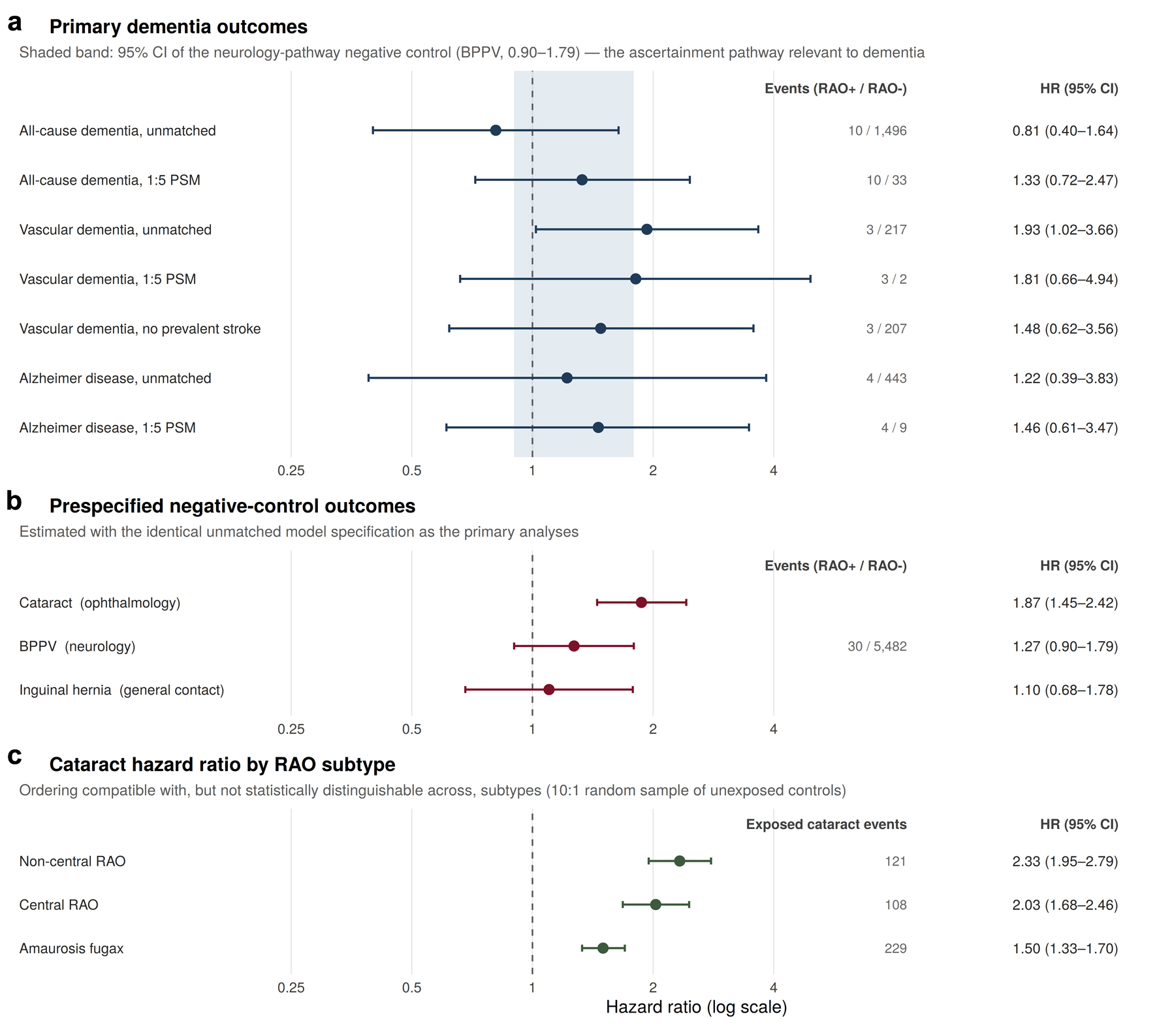
Figure 1.

Tables

↓  Table 1. Baseline Characteristics and Covariate Balance Before and After 1:5 Propensity-Score Matching, by Retinal Artery Occlusion Status
 
CharacteristicRAO+ (n = 339)RAO− (n = 128,940)SMD, pre-matchSMD, post-match
All covariates are defined at cohort entry. Post-match column refers to the 1:5 propensity-score matched set (339 exposed, 1,695 unexposed). All 339 exposed participants were matched; none were dropped under the caliper. IQR: interquartile range; RAO: retinal artery occlusion; SD: standard deviation; SMD: standardized mean difference.
Age at cohort entry, mean (SD), years61.0 (6.8)60.4 (7.1)0.082−0.034
Calendar year of cohort entry, mean2008.22012.7−0.726−0.015
Female, n (%)121 (35.7)69,595 (54.0)−0.3740.005
Hypertension, n (%)65 (19.2)19,944 (15.5)0.098−0.027
Diabetes, n (%)31 (9.1)8,372 (6.5)0.0990.010
Hyperlipidemia, n (%)44 (13.0)14,704 (11.4)0.048−0.005
Atrial fibrillation, n (%)8 (2.4)1,886 (1.5)0.0660.012
Heart failure, n (%)8 (2.4)1,707 (1.3)0.0770.051
Prior ischemic stroke, n (%)3 (0.9)656 (0.5)0.0450.000
Prior transient ischemic attack, n (%)0 (0.0)307 (0.2)−0.0690.000
Depression, n (%)13 (3.8)5,013 (3.9)−0.003−0.030
Chronic kidney disease, n (%)7 (2.1)1,703 (1.3)0.058−0.004
Follow-up, median (IQR), years13.3 (9.0–19.0)8.2 (4.2–12.7)--


↓  Table 2. Primary Outcomes, Sensitivity Analyses, and Prespecified Negative-Control Outcomes
 
Outcome and specificationEvents, RAO+/RAO−HR (95% CI)P
All unmatched estimates derive from Cox proportional hazards models on an age timescale with left truncation at cohort entry and an identical covariate set (sex, calendar year of cohort entry, and baseline hypertension, diabetes, hyperlipidemia, atrial fibrillation, heart failure, stroke, transient ischemic attack, depression, and chronic kidney disease). Negative controls were not propensity-matched and are therefore compared with the unmatched primary estimates. Cataract subtype analyses used a 10:1 random sample of unexposed participants; the events column for those rows shows exposed events only. Bonferroni-corrected P for unmatched vascular dementia was 0.225 across the five prespecified primary tests (α = 0.01); the Benjamini–Hochberg adjusted value was also 0.225. BPPV: benign paroxysmal positional vertigo; CI: confidence interval; CRAO: central retinal artery occlusion; HR: hazard ratio; PSM: propensity-score matching; RAO: retinal artery occlusion.
All-cause dementia, unmatched10/1,4960.81 (0.40–1.64)0.56
All-cause dementia, 1:5 PSM10/331.33 (0.72–2.47)0.37
Vascular dementia, unmatched3/2171.93 (1.02–3.66)0.045
Vascular dementia, 1:5 PSM3/21.81 (0.66–4.94)0.25
Vascular dementia, no prevalent stroke, unmatched3/2071.48 (0.62–3.56)0.38
Alzheimer disease, unmatched4/4431.22 (0.39–3.83)0.73
Alzheimer disease, 1:5 PSM4/91.46 (0.61–3.47)0.40
Broad RAO, all-cause dementia, unmatched-0.88 (0.53–1.45)0.62
CRAO only, all-cause dementia, unmatched-0.70 (0.23–2.18)0.54
Negative control: cataract (ophthalmology), unmatched-1.87 (1.45–2.42)< 0.001
Negative control: BPPV (neurology), unmatched30/5,4821.27 (0.90–1.79)0.17
Negative control: inguinal hernia (general contact), unmatched-1.10 (0.68–1.78)0.69
Cataract by subtype: non-central RAO, unmatched1212.33 (1.95–2.79)< 0.001
Cataract by subtype: central RAO, unmatched1082.03 (1.68–2.46)< 0.001
Cataract by subtype: amaurosis fugax, unmatched2291.50 (1.33–1.70)< 0.001