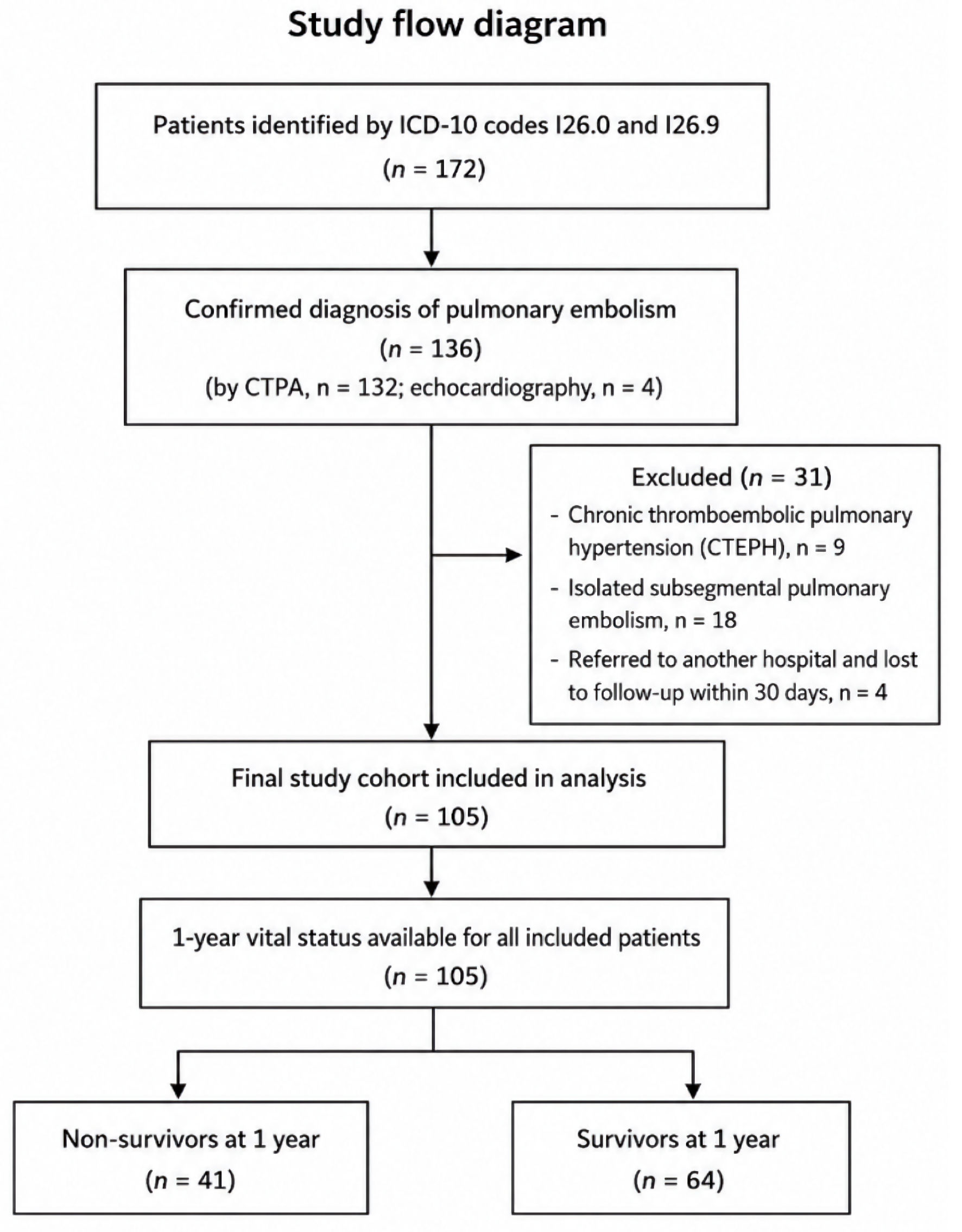
↓ Figure 1. Study flow diagram of patient selection and follow-up. ICD-10: International Classification of Diseases, 10th Revision; CTPA: computed tomography pulmonary angiography.
| Journal of Clinical Medicine Research, ISSN 1918-3003 print, 1918-3011 online, Open Access |
| Article copyright, the authors; Journal compilation copyright, J Clin Med Res and Elmer Press Inc |
| Journal website https://jocmr.elmerjournals.com |
Original Article
Volume 18, Number 9, September 2026, pages 661-670
Prognostic Significance of Serum Sodium in Patients With Acute Pulmonary Embolism
Figures
Tables
| Characteristics | Non-survivors (1 year) (n=41) | Survivors (1 year) (n=64) | P value |
|---|---|---|---|
| aThe institutional reference range for serum sodium was 135–145 mmol/L. APE: acute pulmonary embolism; BMI: body mass index; BW: body weight; COPD: chronic obstructive pulmonary disease; DBP: diastolic blood pressure; IQR: interquartile range; LOS: length of stay; MAP: mean arterial pressure; PESI: Pulmonary Embolism Severity Index; SBP: systolic blood pressure; VTE: venous thromboembolism. | |||
| Male, n (%) | 17 (41.5%) | 20 (31.3%) | 0.303 |
| Age (year), mean ± SD | 66.9 ± 12.8 | 61.6 ± 20.6 | 0.143 |
| BMI (kg/m2), mean ± SD | 23.1 ± 5.1 | 25.8 ± 6.0 | 0.020 |
| BW (kg), mean ± SD | 58.9 ± 14.8 | 67.8 ± 20.7 | 0.020 |
| Active cancer, n (%) | 25 (61.0%) | 10 (15.6%) | < 0.001 |
| Comorbidity, n (%) | |||
| Diabetes | 10 (24.4%) | 19 (29.7%) | 0.657 |
| Heart failure | 5 (12.2%) | 9 (14.1%) | 1.000 |
| Hyperlipidemia | 25 (61.0%) | 33 (51.6%) | 0.422 |
| Cerebrovascular disease | 6 (14.6%) | 6 (9.4%) | 0.532 |
| Coronary artery disease | 2 (4.9%) | 4 (6.3%) | 1.000 |
| Previous VTE | 2 (4.9%) | 3 (4.7%) | 1.000 |
| COPD | 9 (21.9%) | 1 (1.6%) | 0.001 |
| Recent surgery/trauma status, n (%) | |||
| Trauma | 1 (2.4%) | 6 (9.4%) | 0.162 |
| Recent surgery | 3 (7.3%) | 10 (15.6%) | 0.242 |
| Hemodynamic data, mean ± SD | |||
| Heart rate | 109.1 ± 20.5 | 99.9 ± 20.3 | 0.026 |
| SBP | 108.9 ± 25.9 | 130.8 ± 21.6 | < 0.001 |
| DBP | 70.2 ± 15.5 | 79.3 ± 14.6 | 0.003 |
| MAP | 83.11 ± 17.8 | 96.5 ± 15.0 | < 0.001 |
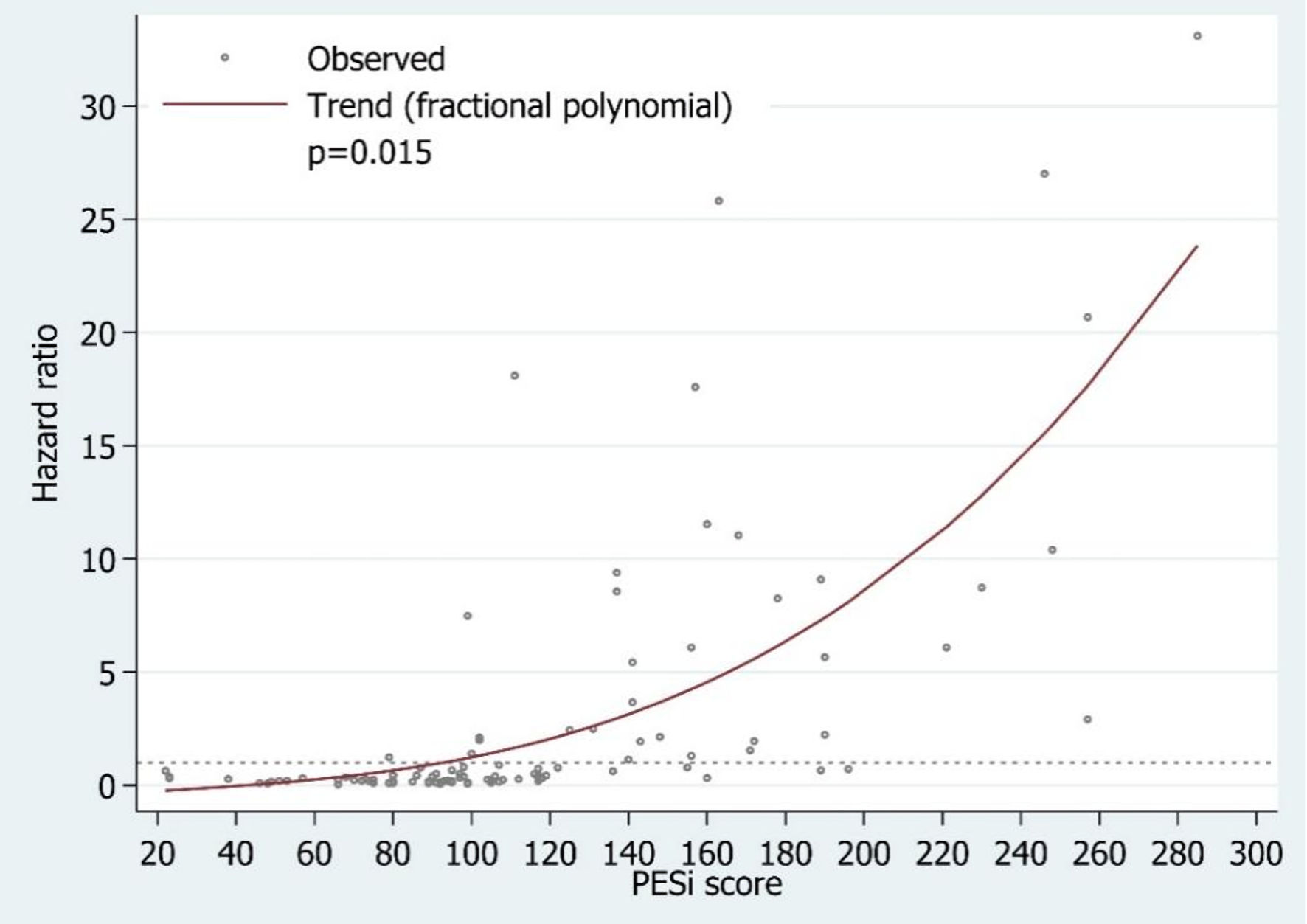
| PESI score, mean ± SD | 157.3 ± 56.0 | 91.0 ± 32.7 | < 0.001 |
| PESI classification, n (%) | |||
| Class I | 0 | 10 (15.6%) | < 0.001 |
| Class II | 3 (7.3%) | 14 (21.9%) | |
| Class III | 6 (14.6%) | 24 (37.5%) | |
| Class IV | 5 (12.2%) | 11 (17.2%) | |
| Class V | 27 (65.9%) | 5 (7.8%) | |
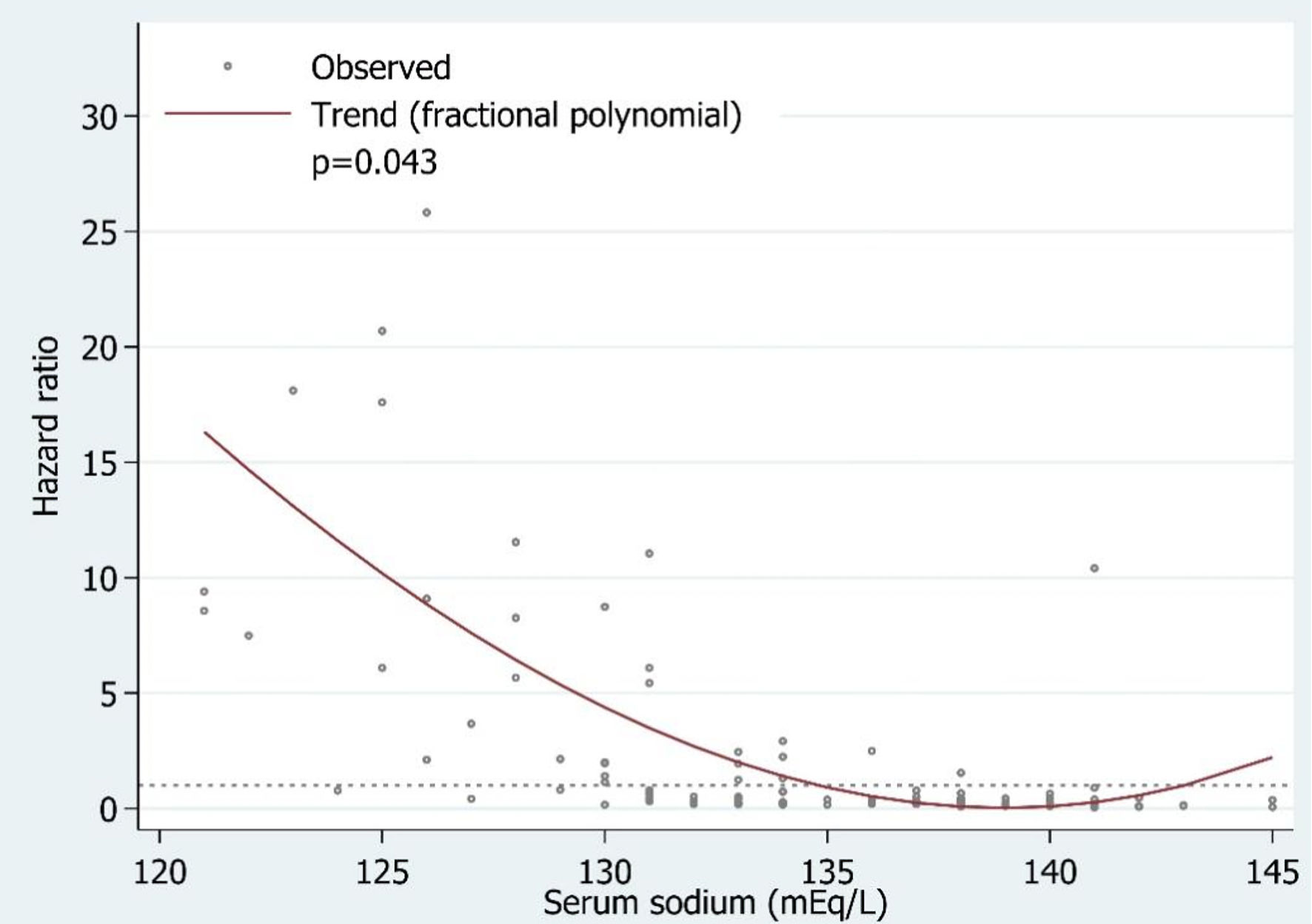
| Serum sodium at APE diagnosisa, mean ± SD | 130.6 ± 5.9 | 136.4 ± 4.4 | < 0.001 |
| Hyponatremia (Na < 135), n (%) | 32 (78.1%) | 23 (35.9%) | < 0.001 |
| Serum troponin, median (IQR) (n = 27,50) | 66.6 (36.2–89.5) | 41.2 (12.0–81.9) | 0.946 |
| Severity of APE, n (%) | |||
| Low | 1 (2.4%) | 7 (10.9%) | < 0.001 |
| Intermediate-low | 10 (24.4%) | 23 (35.9%) | |
| Intermediate-high | 14 (34.2%) | 32 (50.0%) | |
| High | 16 (39.0%) | 2 (3.2%) | |
| LOS (day), median (IQR) | 12.0 (6–21) | 12.0 (8–19) | 0.659 |
| Follow-up time (day, median) (IQR) | 25.0 (10–63) | 785.5 (475–1,363) | < 0.001 |
| Prognostic factors | uHR | 95% CI | P value |
|---|---|---|---|
| aNon-estimable due to zero n in reference category. APE: acute pulmonary embolism; BMI: body mass index; BW: body weight; COPD: chronic obstructive pulmonary disease; DBP: diastolic blood pressure; MAP: mean arterial pressure; PESI: Pulmonary Embolism Severity Index; SBP: systolic blood pressure; VTE: venous thromboembolism; CI: confidence interval; uHR: univariable hazard ratio. | |||
| Male | 1.39 | 0.75, 2.60 | 0.294 |
| Age (year) | 1.01 | 0.99, 1.03 | 0.216 |
| BMI (kg/m2) | 0.93 | 0.87, 0.98 | 0.017 |
| BW (kg) | 0.98 | 0.96, 0.99 | 0.024 |
| Active cancer | 4.38 | 2.32, 8.27 | < 0.001 |
| Comorbidity | |||
| Heart failure | 0.87 | 0.34, 2.21 | 0.762 |
| Diabetes | 0.82 | 0.40, 1.68 | 0.597 |
| Cerebrovascular disease | 1.45 | 0.61, 3.44 | 0.404 |
| Coronary artery disease | 0.90 | 0.22, 3.72 | 0.881 |
| Previous VTE | 1.08 | 0.26, 4.48 | 0.913 |
| COPD | 3.80 | 1.78, 8.11 | 0.001 |
| Hemodynamic data | |||
| Heart rate | 1.02 | 1.00, 1.03 | 0.021 |
| SBP | 0.96 | 0.95, 0.97 | < 0.001 |
| DBP | 0.96 | 0.94, 0.98 | 0.001 |
| MAP | 0.96 | 0.94, 0.97 | < 0.001 |
| PESI score | 1.01 | 1.01, 1.02 | < 0.001 |
| PESI classificationa | Non-estimable | ||
| Serum sodium at APE diagnosis (mmol/L) | 0.86 | 0.81, 0.91 | < 0.001 |
| Hyponatremia (Na < 135 mmol/L) | 4.20 | 2.00, 8.81 | < 0.001 |
| Serum troponin | 1.0 | 0.99, 1.0 | 0.969 |
| Severity of APE | |||
| Low | Reference | — | — |
| Intermediate-low | 2.50 | 0.32, 19.53 | 0.383 |
| Intermediate-high | 2.54 | 0.33, 19.37 | 0.367 |
| High | 13.53 | 1.79, 102.48 | 0.012 |
| Prognostic factors | mHR | 95% CI | P value |
|---|---|---|---|
| The Cox proportional hazards regression model was adjusted for age, body weight, active cancer, chronic obstructive pulmonary disease, heart rate, systolic blood pressure, diastolic blood pressure, Pulmonary Embolism Severity Index score, and serum sodium at APE diagnosis. PESI classification was excluded because it was directly derived from the PESI score. BMI was excluded because of its strong correlation with body weight. APE: acute pulmonary embolism; BW: body weight; COPD: chronic obstructive pulmonary disease; PESI: Pulmonary Embolism Severity Index; CI: confidence interval; mHR: multivariable hazard ratio. | |||
| Age (per year) | 0.98 | 0.95, 1.01 | 0.203 |
| BW (per kg) | 0.99 | 0.97, 1.01 | 0.172 |
| Active cancer | 1.73 | 0.75, 3.95 | 0.196 |
| COPD | 0.75 | 0.29, 1.98 | 0.565 |
| Heart rate | 0.99 | 0.98, 1.01 | 0.596 |
| Systolic blood pressure (per mm Hg) | 0.99 | 0.97, 1.02 | 0.840 |
| Diastolic blood pressure (per mm Hg) | 0.99 | 0.95, 1.02 | 0.404 |
| PESI score (per 1-point increase) | 1.01 | 1.00, 1.02 | 0.015 |
| Serum sodium at APE diagnosis (per mmol/L) | 0.92 | 0.86, 0.99 | 0.043 |