| Journal of Clinical Medicine Research, ISSN 1918-3003 print, 1918-3011 online, Open Access |
| Article copyright, the authors; Journal compilation copyright, J Clin Med Res and Elmer Press Inc |
| Journal website https://jocmr.elmerjournals.com |
Review
Volume 18, Number 12, December 2026, pages 881-894
Red Blood Cell Alloimmunization in Transfused Chronic Kidney Disease: A 2021–2026 Scoping Review
Figures


Tables
| Study (year) | Evidence role | CKD-specific denominator | Main interpretive constraints | Appropriate inference |
|---|---|---|---|---|
| CKD: chronic kidney disease. | ||||
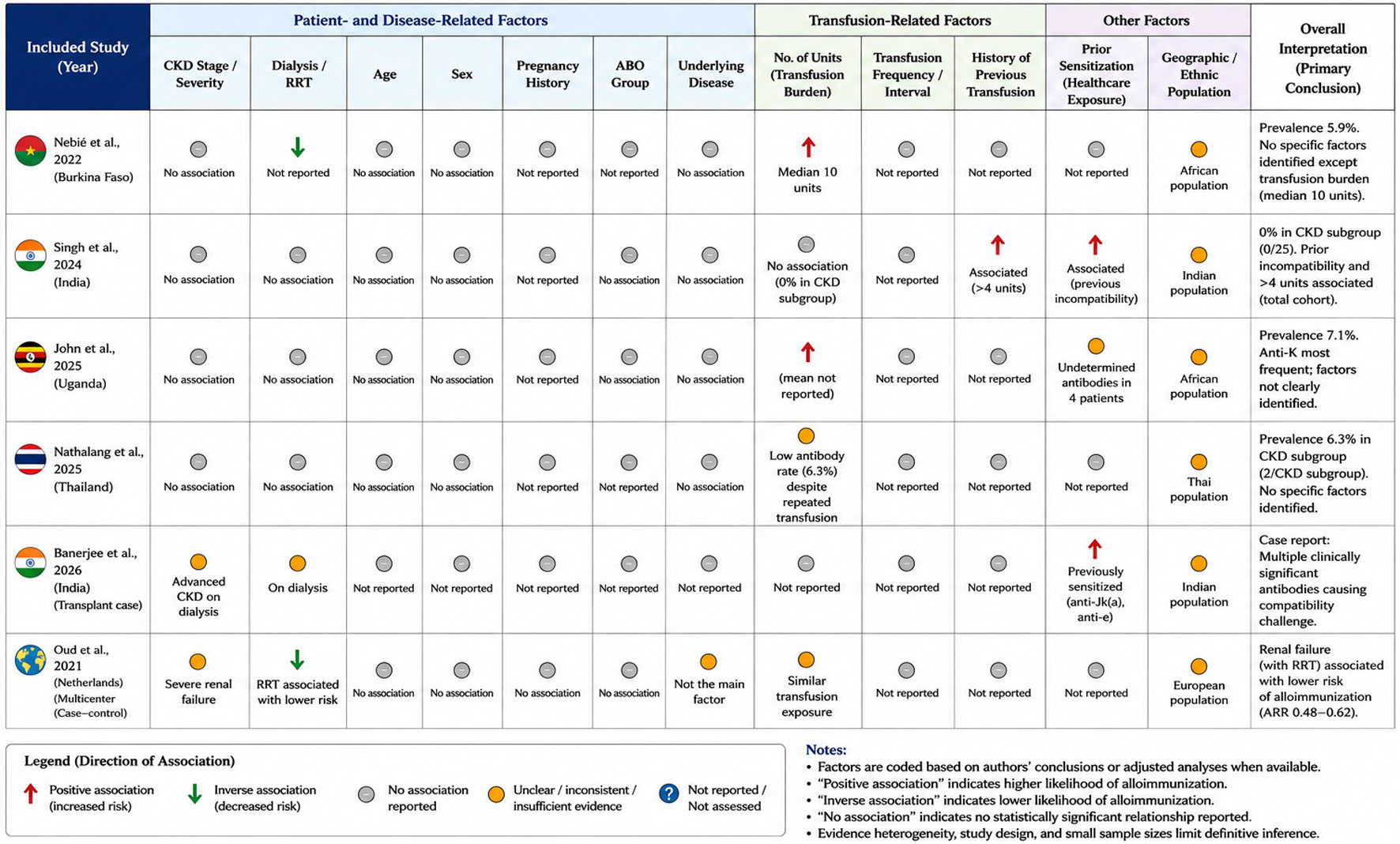
| Oud et al (2021) | Renal-failure determinant | No CKD detection-frequency denominator | Observational association in a broader newly transfused population; residual confounding | Adjusted association only; no dialysis causality |
| Nebie et al (2022) | Dedicated CKD cohort | 235 transfused patients | Cross-sectional detection; historical patient-collection period; four unresolved specificities | Study-specific detected-antibody frequency |
| Singh et al (2024) | Mixed cohort; CKD subgroup | 25 CKD participants | Zero CKD events; very imprecise estimate and small subgroup | Subgroup observation only |
| Nathalang et al (2025) | Mixed cohort; CKD subgroup | Subgroup percentage reported; denominator not independently verified | Small subgroup; CKD-specific antibody types not separable in available report | Subgroup detection observation/technical genotyping evidence |
| John et al (2025) | Dedicated CKD cohort | 141 transfused patients | Cross-sectional design; 10 events; several unresolved specificities; sparse adjusted estimates | Study-specific detected-antibody frequency |
| Banerjee et al (2026) | Transplant case report | Not applicable | Single-patient compatibility episode; no comparator | Case-level compatibility consequence |
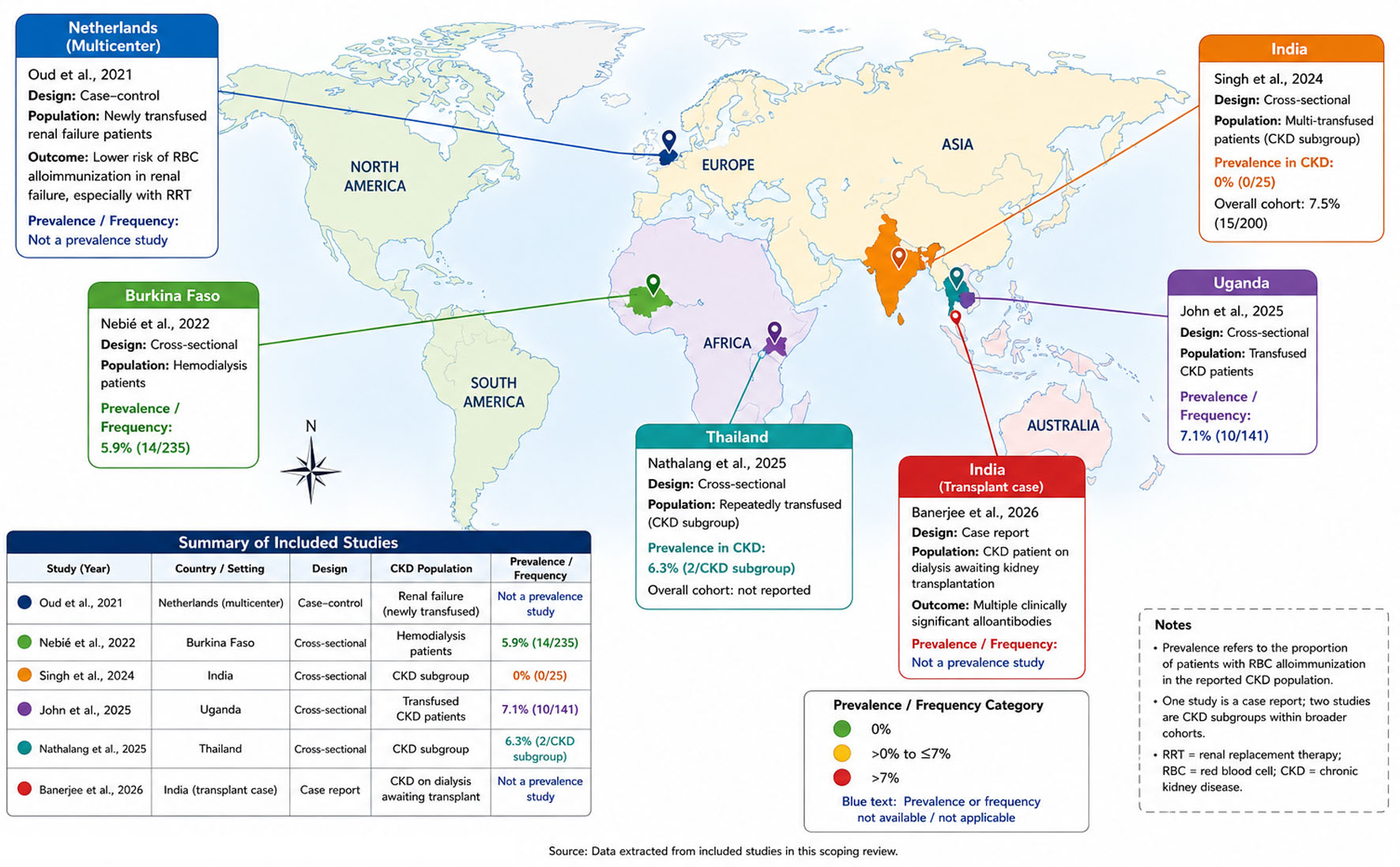
| Study | Setting | Design | Evidence role | Population/exposure | CKD alloimmunization frequency | Key contribution |
|---|---|---|---|---|---|---|
| Evidence-provenance key: dedicated CKD cohort = direct CKD population evidence; mixed cohort—CKD subgroup = CKD-specific subgroup evidence only; renal-failure determinant study = association evidence rather than prevalence; clinical compatibility case = case-level evidence. CI: confidence interval; CKD: chronic kidney disease; IQR: interquartile range; RR: relative rate; RRT: renal replacement therapy. | ||||||
| Oud et al (2021) | Netherlands; multicenter | Case–control | Renal-failure determinant study | Newly transfused; renal failure/RRT strata | Not a CKD frequency study | Chronic renal failure + RRT: adjusted RR 0.62 (95% CI 0.45–0.88) |
| Nebie et al (2022) | Burkina Faso; hemodialysis service | Cross-sectional | Dedicated CKD cross-sectional cohort | 235 CRF patients; ≥ 2 RBC units | 5.9% (14/235); Wilson 95% CI 3.6–9.8% | Median 10 units (IQR 5–20); broad antibody spectrum |
| Singh et al (2024) | India | Cross-sectional | Mixed cohort—CKD subgroup | 200 total; 25 CKD | 0% (0/25); Wilson 95% CI 0–13.3% | All overall alloimmunized cases were malignancy or thalassemia |
| Nathalang et al (2025) | Thailand | Cross-sectional laboratory/genotyping | Mixed cohort—CKD subgroup | 200 repeatedly transfused | Two CKD patients (6.3% of CKD subgroup); subgroup n not independently verified | CKD had lower antibody detection than several other diagnoses |
| John et al (2025) | Uganda | Cross-sectional | Dedicated CKD cross-sectional cohort | 141 transfused CKD patients | 7.1% (10/141); Wilson 95% CI 3.9–12.6% | Four single, two multiple, four undetermined antibodies |
| Banerjee et al (2026) | India; transplant case | Case report | Clinical compatibility case | Dialysis-dependent CKD awaiting kidney transplant | Not applicable (single case) | Anti-Jk(a)+anti-e constrained peri-transplant compatible-unit planning |
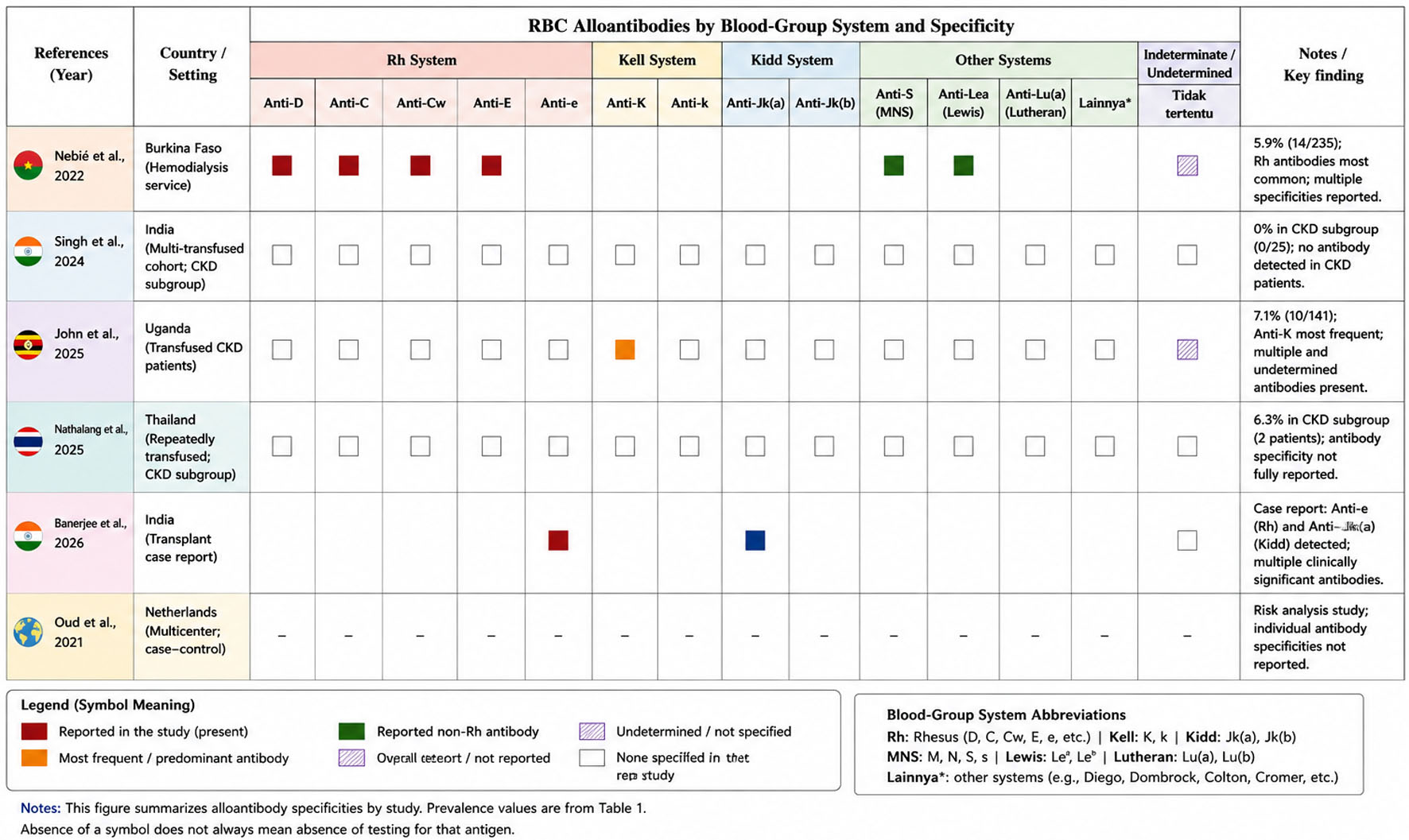
| Study | Evidence role | Rh findings | Kell findings | Other/undetermined | Interpretation |
|---|---|---|---|---|---|
| CKD: chronic kidney disease; RBC: red blood cell. | |||||
| Oud et al (2021) | Renal-failure determinant study | Not applicable (determinant study) | Not applicable | Not reported | Specificity was not the study objective |
| Nebie et al (2022) | Dedicated CKD cohort | Anti-D, anti-C, anti-D+C, anti-Cw, anti-E | Not reported | anti-S; anti-Lea; four indeterminate | Broad Rh spectrum plus non-Rh and unresolved antibodies |
| Singh et al (2024) | Mixed cohort—CKD subgroup | None detected in CKD subgroup | None detected in CKD subgroup | None detected in CKD subgroup | Overall cohort specificities cannot be assigned to CKD |
| Nathalang et al (2025) | Mixed cohort—CKD subgroup | CKD-specific distribution not reported | CKD-specific distribution not reported | CKD-specific distribution not reported | Two CKD patients had antibody detection; specificity not separable in available report |
| John et al (2025) | Dedicated CKD cohort | Not dominant in reported summary | Anti-K most frequent | Four undetermined | Four single; two multiple; four undetermined |
| Banerjee et al (2026) | Clinical compatibility case | anti-e | None | anti-Jk(a) | Combined Rh and Kidd antibodies restricted compatible units |
| Evidence role | Factor | Outcome | Direction | Effect/statistical result | Interpretive limitation |
|---|---|---|---|---|---|
| aOR: adjusted odds ratio; aRR: adjusted relative rate; CI: confidence interval; CKD: chronic kidney disease; IQR: interquartile range; RBC: red blood cell; RRT: renal replacement therapy. | |||||
| Oud et al (2021) Renal-failure determinant study | Renal failure/RRT | First-time transfusion-induced alloantibody | Inverse association | Severe renal failure + RRT: aRR 0.48 (95% CI 0.39–0.58); chronic renal failure + RRT: aRR 0.62 (0.45–0.88) | Not a dedicated CKD prevalence cohort |
| Nebie et al (2022) Dedicated CKD cohort | Demographic/clinical/transfusion characteristics | RBC alloimmunization | No robust predictor established | Fourteen alloimmunized patients among 235 | Cross-sectional; modest event count |
| Singh et al (2024) Mixed cohort—CKD subgroup | Age, sex, transfusion count in mixed cohort | RBC alloimmunization | CKD-specific association not estimable | None of 25 CKD patients alloimmunized | CKD subgroup small; overall associations not transferable to CKD |
| Nathalang et al (2025) Mixed cohort—CKD subgroup | Diagnostic group | Antibody detection | Lower detection in CKD than several diagnoses | Two CKD patients; 6.3% of CKD subgroup | Mixed cohort; subgroup small |
| John et al (2025) Dedicated CKD cohort | ABO group and other covariates | RBC alloimmunization | Lower adjusted odds for A and O | A: aOR 0.01 (95% CI 0.0005–0.229); O: aOR 0.01 (0.0007–0.163) | Only 10 alloimmunized patients; sparse estimates |
| Banerjee et al (2026) Clinical compatibility case | Not applicable | Case-level antibody burden | Not a determinant analysis | Not applicable | Case report |
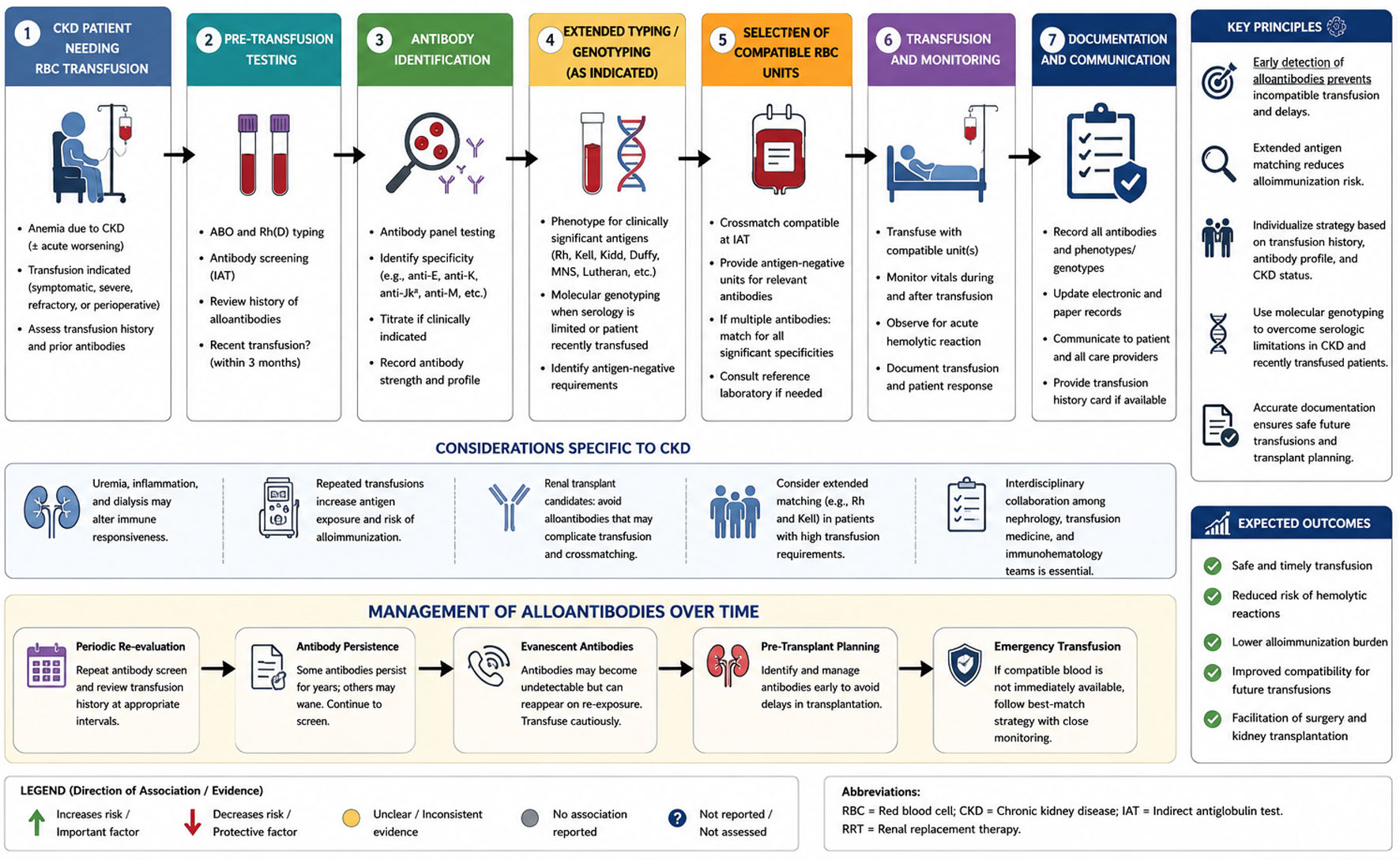
| Evidence role | Detection/typing approach | Compatibility issue | Management signal | Evidence gap |
|---|---|---|---|---|
| CKD: chronic kidney disease; IAT: indirect antiglobulin test; LISS: low ionic strength solution; PCR-SSP: polymerase chain reaction with sequence-specific primers; RRT: renal replacement therapy. | ||||
| Oud et al (2021) Renal-failure determinant study | Routine transfusion-record/laboratory data in multicenter study | Not a compatibility study | None evaluated | Defines renal/RRT association rather than a management intervention |
| Nebie et al (2022) Dedicated CKD cohort | IAT; LISS microcolumn gel; three-cell screen; 11-cell identification | Four positive patients had indeterminate specificity | Antibody-directed antigen avoidance is clinically relevant | Need locally informative panels and prospective CKD studies |
| Singh et al (2024) Mixed cohort—CKD subgroup | Coombs testing; three-cell screen; 11-cell panel; column agglutination | No CKD alloantibody in subgroup | Routine screening advocated in multi-transfused patients | CKD-specific benefit not demonstrated |
| Nathalang et al (2025) Mixed cohort—CKD subgroup | PCR-SSP extended blood-group genotyping | Serologic typing limitations after repeated transfusion | Genotype-informed antigen-negative unit selection | Clinical and cost effectiveness in CKD untested |
| John et al (2025) Dedicated CKD cohort | Automated Echo Lumena solid-phase screening/identification | Multiple and unresolved antibodies may complicate compatibility | Screening and specificity identification | Small number of alloimmunized CKD patients |
| Banerjee et al (2026) Clinical compatibility case | Pre-transplant immunohematologic workup and donor typing | Required rare Jk(a)-negative/e-negative compatible units | Advance planning for antigen-negative blood | Single-patient evidence |