| Journal of Clinical Medicine Research, ISSN 1918-3003 print, 1918-3011 online, Open Access |
| Article copyright, the authors; Journal compilation copyright, J Clin Med Res and Elmer Press Inc |
| Journal website https://jocmr.elmerjournals.com |
Original Article
Volume 18, Number 10, October 2026, pages 784-794
Precision Oncology: Cancer Specialists’ Perspectives on Molecular Profiling, Targeted Therapy, and Barriers to Access
Figures


Tables
| Domain | Survey question/item | Response options |
|---|---|---|
| ALK: anaplastic lymphoma kinase; BRCA1/BRCA2: breast cancer susceptibility gene 1/2; EGFR: epidermal growth factor receptor; ER: estrogen receptor; HER2: human epidermal growth factor receptor 2; KRAS/BRAF: Kirsten rat sarcoma viral oncogene homolog/B-Raf proto-oncogene; MMR: mismatch repair; MSI: microsatellite instability; NGS: next-generation sequencing; PD-L1: programmed death-ligand 1; PR: progesterone receptor; ROS1: ROS proto-oncogene 1. | ||
| Participant characteristics | 1. What is your primary specialty? | Clinical Oncology; Radiation Oncology; Surgical Oncology; Medical Oncology; Hematology; Other (Please specify) |
| 2. Years in independent clinical practice | < 5 years; 5–10 years; 11–20 years; > 20 years | |
| 3. Identify your primary role | Clinician; Educator; Researcher | |
| 4. Which of the following is your current primary practice setting? | Government Hospital; University Hospital; Private Hospital; Autonomous nonprofit Institution/Hospital | |
| 5. Which level of healthcare facility best describes your current primary practice setting? | Primary care hospital/center; Secondary-level hospital; Tertiary referral hospital; Specialized cancer center; Multiple practice settings; Other (please specify) | |
| 6. Which of the following is the approximate number of cancer patients managed by you per month? | < 50; 50–100; 100–200; > 200 | |
| Molecular profiling and targeted therapy practices | 7. How often do you recommend molecular profiling (genomic/biomarker testing) for eligible cancer patients? | Never; Rarely (less than 25% of cases); Sometimes (25–50% of cases); Often (more than 50% of cases); Always |
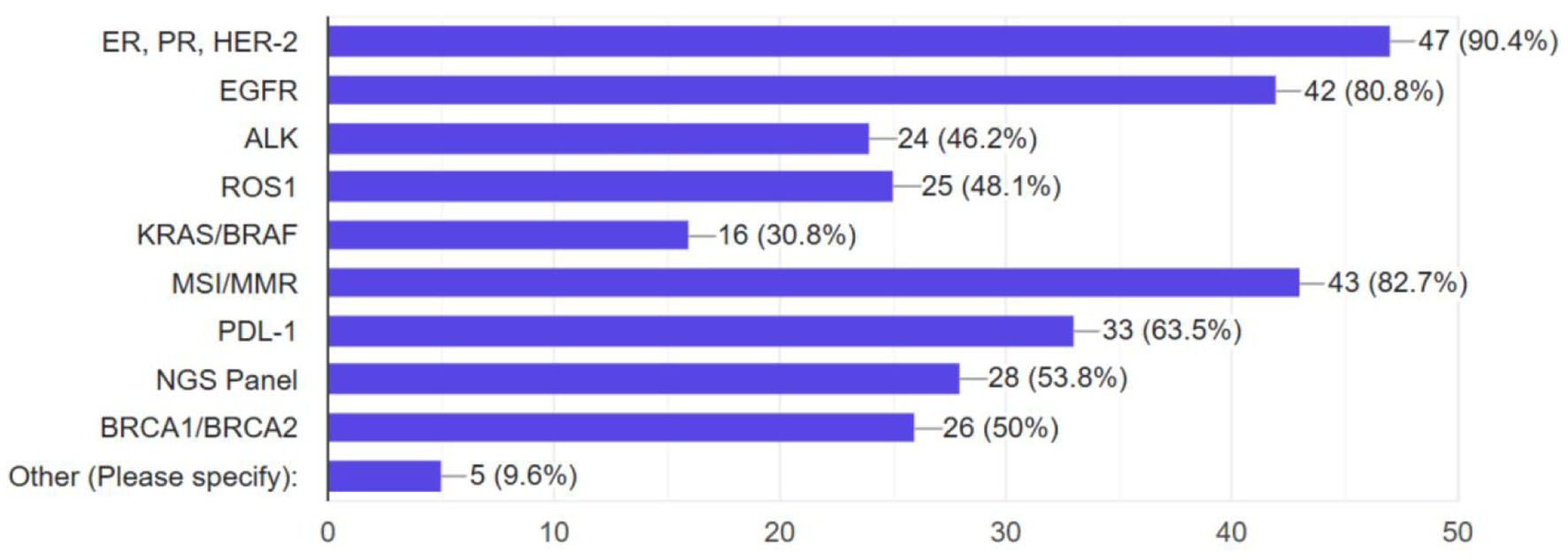
| 8. Which molecular tests do you commonly request? (Select all that apply) | ER, PR, HER2; EGFR; ALK; ROS1; KRAS/BRAF; MSI/MMR; PD-L1; NGS Panel; BRCA1/BRCA2; Other (Please specify) | |
| 9. Approximately what proportion of your patients who are eligible ultimately receive targeted therapy? | < 10%; 10–25%; 26–50%; 51–75%; > 75% | |
| Perceived barriers | 10. High cost of molecular testing | 1 = Not a barrier to 5 = Very major barrier |
| 11. High cost of targeted therapy | 1 = Not a barrier to 5 = Very major barrier | |
| 12. Limited availability of testing facilities within Bangladesh | 1 = Not a barrier to 5 = Very major barrier | |
| 13. Limited availability of targeted therapy/supply issues | 1 = Not a barrier to 5 = Very major barrier | |
| 14. Long turnaround time for molecular testing results | 1 = Not a barrier to 5 = Very major barrier | |
| 15. Limited physician awareness/training regarding molecular-guided treatment | 1 = Not a barrier to 5 = Very major barrier | |
| 16. Limited local clinical guideline | 1 = Not a barrier to 5 = Very major barrier | |
| 17. Limited patient understanding or acceptance of molecular testing | 1 = Not a barrier to 5 = Very major barrier | |
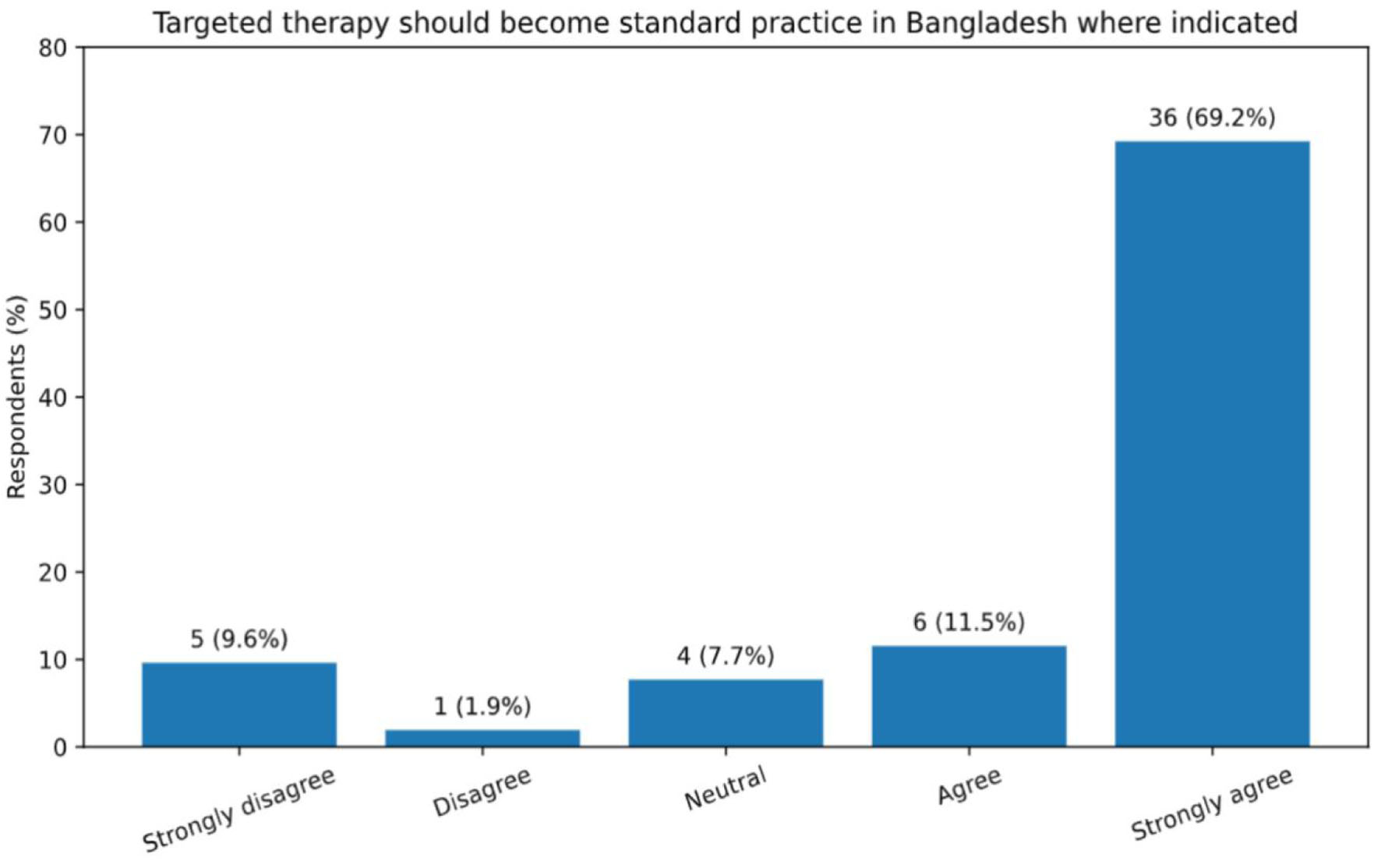
| Attitudes and potential interventions | 18. Targeted therapy should become standard practice in Bangladesh where indicated. | 1 = Strongly disagree to 5 = Strongly agree |
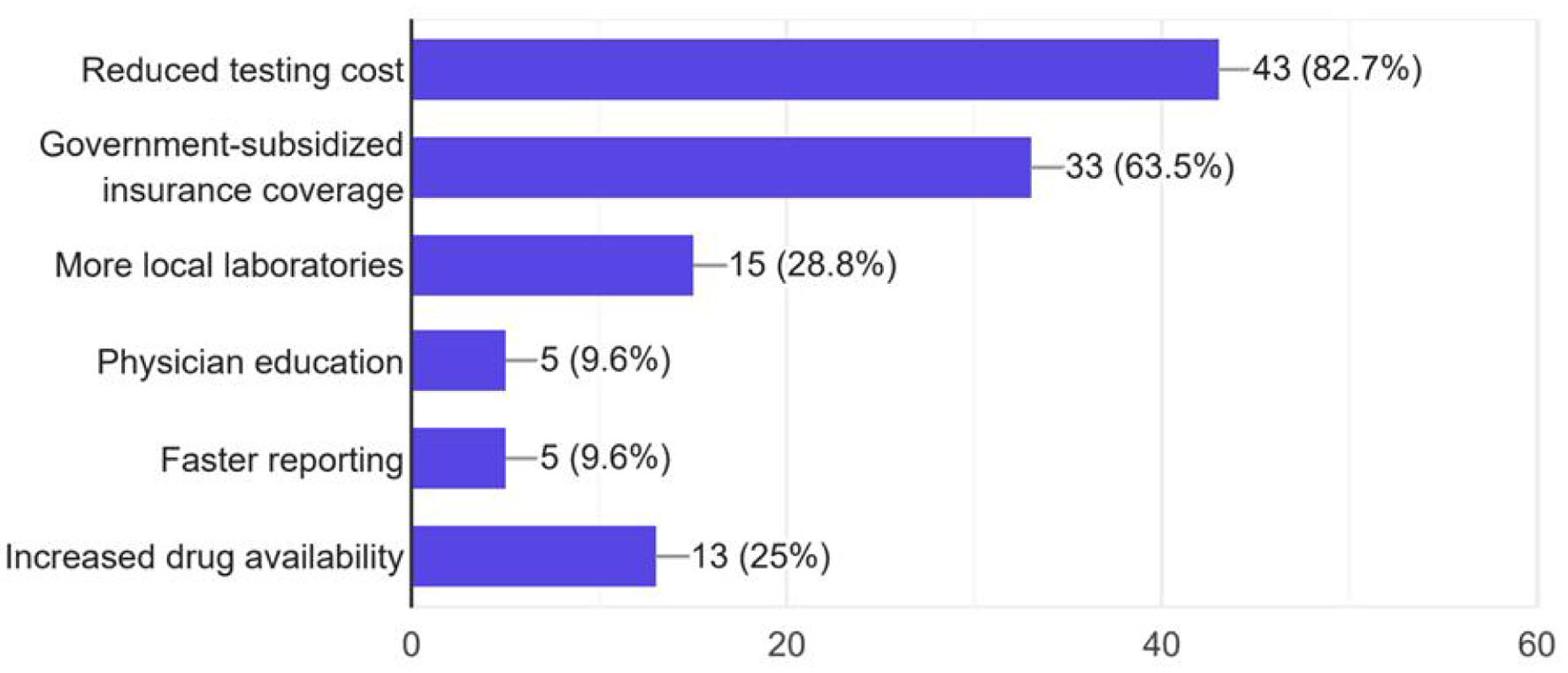
| 19. Which intervention would MOST improve access to molecular profiling and targeted therapy? (Choose two) | Reduced testing cost; Government-subsidized insurance coverage; More local laboratories; Physician education; Faster reporting; Increased drug availability | |
| Characteristic | n (%) |
|---|---|
| Primary specialty | |
| Clinical Oncology | 36 (69.2) |
| Hematology | 5 (9.6) |
| Medical Oncology | 4 (7.7) |
| Radiation Oncology | 5 (9.6) |
| Surgical Oncology | 2 (3.8) |
| Years in independent clinical practice | |
| < 5 years | 31 (59.6) |
| 5–10 years | 15 (28.8) |
| 11–20 years | 4 (7.7) |
| > 20 years | 2 (3.8) |
| Primary practice setting | |
| Government hospital | 32 (61.5) |
| Private hospital | 14 (26.9) |
| Autonomous nonprofit institution/hospital | 4 (7.7) |
| University hospital | 2 (3.8) |
| Level of healthcare facility | |
| Primary care hospital/center | 1 (1.9) |
| Secondary-level hospital | 3 (5.8) |
| Tertiary referral hospital | 17 (32.7) |
| Specialized cancer center | 24 (46.2) |
| Multiple practice settings | 6 (11.5) |
| Other | 1 (1.9) |
| Approximate number of cancer patients managed per month | |
| < 50 | 20 (38.5) |
| 50–100 | 16 (30.8) |
| 100–200 | 6 (11.5) |
| > 200 | 10 (19.2) |
| Practice characteristic | n (%) |
|---|---|
| Frequency of recommending molecular profiling for eligible patients | |
| Always | 9 (17.3) |
| Often (> 50% of cases) | 18 (34.6) |
| Sometimes (25–50% of cases) | 17 (32.7) |
| Rarely (< 25% of cases) | 8 (15.4) |
| Proportion of eligible patients ultimately receiving targeted therapy | |
| < 10% | 22 (42.3) |
| 10–25% | 23 (44.2) |
| 26–50% | 6 (11.5) |
| 51–75% | 1 (1.9) |
| Perceived barrier | Median (IQR) | Rating 4–5, n (%) |
|---|---|---|
| Barrier items were rated on a 5-point scale. Data are presented as median (IQR) and n (%) of respondents assigning a rating of 4 or 5. Higher ratings indicate a greater perceived barrier. | ||
| High cost of molecular testing | 5 (4–5) | 45 (86.5) |
| High cost of targeted therapy | 5 (4–5) | 46 (88.5) |
| Limited availability of testing facilities within Bangladesh | 4 (3–4) | 29 (55.8) |
| Limited availability of targeted therapy/supply issues | 3 (2–4) | 18 (34.6) |
| Long turnaround time for molecular testing results | 3 (2–4) | 25 (48.1) |
| Limited physician awareness/training regarding molecular-guided treatment | 3 (2–4) | 15 (28.8) |
| Limited local clinical guidelines | 3 (2–4) | 20 (38.5) |
| Limited patient understanding or acceptance of molecular testing | 4 (3–4) | 28 (53.8) |