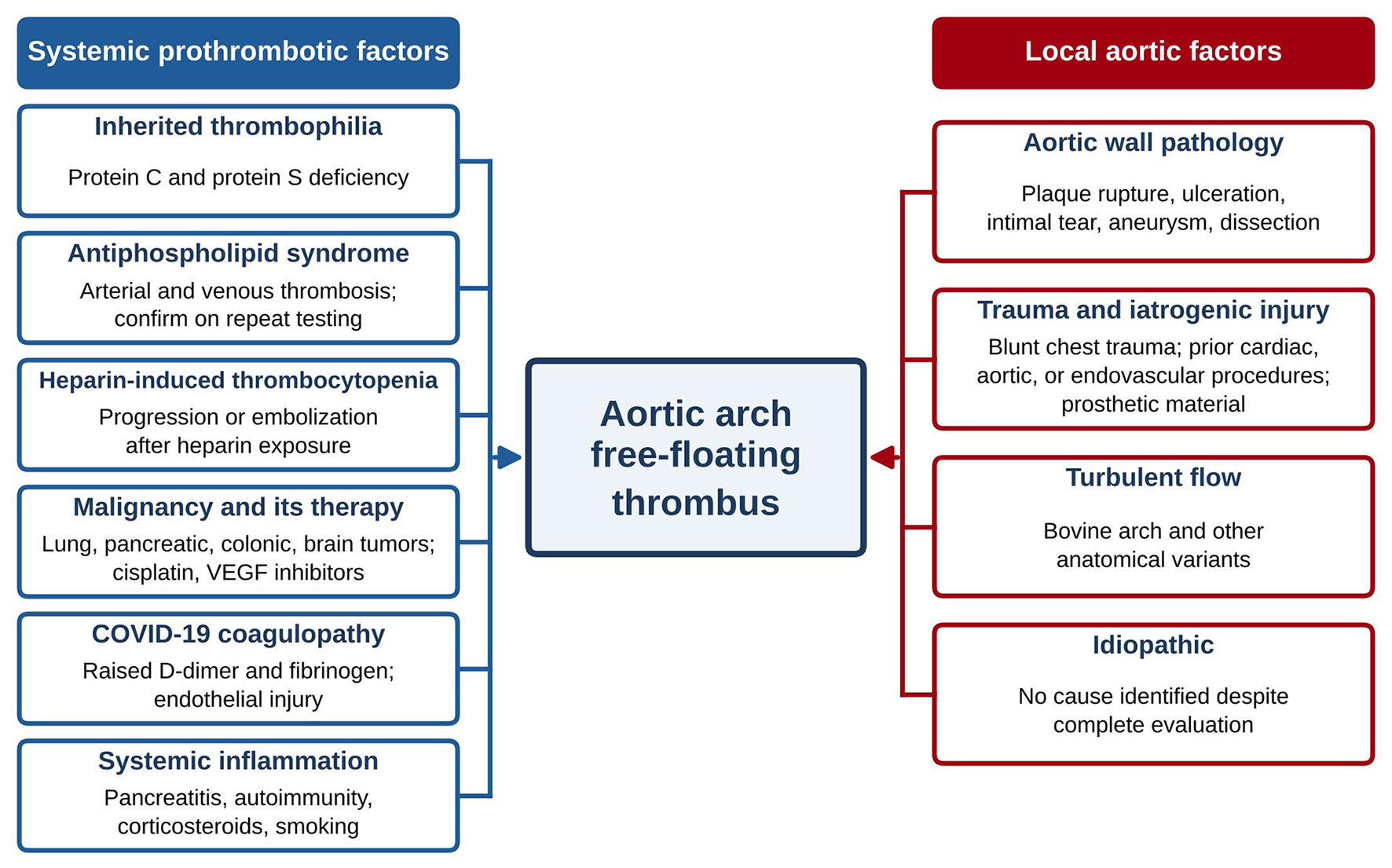
↓ Figure 1. Etiology and risk factors of aortic arch free-floating thrombus. COVID-19: coronavirus disease 2019; MTHFR: methylenetetrahydrofolate reductase; PAI-1: plasminogen activator inhibitor-1; VEGF: vascular endothelial growth factor.
| Journal of Clinical Medicine Research, ISSN 1918-3003 print, 1918-3011 online, Open Access |
| Article copyright, the authors; Journal compilation copyright, J Clin Med Res and Elmer Press Inc |
| Journal website https://jocmr.elmerjournals.com |
Review
Volume 18, Number 12, December 2026, pages 895-911
Management of Free-Floating Thrombus in the Aortic Arch: A Narrative Review of Antithrombotic, Open Surgical, and Endovascular Strategies
Figure
Tables
| Study [ref] | Year | Design | Arch n/total n | Thrombus type | Treatment (n) | Follow-up | Outcomes (persistence; thrombus recurrence; clinical embolization; death) |
|---|---|---|---|---|---|---|---|
| Data as reported in the original publications. Arch-specific: all patients, or a separately reported subgroup, had arch thrombus; mixed: arch and other segments without separate arch outcomes; non-arch: no arch thrombi. NR: not reported in a form allowing extraction; DAPT: dual antiplatelet therapy; DHCA: deep hypothermic circulatory arrest; FFT: free-floating thrombus; IV: intravenous; LMWH: low-molecular-weight heparin; PAMT: primary aortic mural thrombus; TEE: transesophageal echocardiography; TIA: transient ischemic attack. | |||||||
| Hausmann [71] | 1992 | Case report | 1/1 (arch-specific) | Not stated | Alteplase (1) | 180 days | Resolved on TEE; no further events reported |
| Aldrich [52] | 1994 | Case report | 1/2 (mixed) | Not stated | Heparin → warfarin (2) | 16 months | Bowel resection; small residual mass (persistence); no recurrent embolization |
| Laperche [35] | 1997 | Retrospective multicenter TEE series | 23/23 (arch-specific) | Plaque-associated (small plaque at insertion in 21/23) | IV heparin (23); surgical thrombectomy (10) | Up to 2 years | Medical (n = 13): resolved 11; persistent 1; death 1 (mesenteric infarction) |
| Arko [53] | 1997 | Retrospective series | Arch (14) | Mobile atheroma, not thrombus (context only) | Heparin → warfarin | NR | 1 death (cholesterol embolization) in an untreated patient |
| Choukroun [44] | 2002 | Retrospective series | 4/9 (mixed) | Mobile thoracic thrombus | IV heparin (9); thrombectomy for persistence (5) | NR | Resolved on heparin 4/9; persistent 5/9 (operated); 1 recurrence after stopping anticoagulation |
| Tsilimparis [5] | 2011 | Case series and literature review | 0/8 (non-arch) | Primary (descending thoracic) | Medical (4); open or endovascular (4) | NR | No recurrence reported |
| Fayad [8] | 2013 | Pooled individual-patient analysis of published reports (98 articles) | 74/200 (mixed; no separate arch outcomes) | Primary (normal or minimally atherosclerotic aorta) | Anticoagulation (112); surgery (88) | Variable | Persistence/recurrence 26.4% vs. 5.7% (P < 0.001); embolization 25.7% vs. 9.1% (P = 0.003); death 6.2% vs. 5.7% (P = 0.879) |
| Gülcü [45] | 2014 | Retrospective series | 5/34 (mixed) | FFT of arch and supra-aortic arteries with acute stroke | Warfarin or antiplatelet therapy; stenting | NR | Favorable outcomes reported; arch outcomes not separately extractable |
| Verma [47] | 2014 | Retrospective series | 2/19 (mixed) | Primary (symptomatic PAMT) | Anticoagulation; endovascular (7, descending) | NR | Arch: 1 regression; 1 switched to LMWH. Descending: 6/7 endovascular successes |
| Weiss [1] | 2016 | Retrospective single-center series | 10/10 (arch-specific) | Primary and plaque-associated (plaque at attachment in 3/6 resected) | Anticoagulation (3); open thrombectomy with DHCA (6); no aortic treatment (1) | Median 17 months (11–89) | Medical: resolved 2/3, persistent 1/3 with recurrent stroke/TIA, 1 embolism after stopping; surgical: 0/6 recurrence; deaths 2/10 (early stroke; malignancy) |
| Démoulin [2] | 2025 | Two case reports and literature review | 2/2 (ascending/arch) | Not stated | Heparin; thrombectomy | NR | See source |
| Esnaola Barriola [9] | 2025 | Imaging series (stroke patients) | 10/10 (arch-specific) | Plaque-associated | Acenocoumarol ± antiplatelet; apixaban + DAPT (1) | NR | Resolved 8/10; recurrence while thrombus persisted 1; major bleeding 2; deaths 2 |
| Liu [11] | 2026 | Systematic review of published reports, 2000–2022 (99 studies) | 64/250 (arch subgroup reported) | Primary (PAMT) | Arch: anticoagulation (36); surgery (28) | Variable | Arch: persistence/recurrence 10/36 vs. 0/28; complications 15/36 vs. 3/28; deaths 2/36 vs. 1/28. Likely overlap with Fayad [8] |
| Category | When to consider | Suggested tests | Management implication | Evidence |
|---|---|---|---|---|
| Suggested workup based on the cited guidance and the authors’ opinion; not validated for AAFT. aPTT: activated partial thromboplastin time; CTA: computed tomography angiography; COVID-19: coronavirus disease 2019; DOAC: direct oral anticoagulant; HIT: heparin-induced thrombocytopenia; INR: international normalized ratio; MTHFR: methylenetetrahydrofolate reductase; PAI-1: plasminogen activator inhibitor-1; PF4: platelet factor 4; PT: prothrombin time; SAPT: single antiplatelet therapy; SARS-CoV-2: severe acute respiratory syndrome coronavirus 2; VKA: vitamin K antagonist; IgG/IgM: immunoglobulin G/immunoglobulin M. | ||||
| All patients (baseline) | At diagnosis, before antithrombotic therapy | Complete blood count with platelets, PT/INR, aPTT, renal and hepatic function | Baseline for bleeding risk, drug choice and dosing; platelet trend for HIT | Expert opinion |
| Antiphospholipid syndrome | All patients, particularly if young, with no aortic disease, or with prior thrombosis or pregnancy morbidity | Lupus anticoagulant (ideally before anticoagulation), anticardiolipin and anti-β2-glycoprotein I IgG/IgM; repeat after ≥ 12 weeks | VKA (target INR 2–3) preferred; avoid rivaroxaban/DOACs, especially if triple-positive [68, 72, 73] | Guideline, indirect |
| Heparin-induced thrombocytopenia | Platelet fall > 50% or new thrombosis 5–10 days after heparin | 4Ts score; anti-PF4 immunoassay; functional assay | Stop heparin; non-heparin anticoagulant [74] | Guideline, indirect |
| Malignancy | All patients; especially older age, weight loss, normal aorta | History, examination, age-appropriate screening; review of CTA for incidental masses; targeted imaging | Agent choice (interactions, bleeding, platelets); possibly extended anticoagulation [25–27] | Case reports |
| Infection or inflammation (including COVID-19) | Recent infection, inflammatory disease, pancreatitis | SARS-CoV-2 testing when relevant; C-reactive protein, D-dimer, fibrinogen | Treat the trigger; anticoagulation [30] | Case reports |
| Inherited thrombophilia | Young patients without another cause, or family history | Protein C, protein S, antithrombin (interpret with caution during acute thrombosis or anticoagulation) | Rarely changes acute management; may inform duration. MTHFR and PAI-1 variant testing not recommended [20] | Expert opinion |
| Local aortic disease, trauma, procedures | All patients | CTA of the entire aorta (plaque, ulcer, dissection, aneurysm, prosthetic material) | Secondary thrombus: manage aortic disease; SAPT and statin after resolution if plaque-associated [36, 68] | Guideline, indirect |
| Study [ref] | Arch patients | Selection | Symptomatic | Stroke/TIA | Limb ischemia | Visceral ischemia | Incidental/other |
|---|---|---|---|---|---|---|---|
| Only series with extractable arch-specific denominators are shown; presentation frequencies depend strongly on selection criteria and cannot be pooled. Case reports describe additional presentations, including multi-territory embolism [3], visceral and renal embolism progressing on anticoagulation [7], and initially incidental thrombi that later embolized [40]. NR: not reported in a form allowing extraction; —: not applicable; FFT: free-floating thrombus; TIA: transient ischemic attack. | |||||||
| Weiss [1] | 10 | Consecutive floating arch thrombi | 8/10 | 2/10 | 4/10 | 1/10 | Asymptomatic 2/10; distal aortic occlusion 1/10 |
| Laperche [35] | 23 | Recent arterial embolic event (inclusion criterion) | 23/23 | NR | NR | NR | 0 (by design) |
| Esnaola Barriola [9] | 10 | Patients with ischemic stroke | 10/10 | 10/10 | — | — | 0 (by design) |
| Gülcü [45] | 5 (of 34) | Acute stroke with FFT of arch or supra-aortic arteries | 5/5 | 5/5 | — | — | 0 (by design) |
| Report [ref] | Thrombus location | Reason for conservative/DOAC strategy | Agent and regimen | Imaging outcome | Subsequent therapy/events |
|---|---|---|---|---|---|
| Individual case reports; they show feasibility but not efficacy or safety relative to VKAs. CTA: computed tomography angiography; DAPT: dual antiplatelet therapy; DOAC: direct oral anticoagulant; MCA: middle cerebral artery; NR: not reported; VKA: vitamin K antagonist. | |||||
| Ghoweba et al [19] | Distal arch, highly mobile | Surgery unfavorable (location; recent coronary artery bypass grafting) | Rivaroxaban 20 mg once daily | Complete resolution on CTA at 3 months | Anticoagulation discontinued |
| Udeaja et al [42] | Proximal arch, 4 cm; embolic MCA stroke | Recent infarction increased perioperative risk | Dabigatran 150 mg twice daily (preserved renal function) | Complete resolution at 4 months | 6-month course, then lifelong clopidogrel |
| Toyama et al [55] | Ascending aorta (non-arch) | Patient declined surgery | Rivaroxaban 15 mg twice daily for 3 months, then 15 mg once daily | Decreased at 1 month; undetectable at 3 months | No embolic events |
| Ikeda and Hiraoka [54] | Multiple aortic floating thrombi | Conservative strategy | DOAC, continued | Resolution reported | See source |
| Esnaola Barriola et al [9] | Aortic arch, plaque-associated | Stroke; medical management | Apixaban plus DAPT | NR | Major gastrointestinal bleeding |
| Step/domain | Decision element | Suggested action | Escalation trigger | Evidence level |
|---|---|---|---|---|
| Literature-informed decision elements; not prospectively validated. AAFT: aortic arch free-floating thrombus; APS: antiphospholipid syndrome; CI: confidence interval; COVID-19: coronavirus disease 2019; CTA: computed tomography angiography; DAPT: dual antiplatelet therapy; HIT: heparin-induced thrombocytopenia; OR: odds ratio; SAPT: single antiplatelet therapy; TEE: transesophageal echocardiography; TIA: transient ischemic attack; TTE: transthoracic echocardiography; —: not applicable; VKA: vitamin K antagonist. | ||||
| Initial assessment: presentation | Embolic event (stroke/TIA, limb, visceral) | Treat the affected territory per specialty guidance; start anticoagulation when bleeding risk allows; early multidisciplinary review of source control [1, 8, 11] | Recurrent embolism on therapy | Arch series; pooled data (stroke OR: 11.8) [8] |
| Initial assessment: presentation | Incidental, asymptomatic thrombus | Anticoagulation with surveillance [1, 40] | Growth, new mobility, or any embolic event | Case reports |
| Initial assessment: thrombus | Arch or ascending location | Lower threshold for multidisciplinary review [8] | — | Pooled data, imprecise (arch OR: 18.3; 95% CI: 2.6–376.7) [8] |
| Initial assessment: thrombus | Large, pedunculated, or highly mobile thrombus | Closer surveillance; consider intervention when combined with other high-risk features [14, 43, 47] | Persistence without regression | Inconsistent; expert opinion |
| Initial assessment: cause | APS, HIT, active cancer, COVID-19, local aortic disease | Etiology-specific choice of agent (Table 2); VKA in APS; non-heparin agent in HIT [68, 72–74] | Thrombosis despite therapeutic anticoagulation | Guideline (indirect); case reports |
| Initial assessment: patient | Bleeding risk, recent infarction, renal function, operative fitness, anatomy, preference | Individualize timing; avoid anticoagulant plus DAPT; adjust agent to renal function; assess open, endovascular, and hybrid feasibility [9, 64, 75, 76] | — | Indirect; expert opinion |
| Early reassessment | Clinical status daily; imaging (CTA, TEE, or suprasternal TTE) within 1–2 weeks, immediately if new symptoms [7, 44, 46] | Continue medical therapy if regression or resolution | Persistence without regression, enlargement, or new embolization → multidisciplinary reassessment for source control | Expert opinion |
| Source control | Open thrombectomy, endovascular exclusion, or hybrid repair | Choose by zone, branch involvement, landing zone, procedural embolic risk, and operative risk [1, 60–64] | — | Case reports and small series for AAFT |
| Later reassessment | Imaging at about 3 months and after stopping anticoagulation [1, 19, 42, 44] | Stop after ≥ 3 months if resolved and no persistent risk factor; consider SAPT if plaque-associated [36, 68] | Recurrence after cessation → extended anticoagulation or source control | Case reports; expert opinion |