| Journal of Clinical Medicine Research, ISSN 1918-3003 print, 1918-3011 online, Open Access |
| Article copyright, the authors; Journal compilation copyright, J Clin Med Res and Elmer Press Inc |
| Journal website https://jocmr.elmerjournals.com |
Original Article
Volume 18, Number 8, August 2026, pages 585-598

Incidence and Predictors of Anticoagulant-Associated Bleeding in Patients With Venous Thromboembolism
Tanapun Thamgranga, c  , Pakkapol Thiwannarakb, Pornpavee Siricharoenthaia , Kannadit Prayongratanaa , Chonlada Laoruangroja , Panachai Silpsamrita , Rattapan Lamoola
aDivision of Hematology, Department of Medicine, Phramongkutklao Hospital, Bangkok, Thailand
bDepartment of Medicine, Phramongkutklao Hospital, Bangkok, Thailand
cCorresponding Author: Tanapun Thamgrang, Division of Hematology, Department of Medicine, Phramongkutklao Hospital, Bangkok 10400, Thailand
Manuscript submitted July 19, 2026, accepted August 14, 2026, published online August 26, 2026
Short title: Predictors of Anticoagulant Bleeding in VTE
doi: https://doi.org/10.14740/jocmr6679
| Abstract | ▴Top |
Background: Data on anticoagulant-associated bleeding among patients with venous thromboembolism (VTE) in Southeast Asia are limited. We aimed to determine the incidence and predictors of anticoagulant-associated bleeding and evaluate its association with mortality.
Methods: We conducted a retrospective cohort study of patients with VTE treated with anticoagulants between January 2014 and June 2024. Clinically relevant bleeding (CRB) was defined according to the International Society on Thrombosis and Haemostasis criteria. Cumulative incidence was estimated using the Aalen–Johansen method with death as a competing event, and predictors were identified using Fine–Gray sub-distribution hazard models. The association between bleeding and all-cause mortality was evaluated using time-dependent Cox proportional hazards models.
Results: Among 395 patients (mean age, 60.7 ± 16.2 years; 65.3% female), 43.5% had cancer-associated thrombosis. Low-molecular-weight heparin was the most commonly prescribed initial anticoagulant (39.0%), followed by warfarin (32.7%) and direct oral anticoagulants (25.1%), of which apixaban was the most frequently used (12.7%). During a median follow-up of 0.88 years, 60 patients (15.2%) developed CRB. The 1-year cumulative incidence of CRB was 14.89% (95% confidence interval (CI), 11.09–19.23). Independent predictors of CRB included concomitant antiplatelet therapy (adjusted sub-distribution hazard ratio (aSHR), 3.48; 95% CI, 1.76–6.90), Eastern Cooperative Oncology Group performance status ≥ 2 (aSHR, 3.05; 95% CI, 1.34–6.94), body mass index (BMI) < 20 kg/m2 (aSHR, 2.50; 95% CI, 1.36–4.61), and age ≥ 65 years (aSHR, 1.97; 95% CI, 1.12–3.45). Both clinically relevant non-major bleeding (adjusted hazard ratio (aHR), 3.72; 95% CI, 1.55–8.92) and major bleeding (aHR, 5.62; 95% CI, 2.91–10.85) were independently associated with increased all-cause mortality.
Conclusions: Anticoagulant-associated bleeding is common among Thai patients with VTE and is associated with an increased risk of all-cause mortality. Patients with advanced age, poor performance status, low BMI, or concomitant antiplatelet therapy may benefit from closer monitoring during anticoagulant treatment.
Keywords: Venous thromboembolism; Anticoagulants; Bleeding; Southeast Asia; Mortality; Predictor
| Introduction | ▴Top |
Venous thromboembolism (VTE), comprising deep vein thrombosis (DVT) and pulmonary embolism (PE), represents a substantial global health burden, affecting millions of patients annually [1] and ranking as the third most common cardiovascular cause of death worldwide [2]. Anticoagulant therapy is the cornerstone of VTE management; however, major bleeding (MB) remains the most frequent and serious complication of treatment. Reported incidence rates reach up to 7.22 events per 100 patient-years, depending on the class of anticoagulant used, with an associated case fatality rate of approximately 9%. Beyond its direct morbidity and mortality, MB often results in premature discontinuation of anticoagulant therapy, thereby potentially increasing the risk of recurrent thromboembolic events [3].
Ethnic differences play an important role in anticoagulant safety profiles [4–6]. Anticoagulant-associated bleeding has been reported to occur more frequently in Asian populations. Among patients with atrial fibrillation (AF), the risk of intracranial hemorrhage is higher in Asian than in non-Asian patients (1.8% vs. 0.4%) [5]. In a meta-analysis of patients with VTE comparing direct oral anticoagulants (DOACs) with vitamin K antagonists (VKAs) in Asian populations, rates of MB or clinically relevant non-major bleeding (CRNMB) differed by anticoagulant class. The absolute rate of the composite safety endpoint with DOACs was similar between Asian and non-Asian patients (7.9% vs. 7.3%), whereas the corresponding rate with VKAs was numerically higher in Asian than in non-Asian patients (11.8% vs. 9.4%) [7].
Despite these observations, there is a paucity of data on anticoagulant-associated bleeding among patients with VTE in Southeast Asia, including Thailand, as existing studies have predominantly focused on AF [8–11]. Estimating bleeding risk in VTE patients is particularly challenging because of the high prevalence of comorbidities, especially active cancer [12]. Observational studies in Asian populations consistently identify cancer as the most common risk factor for VTE [4, 6, 13] and cancer-associated thrombosis (CAT) is associated with an increased risk of bleeding and bleeding-related mortality [4]. Moreover, traditional survival analyses, such as the Kaplan–Meier method, treat death as a censoring event and may therefore overestimate the cumulative incidence of bleeding. As a result, real-world epidemiological data in Southeast Asian patients with VTE that incorporate competing-risk methodology to generate accurate bleeding risk estimates are scarce.
To address these knowledge gaps, this study aimed to determine the incidence and predictors of anticoagulant-associated bleeding in a cohort of Thai patients with VTE. By applying competing-risk analysis, we sought to provide robust real-world evidence that may offer valuable insights into risk stratification and clinical management within the Southeast Asian context.
| Materials and Methods | ▴Top |
Study design and setting
This retrospective cohort study included patients diagnosed with VTE who were treated at Phramongkutklao Hospital, a tertiary care center in Thailand, between January 2014 and June 2024.
Study population
Adult patients (aged ≥ 20 years) with a first episode of objectively confirmed VTE, defined as lower-extremity DVT and/or PE, were eligible for inclusion. DVT was diagnosed using compression Doppler ultrasonography or, when clinically indicated, computed tomography venography (CTV). PE was diagnosed using computed tomography pulmonary angiography (CTPA). All included patients received anticoagulant therapy, regardless of the anticoagulant class or dosage.
Patients with VTE occurring at sites other than the lower extremities or lungs were excluded. Patients who were diagnosed with VTE at our institution but were subsequently referred to another hospital for ongoing treatment and follow-up, without any subsequent visits to our center, were also excluded. Hepatic dysfunction, active infection, and heart failure were not exclusion criteria, and patients with these conditions were eligible for inclusion.
Objectives
The primary objective was to determine the incidence proportion, incidence rate, and 1-year cumulative incidence of clinically relevant bleeding (CRB). CRB was defined according to the International Society on Thrombosis and Haemostasis (ISTH) criteria as MB or CRNMB [14, 15].
Secondary objectives were to describe the clinical characteristics of patients who developed CRB, identify predictors of anticoagulant-associated CRB, and evaluate the association between CRB and mortality. Exploratory objectives included describing the management of CRB and estimating the incidence of recurrent VTE.
Patient identification and data collection
Patients were identified through the hospital electronic medical record (EMR) system by searching for International Classification of Diseases, 10th Revision (ICD-10) codes corresponding to DVT (I80, I82) and PE (I26) during the study period. Each identified case was individually reviewed to confirm the diagnosis of VTE, and only patients who met the predefined inclusion and exclusion criteria were included in the final analysis.
Baseline characteristics—including age, sex, comorbidities, type of VTE, provoking factors, and laboratory parameters—were collected using the Research Electronic Data Capture (REDCap) electronic data capture system. Dates of anticoagulant initiation and discontinuation, as well as the date of last follow-up, were recorded for time-to-event analyses. Bleeding events and recurrent thrombotic events occurring during follow-up were systematically documented.
A body mass index (BMI) cutoff of < 20 kg/m2 was selected based on previous studies suggesting an increased risk of MB among patients receiving anticoagulant therapy with a BMI < 20 kg/m2 [16, 17].
Active cancer was defined as cancer diagnosed or treated within the previous 6 months; recurrent, regionally advanced, or metastatic disease; or hematological malignancy not in complete remission [18]. Anemia was defined as a hemoglobin level < 13 g/dL in males and < 12 g/dL in females. Chronic kidney disease (CKD) was defined by the presence of kidney damage, an estimated glomerular filtration rate (eGFR) < 60 mL/min/1.73 m2, or a documented physician diagnosis of CKD in the medical record.
Only the first bleeding event per patient during the study period was included in the analysis. Recurrent thrombotic events were defined as objectively confirmed recurrent VTE based on standard imaging modalities (e.g., compression ultrasonography or computed tomography) during follow-up.
Anticoagulant classification and follow-up strategy
The anticoagulant reported in the baseline characteristics represents the initial intended treatment strategy prescribed during the primary treatment phase of VTE [19]. Dosages reflect those used during this initial therapeutic period. Patients receiving warfarin, edoxaban, or dabigatran with bridging or lead-in heparin therapy were classified according to the specific oral anticoagulant received. Those treated exclusively with heparin were categorized as receiving heparin monotherapy. Patients who initially received heparin and were subsequently transitioned to a DOAC (including apixaban or rivaroxaban) as part of their planned primary treatment were classified in the DOAC group.
Follow-up commenced at initiation of anticoagulant therapy and continued until the first occurrence of a bleeding event, death, or loss to follow-up, whichever occurred first. To preserve the validity of risk estimates associated with the initial treatment strategy, patients were censored at the time of any deviation from the primary regimen.
Deviations were defined as permanent discontinuation of anticoagulation; transition from the primary treatment phase to extended-phase (secondary prevention) therapy involving a change in anticoagulant class or a planned dose reduction; or any switch between different anticoagulant classes (such as routine clinical transitions between VKAs and DOACs, or transitions driven by non-clinical reasons like medication cost, patient preference, or drug availability). Additionally, any switch between different anticoagulant classes driven by a non-bleeding clinical event (e.g., recurrent thrombosis) resulted in censoring at the time of the switch. Conversely, switching between agents within the same anticoagulant class for clinical indications (e.g., intolerance or adverse effects) was not considered a deviation. In such cases, patients remained classified within the same anticoagulant class, and dosage information reflected the regimen administered until a subsequent change in treatment occurred.
For secondary survival analysis, overall survival (OS) was defined as the time from the initiation of anticoagulant therapy to death from any cause or last follow-up, whichever occurred first.
Statistical analysis
Categorical variables are presented as frequencies and percentages and were compared using Fisher’s exact test. Continuous variables are presented as mean ± standard deviation (SD) or median (interquartile range (IQR)), as appropriate, and were compared using the independent t-test or the Wilcoxon rank-sum test.
Cumulative incidence functions were estimated using the Aalen–Johansen method within a competing-risk framework. For overall CRB, MB and CRNMB were treated as failure events, with death considered a competing event. For analyses of MB alone, CRNMB and death were treated as competing events.
Missing data among variables planned for inclusion in the multivariable model were assessed using Little’s test for missing completely at random (MCAR). As the test was statistically significant, data were assumed to be missing at random. Missing baseline variables (BMI, Eastern Cooperative Oncology Group (ECOG) performance status, and hemoglobin level) were handled using multiple imputation by chained equations (MICE) with 50 imputations. All variables included in the multivariable model, as well as the Nelson–Aalen cumulative hazard estimator and bleeding events, were incorporated into the imputation model. The largest fraction of missing information (FMI) was 0.38, with a relative increase in variance (RVI) of 0.19. With 50 imputations, the relative efficiency exceeded 99%, indicating adequate precision. Pooled estimates were derived using Rubin’s rules.
Predictors of CRB were evaluated using Fine and Gray competing-risk regression models. Variables with P values < 0.20 in univariable analysis were considered candidates for inclusion in the multivariable model. The significance of predictors in the pooled multivariable models was assessed using Wald tests according to Rubin’s rules. The proportional sub-distribution hazards assumption was evaluated for all covariates, and no significant violations were detected.
The association between bleeding events and all-cause mortality was evaluated using time-dependent Cox proportional hazards regression models. Bleeding events were modeled as time-dependent covariates. Candidate variables with a P value < 0.20 in the univariable time-dependent Cox regression were included in the initial multivariable model. Model simplification was performed via backward elimination guided by the joint Wald test. Non-significant covariates were sequentially removed if their joint deletion did not significantly alter model fit (P value ≥ 0.05). Other clinically important risk factors were retained in the final multivariable model regardless of statistical significance. The proportional hazards assumption was assessed using Schoenfeld residuals.
Sensitivity analyses were performed after excluding patients who received low-molecular-weight heparin (LMWH) at intermediate or prophylactic doses, as well as those receiving reduced-dose DOACs, defined as dabigatran 110 mg twice daily, apixaban 2.5 mg twice daily, rivaroxaban 10 mg once daily, or edoxaban 30 mg once daily. The cumulative incidence of CRB was re-estimated in the restricted cohort. The Fine–Gray regression analysis was then repeated using the same predictors included in the final multivariable model to assess the robustness of the identified predictors of CRB.
All analyses were performed using Stata version 17.0 (StataCorp LLC, College Station, TX, USA). Two-sided P values < 0.05 were considered statistically significant.
Sample size calculation
The sample size was estimated based on the GARFIELD-VTE study [6], which reported a bleeding incidence of 9.6 per 100 patient-years in Asian populations. Assuming a median follow-up of 1 year, this corresponded to an anticipated cumulative incidence of 9.6%. Using a 95% confidence level and a margin of error of 3%, a minimum of 371 patients was required. After accounting for an anticipated 5% loss to follow-up, the final target sample size was set at 391 patients. This sample size was expected to yield an adequate number of events to support multivariable analyses of 3–4 independent predictors, maintaining approximately 10 events per variable [20].
Ethical considerations
This study was approved by the Institutional Review Board of the Royal Thai Army Medical Department (Approval Number IRBRTA 0937/2567). The study was conducted in accordance with the principles of the Declaration of Helsinki and adhered to the International Conference on Harmonization Good Clinical Practice (ICH-GCP) guidelines.
| Results | ▴Top |
A total of 910 patients with VTE were identified through ICD-10 screening. Of these, 515 were excluded for the following reasons: pediatric age (n = 14), refusal of anticoagulation (n = 32), receipt of thromboprophylaxis rather than therapeutic anticoagulation (n = 44), venous insufficiency without confirmed VTE (n = 38), treatment at another hospital (n = 110), and unusual-site VTE (n = 277).
The final cohort comprised 395 patients included in the analysis. During follow-up, 60 patients developed CRB, representing an incidence proportion of 15.2% (95% confidence interval (CI), 11.8–19.1). Of these, 32 were MB events (8.1%) and 28 were CRNMB events (7.1%) (Supplementary Material 1, jocmr.elmerjournals.org).
Baseline characteristics
The mean age of the cohort was 60.7 ± 16.2 years and was significantly higher among patients who developed CRB than among those who did not (67.4 ± 15.7 vs. 59.5 ± 16.0 years; P = 0.001). A greater proportion of patients aged ≥ 65 years was observed in the bleeding group (37 (61.7%) vs. 122 (36.4%); P < 0.001). Most patients were female (258 (65.3%)), with a similar distribution between groups. The median BMI was 23.44 kg/m2 (IQR, 20.70–26.16), based on available data for 332 patients. A BMI < 20 kg/m2 was more frequent in the bleeding group compared with the non-bleeding group (15 (31.9%) vs. 49 (17.2%); P = 0.027). An ECOG performance status ≥ 2 was also more common among patients with CRB (7 (18.0%) vs. 8 (3.5%); P = 0.002).
Hypertension was the most prevalent comorbidity (140 (35.4%)). Cerebrovascular disease was more frequent in the bleeding group. Active cancer was present in 172 patients (43.5%), the majority of whom had solid malignancies (159 (92.4%)).
Initial concomitant antiplatelet therapy included aspirin (21 (5.3%)), clopidogrel (3 (0.8%)), and dual antiplatelet therapy (7 (1.8%)). The proportion of patients receiving antiplatelet therapy was significantly higher in the bleeding group than in the non-bleeding group (P = 0.002). Nonsteroidal anti-inflammatory drug (NSAID) use was reported in two patients (0.5%). Use of oral contraceptives or hormone replacement therapy was recorded in eight patients (2.0%).
The distribution of VTE presentation was as follows: PE alone in 191 patients (48.4%), DVT alone in 146 (37.0%), and concomitant DVT and PE in 58 (14.7%). Regarding VTE classification, 172 patients (43.5%) had CAT, 80 (20.3%) had provoked VTE (including transient and persistent risk factors apart from active cancer), and 143 (36.2%) had unprovoked VTE. The distribution of VTE presentation and classification did not differ significantly between the bleeding and non-bleeding groups.
LMWH was the most frequently prescribed initial anticoagulant, used in 154 patients (39.0%), followed by warfarin in 129 (32.7%). DOACs were prescribed in 99 patients (25.1%), with apixaban being the most commonly used DOAC (50 (12.7%)).
Additional baseline characteristics and laboratory parameters at the time of VTE diagnosis are summarized in Table 1. Detailed information regarding anticoagulant dosing in the study population is provided in Table 2. The distribution of primary cancer sites is presented in Table 3.
 Click to view | Table 1. Baseline Characteristics |
Click to view | Table 2. Doses of Anticoagulants Used in the Study Population |
Click to view | Table 3. Baseline Characteristics of Patients With Active Cancer According to Clinically Relevant Bleeding Status |
Characteristics of CRB
Over a median follow-up of 0.88 years (95% CI, 0.69–1.21), 60 patients experienced CRB, including 32 patients (53.3%) with MB and 28 patients (46.7%) with CRNMB.
Across 499.38 patient-years of follow-up, the incidence rate of CRB was 12.02 per 100 patient-years (95% CI, 9.33–15.47). The incidence rate of first MB was 6.41 per 100 patient-years (95% CI, 4.53–9.06), while that of first CRNMB was 5.61 per 100 patient-years (95% CI, 3.87–8.12).
Most bleeding events occurred within the first year after initiation of anticoagulation. The cumulative incidence of CRB at 1 and 2 years was 14.89% (95% CI, 11.09–19.23) and 19.36% (95% CI, 14.59–24.64), respectively.
For MB, the cumulative incidence of first MB was 7.89% (95% CI, 5.29–11.15) at 1 year and 9.83% (95% CI, 6.61–13.79) at 2 years (Fig. 1).
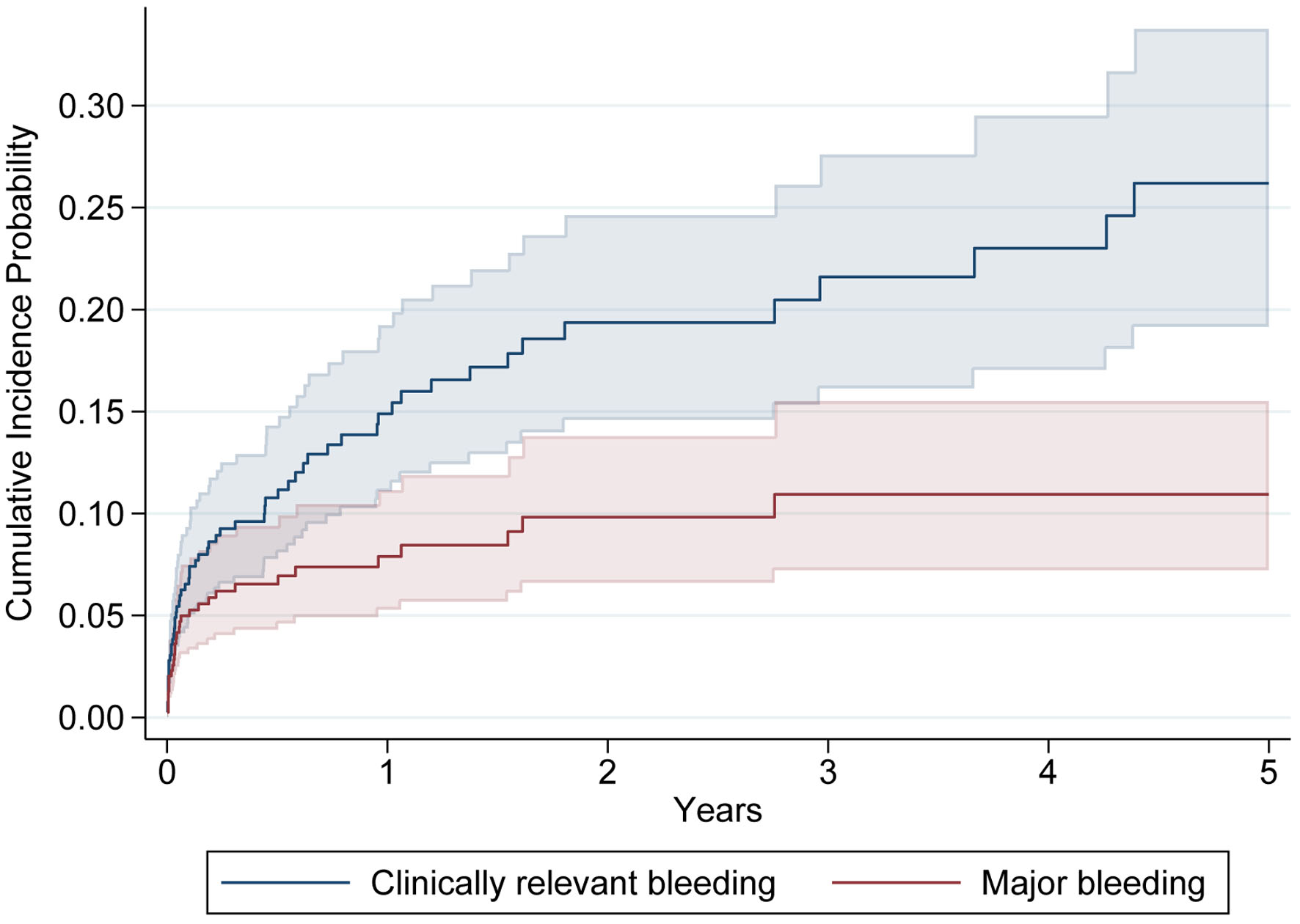 Click for large image | Figure 1. Cumulative incidence of clinically relevant bleeding and major bleeding estimated using the Aalen–Johansen method. For CRB, death was treated as a competing event. For MB, CRNMB and death were treated as competing events; therefore, the cumulative incidence represents the probability of experiencing MB as the first bleeding event. Shaded areas represent the 95% confidence intervals. CRB: clinically relevant bleeding; MB: major bleeding; CRNMB: clinically relevant non-major bleeding. |
The median time to first bleeding event was 1.95 months (IQR, 0.33–10.46). Patients who developed MB experienced bleeding earlier than those with CRNMB (median, 0.59 months (IQR, 0.16–4.88) vs. 5.98 months (IQR, 1.20–13.32); P = 0.018).
Most bleeding events occurred in the outpatient setting (40 patients (66.7%)); however, 24 patients (60.0% of outpatient events) subsequently required hospitalization. Gastrointestinal (GI) bleeding was the most common site, including upper GI bleeding in 16 patients (26.7%) and lower GI bleeding in nine (15.0%). Skin and musculoskeletal bleeding occurred in 16 patients (26.7%). Central nervous system (CNS) bleeding was observed in six patients (10.0%) and accounted for 18.8% of all MB events.
A total of 28 patients (46.7%) required transfusion of ≥ 2 units of packed red blood cells. Surgical or procedural hemostasis was required in 24 patients (40.0%), more frequently among those with MB than among those with CRNMB (19 (59.4%) vs. 5 (17.9%); P = 0.001). More than half of patients with bleeding (31 (51.7%)) permanently discontinued anticoagulation. Permanent discontinuation occurred in 20 patients (62.5%) with MB and 11 (39.3%) with CRNMB, although the difference was not statistically significant (P = 0.120). Among patients with MB, 14 (43.8%) received a specific reversal agent.
Detailed characteristics of bleeding events and their management are summarized in Table 4 and Supplementary Materials 2 and 3 (jocmr.elmerjournals.org).
Click to view | Table 4. Clinical Characteristics of Patients With Clinically Relevant Bleeding |
Predictors of CRB
The results of the univariable and multivariable competing-risk regression analyses for CRB are presented in Table 5.
Click to view | Table 5. Univariable and Multivariable Competing Risk Regression Analysis of Clinically Relevant Bleeding |
In the multivariable model, four independent predictors of CRB were identified. Concomitant antiplatelet therapy was associated with the largest effect size (adjusted sub-distribution hazard ratio (aSHR), 3.48; 95% CI, 1.76–6.90), followed by ECOG performance status ≥ 2 (aSHR, 3.05; 95% CI, 1.34–6.94). BMI < 20 kg/m2 was also independently associated with CRB (aSHR, 2.50; 95% CI, 1.36–4.61), as was age ≥ 65 years (aSHR, 1.97; 95% CI, 1.12–3.45).
Use of non-DOACs was associated with a numerically higher risk of bleeding (aSHR, 1.79; 95% CI, 0.98–3.26), although this did not reach statistical significance.
Multivariable analyses of predictors associated with CRB and MB are presented in Supplementary Material 4 (jocmr.elmerjournals.org).
Mortality
During follow-up, 81 patients (20.5%) in the overall cohort died. Among those who experienced CRB, 18 patients (30.0%) died; however, only one death (5.6% of deaths in the bleeding group) was adjudicated as directly attributable to bleeding.
In multivariable time-dependent Cox proportional hazards analysis for all-cause mortality, both CRNMB and MB were independently associated with an increased risk of death. CRNMB was associated with an adjusted hazard ratio (aHR) of 3.72 (95% CI, 1.55–8.92), whereas MB was associated with a substantially higher risk (aHR, 5.62; 95% CI, 2.91–10.85) (Table 6).
Click to view | Table 6. Univariable and Multivariable Time-Dependent Cox Regression Analysis of All-Cause Mortality |
Recurrent thrombosis
During anticoagulant therapy, six patients (1.5%) developed recurrent venous thrombosis (DVT, n = 2; PE, n = 4). The median time to recurrence was 0.76 years (IQR, 0.02–0.96). The 1-year cumulative incidence, accounting for death and CRB as competing risks, was 1.98% (95% CI, 0.72–4.44). The incidence rate was 1.20 (95% CI, 0.54–2.68) per 100 patient-years over 498.89 patient-years of follow-up.
Sensitivity analysis
After excluding 32 patients who received anticoagulants at less than therapeutic doses, 363 patients remained for the sensitivity analysis. The 1- and 2-year cumulative incidences of CRB were 16.01% (95% CI, 11.80–20.78) and 19.91% (95% CI, 14.77–25.62), respectively. For MB, the 1- and 2-year cumulative incidences of first MB were 8.38% (95% CI, 5.55–11.92) and 10.68% (95% CI, 7.07–15.13), respectively.
Comparisons of predictors of CRB across the multiple-imputation, complete-case, and sensitivity analyses are presented in Supplementary Material 5 (jocmr.elmerjournals.org).
| Discussion | ▴Top |
This study provides real-world data on the incidence and predictors of anticoagulant-associated bleeding in a Thai cohort of patients with VTE. The incidence rate of CRB was 12.02 per 100 patient-years, with first MB and first CRNMB occurring at rates of 6.41 and 5.61 per 100 patient-years, respectively. Using a competing-risk framework with death treated as a competing event, the 1-year cumulative incidence of CRB was 14.89%, with MB accounting for 7.89% during the first year after initiation of anticoagulation. Concomitant antiplatelet therapy was the strongest independent predictor of CRB, followed by poor performance status (ECOG ≥ 2). In time-dependent multivariable Cox proportional hazards analysis, CRNMB was associated with an increased risk of all-cause mortality (aHR, 3.72), whereas MB conferred an even greater mortality risk (aHR, 5.62). These findings highlight the substantial clinical significance of anticoagulant-associated bleeding among Thai patients with VTE.
In the GARFIELD-VTE registry [6], a large international prospective cohort study, the incidence rate of any bleeding among Asian patients was 9.6 per 100 person-years (95% CI, 8.1–11.3), with MB occurring at 3.5 per 100 person-years (95% CI, 2.7–4.6). Although our study demonstrated numerically higher rates of CRB and MB, the overlapping CIs suggest no statistically significant difference. Notably, bleeding rates in VTE appear substantially higher than those reported in AF; a Thai cohort of patients with AF receiving oral anticoagulation reported an incidence rate of any bleeding of 2.37 per 100 patient-years (95% CI, 1.95–2.86) [9].
The relatively high bleeding rates observed in our study may partly reflect differences in patient characteristics, particularly the higher prevalence of active cancer compared with the GARFIELD-VTE Asian cohort (43.5% vs. 19.8%). However, active cancer was not independently associated with bleeding in our analysis, possibly because its effect was captured by other correlated factors, such as poor performance status and comorbidity burden. In addition, as a tertiary-care referral center, our institution is more likely to manage patients with complex clinical conditions who are at intrinsically higher risk of bleeding. Furthermore, the choice of anticoagulant may have been influenced by confounding by indication, as physicians may preferentially prescribe specific anticoagulants according to individual patient characteristics and perceived bleeding risk. Differences in the distribution of primary cancer sites across VTE cohorts may also have contributed to the observed variation in bleeding rates.
In our cohort, both CRB and MB occurred predominantly during the first year of anticoagulation. Beyond 2 years, the cumulative incidence of MB appeared to plateau, whereas CRB continued to increase gradually, suggesting that CRNMB may accumulate over time while MB occurs mainly during the early treatment phase. This pattern is consistent with prior studies demonstrating that bleeding risk is highest during the initial months of anticoagulant therapy [21].
As this was a retrospective study, interpretation of MB events may be challenging because event classification relies on documentation by treating physicians at the time of care. Therefore, we focused primarily on CRB, which combines MB and CRNMB and may provide a more robust outcome measure in retrospective analyses where misclassification between MB and CRNMB can occur.
Overall, the predictors of anticoagulant-associated bleeding identified in our cohort were broadly consistent with those reported in previous studies. In particular, advanced age has been consistently associated with a modest to moderate increase in bleeding risk across multiple studies of patients with VTE receiving anticoagulant therapy [21, 22].
Several factors previously associated with bleeding, including prior bleeding, cancer, CKD, and prior stroke [21–24], were not retained in the final multivariable model, possibly due to collinearity with other covariates. For example, most patients with coronary artery disease (10 of 11) and cerebrovascular disease (12 of 18) in our cohort were receiving concomitant antiplatelet therapy, which likely captured much of the associated bleeding risk. Similarly, CKD is strongly correlated with advanced age and poor performance status, which may have attenuated its independent effect in our analysis.
An important finding of our study was that BMI < 20 kg/m2 was an independent predictor of anticoagulant-associated bleeding. Although low BMI has been recognized as a bleeding risk factor in Asian populations, most evidence derives from studies in AF rather than VTE, and data in VTE remain limited [25–27]. Nevertheless, findings from a Japanese registry have demonstrated significantly higher 5-year cumulative incidences of MB and all-cause mortality among patients with lower body weight [27]. Several mechanisms may explain this association, including higher effective drug exposure, altered pharmacokinetics in individuals with low BMI, and the potential contribution of frailty or poor nutritional status [25, 28].
Given concerns about bleeding risk in Asian populations, reduced anticoagulant dosing is often used in clinical practice [23, 27, 29]. However, prior studies have not consistently demonstrated significant differences in bleeding risk across anticoagulant types or dosing strategies [30–32]. In our study, anticoagulant dosage was not included in the predictive analysis because the number of patients in each dosing category was too small for reliable evaluation.
GI bleeding accounted for a substantial proportion of bleeding events in our cohort. Consistently, concomitant antiplatelet therapy was identified as the strongest predictor of CRB. We did not collect data on proton pump inhibitor (PPI) prophylaxis in our study. PPIs are effective in reducing the risk of GI bleeding but are often underused in clinical practice [33, 34]. Future studies should evaluate the use of PPI prophylaxis in this population, including adherence to guideline recommendations and its potential role in reducing GI bleeding risk [35].
In time-dependent Cox regression analysis, non-DOAC use was associated with an increased risk of mortality. However, this finding should be interpreted with caution given the retrospective design of the study and the potential for confounding by indication. In Thailand, access to DOACs is largely restricted to certain reimbursement schemes, whereas many patients must receive warfarin. In addition, because CAT represented a large proportion of VTE patients in our cohort, LMWH was frequently used, which may also explain the relatively low use of DOACs.
Although only one death was directly attributable to bleeding, the magnitude of the mortality risk following bleeding events was substantial. This finding suggests that bleeding may trigger downstream clinical complications and increased hospitalization, ultimately contributing to worse overall outcomes.
The strengths of this study include a relatively large sample size for evaluating anticoagulant-associated bleeding specifically in patients with VTE. We applied competing-risk analysis to avoid overestimation of the cumulative incidence of CRB. In addition, time-dependent Cox regression was used to minimize immortal time bias. Missing data were handled using MICE, as the missingness pattern was consistent with a missing-at-random assumption, with acceptable imputation performance (fraction of missing information 0.38; relative efficiency > 99%).
This study has several limitations. First, it was conducted at a single tertiary-care referral center using a retrospective design, which may limit the generalizability of the findings and introduce selection bias. Second, missing data were unavoidable, and outcome misclassification may have occurred, particularly for MB events when complete information required to apply the ISTH criteria, such as the precise timing of hemoglobin decline, was unavailable. Third, although multivariable adjustment was performed, residual confounding cannot be excluded. In particular, confounding by indication may have influenced anticoagulant selection, as treatment decisions were made at the discretion of the treating physicians. Furthermore, data on warfarin time in therapeutic range (TTR) and anticoagulant drug levels were available only for a subset of patients and were therefore not included in the analysis.
To evaluate anticoagulant-specific predictors of bleeding, patients were censored at the time of switching to a different anticoagulant class, thereby reflecting the as-treated risk associated with each treatment. However, this approach may have introduced informative censoring. For example, if anticoagulant switching was prompted by early non-major bleeding or other clinical concerns, the subsequent risk of MB associated with the initial anticoagulant may have been underestimated.
Some baseline characteristics, such as smoking status, were inconsistently documented and were therefore missing for a substantial proportion of patients. In addition, several baseline coagulation parameters were not routinely measured before initiation of anticoagulant therapy at our institution. We acknowledge the absence of these baseline variables, which may have limited our ability to adjust for all potential confounders.
Finally, the study population was heterogeneous with respect to anticoagulant regimens, including variations in anticoagulant class and dosing, particularly among DOACs. Consequently, the sample size within individual dosing subgroups was insufficient to permit dose-specific regression analyses. This treatment heterogeneity may also have contributed to residual confounding.
Future studies should validate established bleeding risk prediction tools and compare their performance with newly developed models in prospective, multicenter cohorts. Particular attention should be given to the first 1–2 years after anticoagulant initiation, during which the risks of CRB and MB appear to be highest. In addition, the safety and effectiveness of different anticoagulant classes and dosing strategies should be evaluated prospectively, particularly in Southeast Asian populations, as bleeding risk profiles and treatment responses may differ from those reported in other Asian populations owing to differences in ethnicity, clinical characteristics, and healthcare practices.
In conclusion, anticoagulant-associated bleeding is common among Thai patients with VTE, particularly during the first year of treatment, and is independently associated with increased mortality. Concomitant antiplatelet therapy was the strongest predictor of bleeding, followed by poor ECOG performance status, low BMI (< 20 kg/m2), and advanced age. These findings highlight the importance of careful risk assessment and close monitoring during anticoagulant therapy in this population.
| Supplementary Material | ▴Top |
Suppl 1. Flowchart of patient screening, eligibility assessment, and inclusion in the final analysis.
Suppl 2. Management of clinically relevant bleeding events.
Suppl 3. Anatomical sites of bleeding events categorized by antiplatelet use.
Suppl 4. Multivariable analysis of predictors associated with bleeding outcomes.
Suppl 5. Comparison of predictors of clinically relevant bleeding across multiple-imputation, complete-case, and sensitivity analyses.
Acknowledgments
The authors sincerely thank the staff of the Division of Hematology, Department of Medicine, Phramongkutklao Hospital, for their invaluable support throughout this study. The authors also acknowledge all patients whose clinical data contributed to this research. This study was presented as a poster at the 2026 Congress of the International Society on Thrombosis and Haemostasis (ISTH).
Financial Disclosure
This study was supported by the Department of Medicine, Phramongkutklao Hospital; the Division of Hematology, Department of Medicine, Phramongkutklao Hospital; and the Thai Society of Hematology (TSH).
Conflict of Interest
TT reports receiving honoraria for lectures from Takeda and Sanofi. All other authors declare no conflicts of interest.
Informed Consent
The requirement for informed consent was waived by the Institutional Review Board of Phramongkutklao Hospital due to the retrospective nature of the study.
Author Contributions
All authors contributed to the study conception and design. Material preparation and data collection were performed by TT and PT. Data analysis was performed by TT. The first draft of the manuscript was written by TT and PT. All authors commented on previous versions of the manuscript and approved the final manuscript.
Data Availability
The datasets generated during and/or analyzed during the current study are available from the corresponding author on reasonable request.
AI Use Declaration
During the preparation of this manuscript, the authors used ChatGPT (OpenAI) and Gemini (Google) to assist with grammar correction and language refinement. After using these tools, the authors reviewed and edited the content as necessary and take full responsibility for the final version of the manuscript. The AI tools were not used for data collection, statistical analysis, or drawing clinical conclusions.
Abbreviations
AF: atrial fibrillation; aHR: adjusted hazard ratio; aSHR: adjusted subdistribution hazard ratio; BMI: body mass index; CAT: cancer-associated thrombosis; CI: confidence interval; CKD: chronic kidney disease; CNS: central nervous system; CRB: clinically relevant bleeding; CRNMB: clinically relevant non-major bleeding; CTPA: computed tomography pulmonary angiography; CTV: computed tomography venography; DOAC: direct oral anticoagulant; DVT: deep vein thrombosis; ECOG: Eastern Cooperative Oncology Group; EMR: electronic medical record; FMI: fraction of missing information; GI: gastrointestinal; ICD-10: International Classification of Diseases, Tenth Revision; ICH-GCP: International Conference on Harmonisation Good Clinical Practice; IQR: interquartile range; IRB: Institutional Review Board; ISTH: International Society on Thrombosis and Haemostasis; LMWH: low-molecular-weight heparin; MB: major bleeding; MCAR: missing completely at random; MICE: multiple imputation by chained equations; NSAID: nonsteroidal anti-inflammatory drug; OS: overall survival; PE: pulmonary embolism; PPI: proton pump inhibitor; REDCap: Research Electronic Data Capture; RVI: relative increase in variance; SD: standard deviation; TTR: time in therapeutic range; VKA: vitamin K antagonist; VTE: venous thromboembolism
| References | ▴Top |
- Watson C, Saaid H, Vedula V, Cardenas JC, Henke PK, Nicoud F, Xu XY, et al. Venous thromboembolism: review of clinical challenges, biology, assessment, treatment, and modeling. Ann Biomed Eng. 2024;52(3):467-486.
doi pubmed - Naess IA, Christiansen SC, Romundstad P, Cannegieter SC, Rosendaal FR, Hammerstrom J. Incidence and mortality of venous thrombosis: a population-based study. J Thromb Haemost. 2007;5(4):692-699.
doi pubmed - Klok FA, Huisman MV. How I assess and manage the risk of bleeding in patients treated for venous thromboembolism. Blood. 2020;135(10):724-734.
doi pubmed - Wang KL, Yap ES, Goto S, Zhang S, Siu CW, Chiang CE. The diagnosis and treatment of venous thromboembolism in asian patients. Thromb J. 2018;16:4.
doi pubmed - Shen AY, Yao JF, Brar SS, Jorgensen MB, Chen W. Racial/ethnic differences in the risk of intracranial hemorrhage among patients with atrial fibrillation. J Am Coll Cardiol. 2007;50(4):309-315.
doi pubmed - Angchaisuksiri P, Goto S, Farjat AE, Fryk H, Bang SM, Chiang CE, Jing ZC, et al. Venous thromboembolism in Asia and worldwide: Emerging insights from GARFIELD-VTE. Thromb Res. 2021;201:63-72.
doi pubmed - Yamashita Y, Morimoto T, Toyota T, Shiomi H, Makiyama T, Ono K, Kimura T. Asian patients versus non-Asian patients in the efficacy and safety of direct oral anticoagulants relative to vitamin K antagonist for venous thromboembolism: A systemic review and meta-analysis. Thromb Res. 2018;166:37-42.
doi pubmed - Winijkul A, Kaewkumdee P, Yindeengam A, Lip GYH, Krittayaphong R. Clinical outcomes of patients with atrial fibrillation who survived from bleeding event: the results from COOL-AF Thailand registry. Thromb Haemost. 2024;124(11):991-1002.
doi pubmed - Krittayaphong R, Winijkul A, Methavigul K, Sairat P, Investigators C. The rate of clinical outcomes in atrial fibrillation according to antithrombotic strategy: the COOL-AF registry. Cardiovasc Ther. 2022;2022:5797257.
doi pubmed - Srikajornlarp S, Amnueypol M, Vathesatogkit P, Numthavaj P, Ungkanont A, Likittanasombat K, Pattanaprateep O, et al. Effectiveness and safety of direct oral anticoagulants in thai patients with atrial fibrillation: a real-world retrospective cohort study. Clin Appl Thromb Hemost. 2022;28:10760296221130058.
doi pubmed - Liang Y, Yang Q, Zhu J, Eikelboom J. Bleeding risk in Asian patients: potential for thrombin amplification pathway blockade using factor XI inhibitors. JACC Asia. 2024;4(2):163-165.
doi pubmed - Khorana AA, Noble S, Lee AYY, Soff G, Meyer G, O'Connell C, Carrier M. Role of direct oral anticoagulants in the treatment of cancer-associated venous thromboembolism: guidance from the SSC of the ISTH. J Thromb Haemost. 2018;16(9):1891-1894.
doi pubmed - Angchaisuksiri P, Atichartakarn V, Aryurachai K, Archararit N, Rachakom B, Atamasirikul K, Tiraganjana A. Risk factors of venous thromboembolism in thai patients. Int J Hematol. 2007;86(5):397-402.
doi pubmed - Kaatz S, Ahmad D, Spyropoulos AC, Schulman S, Subcommittee on Control of A. Definition of clinically relevant non-major bleeding in studies of anticoagulants in atrial fibrillation and venous thromboembolic disease in non-surgical patients: communication from the SSC of the ISTH. J Thromb Haemost. 2015;13(11):2119-2126.
doi pubmed - Schulman S, Kearon C. Definition of major bleeding in clinical investigations of antihemostatic medicinal products in non-surgical patients. J Thromb Haemost. 2005;3(4):692-694.
doi pubmed - Martin KA, Lancki N, Kreuziger LB, Li C, Eyster ME, Sanfilippo K, Woller SC, et al. DOAC compared with warfarin for VTE in low weight patients: a retrospective cohort study conducted through the VENUS network. Thromb Res. 2023;229:146-148.
doi pubmed - Boriani G, Kirchhof P, de Souza JAG, Steffel J, Koretsune Y, Chao TF, Weiss T, et al. Impact of weight/BMI on clinical and bleeding events in 26 805 atrial fibrillation patients on edoxaban from the Global ETNA-AF Registry. Eur J Prev Cardiol. 2025.
doi pubmed - Alikhan R, Gomez K, Maraveyas A, Noble S, Young A, Thomas M, British Society for H. Cancer-associated venous thrombosis in adults (second edition): A British Society for Haematology Guideline. Br J Haematol. 2024;205(1):71-87.
doi pubmed - Ortel TL, Neumann I, Ageno W, Beyth R, Clark NP, Cuker A, Hutten BA, et al. American Society of Hematology 2020 guidelines for management of venous thromboembolism: treatment of deep vein thrombosis and pulmonary embolism. Blood Adv. 2020;4(19):4693-4738.
doi pubmed - Bursac Z, Gauss CH, Williams DK, Hosmer DW. Purposeful selection of variables in logistic regression. Source Code Biol Med. 2008;3:17.
doi pubmed - den Exter PL, Woller SC, Robert-Ebadi H, Masias C, Morange PE, Castelli D, Hansen JB, et al. Management of bleeding risk in patients who receive anticoagulant therapy for venous thromboembolism: Communication from the ISTH SSC Subcommittee on Predictive and Diagnostic Variables in Thrombotic Disease. J Thromb Haemost. 2022;20(8):1910-1919.
doi pubmed - Paramo JA. Prediction and treatment of bleeding in patients under anticoagulant treatment. Med Clin (Barc). 2021;156(1):20-25.
doi pubmed - Vichaidit K, Chantrathammachart P, Niparuck P, Puawilai T, Angchaisuksiri P, Boonyawat K. Reduced- versus full-dose anticoagulants for the extended treatment of cancer-associated venous thromboembolism in Thai patients. Res Pract Thromb Haemost. 2025;9(1):102643.
doi pubmed - Mahe I, Chapelle C, Girard P, Carrier M, Palomares LJ, Samama CM, Helfer H, et al. Predictors of clinically relevant bleeding during extended anticoagulation for cancer-associated venous thromboembolism (API-CAT): a post-hoc analysis of a randomised, non-inferiority trial. Lancet Haematol. 2026;13(1):e41-e48.
doi pubmed - Park CS, Choi EK, Kim HM, Lee SR, Cha MJ, Oh S. Increased risk of major bleeding in underweight patients with atrial fibrillation who were prescribed non-vitamin K antagonist oral anticoagulants. Heart Rhythm. 2017;14(4):501-507.
doi pubmed - Lee SR, Choi EK, Jung JH, Park SH, Han KD, Oh S, Lip GYH. Body mass index and clinical outcomes in asian patients with atrial fibrillation receiving oral anticoagulation. Stroke. 2021;52(2):521-530.
doi pubmed - Kaneda K, Yamashita Y, Morimoto T, Amano H, Takase T, Hiramori S, Kim K, et al. Influence of low body weight on long-term clinical outcomes in patients with venous thromboembolism: From the COMMAND VTE registry. Thromb Res. 2021;198:26-33.
doi pubmed - Chen A, Stecker E, B AW. Direct oral anticoagulant use: a practical guide to common clinical challenges. J Am Heart Assoc. 2020;9(13):e017559.
doi pubmed - Chong DT, Andreotti F, Verhamme P, Dalal J, Uaprasert N, Wang CC, On YK, et al. Direct oral anticoagulants in asian patients with atrial fibrillation: consensus recommendations by the Asian Pacific Society of Cardiology on Strategies for Thrombotic and Bleeding Risk Management. Eur Cardiol. 2021;16:e23.
doi pubmed - Diaz AB, Chow J, Hoo FK, Keong GLC, Venketasubramanian N, Rey N, Rogelio G, et al. Risk of gastrointestinal bleeding in Asian patients receiving oral anticoagulants for stroke prevention in atrial fibrillation. Drugs Context. 2024;13.
doi pubmed - Lee MC, Liao CT, Feng IJ, Yu T, Chang WT, Shih MF, Su HC, et al. Recurrent thromboembolism, bleeding, and mortality in Asian patients with venous thromboembolism receiving different oral anticoagulants: A nationwide analysis. Medicine (Baltimore). 2022;101(37):e30412.
doi pubmed - Tsai ML, Lee CH, Hsieh MJ, Chen SW, Chang SH, Tseng CN, Chu PH, et al. A comparison among nonvitamin K antagonist oral anticoagulants in asian patients with venous thromboembolism: a multi-institutional study. J Clin Med. 2022;11(23).
doi pubmed - Kurlander JE, Gu X, Scheiman JM, Haymart B, Kline-Rogers E, Saini SD, Kaatz S, et al. Missed opportunities to prevent upper GI hemorrhage: The experience of the Michigan Anticoagulation Quality Improvement Initiative. Vasc Med. 2019;24(2):153-155.
doi pubmed - Ray WA, Chung CP, Murray KT, Smalley WE, Daugherty JR, Dupont WD, Stein CM. Association of oral anticoagulants and proton pump inhibitor cotherapy with hospitalization for upper gastrointestinal tract bleeding. JAMA. 2018;320(21):2221-2230.
doi pubmed - Abrignani MG, Lombardo A, Braschi A, Renda N, Abrignani V. Proton pump inhibitors and gastroprotection in patients treated with antithrombotic drugs: A cardiologic point of view. World J Cardiol. 2023;15(8):375-394.
doi pubmed
This article is distributed under the terms of the Creative Commons Attribution 4.0 International License (CC BY 4.0), which permits unrestricted use, distribution, and reproduction in any medium, including commercial use, provided the original work is properly cited.
Journal of Clinical Medicine Research is published by Elmer Press Inc.