| Journal of Clinical Medicine Research, ISSN 1918-3003 print, 1918-3011 online, Open Access |
| Article copyright, the authors; Journal compilation copyright, J Clin Med Res and Elmer Press Inc |
| Journal website https://jocmr.elmerjournals.com |
Original Article
Volume 18, Number 12, December 2026, pages 945-953

Carvedilol Versus Metoprolol Use and Hyperkalemia in Adults With Reduced Kidney Function
Bei Bei Huanga, b  , Hang Xua
aDepartment of Nephrology, Shenzhen Pingshan Hospital of Southern Medical University (Shenzhen Pingshan People’s Hospital), Shenzhen, Guangdong 518118, China
bCorresponding Author: Bei Bei Huang, Department of Nephrology, Shenzhen Pingshan Hospital of Southern Medical University (Shenzhen Pingshan People’s Hospital), Shenzhen, Guangdong 518118, China
Manuscript submitted September 18, 2026, accepted November 10, 2026, published online November 27, 2026
Short title: β-Blockers and Hyperkalemia
doi: https://doi.org/10.14740/jocmr6735
| Abstract | ▴Top |
Background: Hyperkalemia is common in adults with reduced kidney function, and β-blocker receptor selectivity may influence potassium handling. Direct comparative data for carvedilol and metoprolol are limited. We compared the prevalence of hyperkalemia among current users of these agents with reduced kidney function.
Methods: We conducted an active-comparator cross-sectional analysis of six National Health and Nutrition Examination Survey (NHANES) cycles from 2007 to 2018 among adults aged ≥ 20 years with an estimated glomerular filtration rate (eGFR) of 15–< 60 mL/min/1.73 m2 who were current users of carvedilol or metoprolol. The primary outcome was serum potassium ≥ 5.0 mmol/L. Propensity-score overlap weights were combined with NHANES examination weights, and survey-weighted modified Poisson regression estimated prevalence ratios (PRs).
Results: The analysis included 612 participants (435 metoprolol and 177 carvedilol users), of whom 48 met the primary hyperkalemia definition. Overlap-weighted hyperkalemia prevalence was 13.2% with carvedilol and 6.4% with metoprolol (PR 2.07; 95% CI, 1.08–3.97; P = 0.029), an absolute difference of 6.8 percentage points (95% CI, 0.1–13.5). Multiple imputation produced a similar estimate (PR 2.05; 95% CI, 1.14–3.69).
Conclusions: Among adults with reduced kidney function, current carvedilol use was associated with a higher prevalence of hyperkalemia than current metoprolol use. Longitudinal studies are needed to determine whether potassium changes differ after initiation of the two drugs.
Keywords: Hyperkalemia; Carvedilol; Metoprolol; Reduced kidney function; NHANES
| Introduction | ▴Top |
Hyperkalemia becomes more common as kidney function declines and is further promoted by diabetes, heart failure, and drugs that interfere with the renin-angiotensin-aldosterone system [1–3]. Many adults with reduced kidney function also require several cardiorenal therapies, making medication-level differences in potassium handling clinically relevant.
β-blockade can raise serum potassium by limiting β2 adrenergic stimulation of cellular potassium uptake [4]. Metoprolol is relatively β1 selective, whereas carvedilol blocks both β1 and β2 receptors and also antagonizes α1 receptors. In the SELECT trial, the potassium response to terbutaline indicated greater β2 blockade with carvedilol than with metoprolol across the doses studied [5]. Case reports have linked both agents to hyperkalemia in patients with impaired kidney function [6, 7], but direct comparative data on potassium outcomes during routine use remain limited.
We therefore compared current carvedilol and metoprolol users with an estimated glomerular filtration rate (eGFR) of 15–< 60 mL/min/1.73 m2 across six National Health and Nutrition Examination Survey (NHANES) cycles. Because the two agents are used for overlapping cardiovascular indications, we used an active-comparator design with propensity-score overlap weighting to improve balance in measured characteristics [8]. We hypothesized that hyperkalemia would be more prevalent among carvedilol users.
| Materials and Methods | ▴Top |
Study design and data source
We conducted an active-comparator cross-sectional analysis of six consecutive NHANES cycles, from 2007–2008 through 2017–2018. NHANES uses a complex, multistage probability design to sample the noninstitutionalized civilian US population and combines household interviews, standardized examinations, laboratory testing, and prescription medication data [9, 10].
Ethical approval and informed consent
The NHANES protocols were approved by the National Center for Health Statistics (NCHS) Ethics Review Board, and all participants provided informed consent. This secondary analysis used publicly available, deidentified data and involved no additional participant contact or data collection. The analysis was conducted in accordance with the ethical principles of the Declaration of Helsinki.
Study population and β-blocker exposure
Adults aged ≥ 20 years were eligible if serum creatinine and potassium were available and eGFR was ≥ 15 and < 60 mL/min/1.73 m2. eGFR was calculated with the 2021 Chronic Kidney Disease Epidemiology Collaboration (CKD-EPI) creatinine equation without a race coefficient [11]. Current medication use was ascertained during the household interview, which recorded prescription drugs taken in the preceding month. Blood was collected at the subsequent Mobile Examination Center visit [9, 10]. Carvedilol and metoprolol exposure was identified from exact generic-name records. Participants using both target drugs or another systemic β-blocker were excluded. Fixed-dose products containing metoprolol and a thiazide diuretic were also excluded from the metoprolol group because the accompanying diuretic can affect serum potassium. Study size was determined by the number of participants meeting these prespecified eligibility criteria in the six included NHANES cycles.
Outcomes
The primary outcome was hyperkalemia at the NHANES examination, defined as serum potassium ≥ 5.0 mmol/L. Secondary outcomes were serum potassium > 5.1 mmol/L, serum potassium ≥ 5.5 mmol/L, and serum potassium analyzed as a continuous variable. The ≥ 5.5 mmol/L threshold was an exploratory secondary outcome. Operational definitions are summarized here (Supplementary Material 1, jocmr.elmerjournals.com).
Covariates
The propensity-score model included age, sex, race/ethnicity, NHANES cycle, eGFR, log-transformed urine albumin-to-creatinine ratio (UACR), body mass index, systolic blood pressure, diabetes, hypertension, self-reported heart failure, self-reported cardiovascular disease, angiotensin-converting enzyme inhibitor or angiotensin receptor blocker use, mineralocorticoid receptor antagonist use, loop-diuretic use, thiazide-type diuretic use, prescription nonsteroidal anti-inflammatory drug use, potassium prescription, and total prescription medication count. Diabetes was defined by self-reported physician diagnosis, hemoglobin A1c (HbA1c) ≥ 6.5%, or fasting glucose ≥ 126 mg/dL after at least 8 h of fasting. Hypertension was defined by self-reported physician diagnosis or mean measured blood pressure ≥ 130/80 mm Hg. Cardiovascular disease included self-reported heart failure, coronary heart disease, angina, myocardial infarction, or stroke. Prescription indication data were available for 2013–2018 and were used in a sensitivity analysis. Medication duration and recorded prescription indications are summarized here (Supplementary Material 2, jocmr.elmerjournals.com).
Statistical analysis
The six NHANES cycles were pooled. Mobile Examination Center weights were divided by six, with survey strata and primary sampling units retained for design-based estimation [9, 10]. We estimated the propensity for carvedilol use with sampling-weighted logistic regression. Carvedilol users received an overlap weight of 1 minus the propensity score, and metoprolol users received the propensity score; these weights were then multiplied by the pooled NHANES examination weight [12]. Covariate balance was assessed with absolute standardized mean differences (SMDs), using 0.10 as the balance threshold.
For the primary analysis, survey-weighted modified Poisson regression with a log link estimated the prevalence ratio (PR) for serum potassium ≥ 5.0 mmol/L in the overlap population [13]. We also calculated overlap-weighted group prevalences and the absolute prevalence difference. A second modified Poisson model used the same combined weights and adjusted for age, eGFR, heart failure, diabetes, angiotensin-converting enzyme inhibitor or angiotensin receptor blocker use, mineralocorticoid receptor antagonist use, loop and thiazide-type diuretic use, and serum bicarbonate. The conventional multivariable logistic model used NHANES examination weights and adjusted for age, sex, race/ethnicity, survey cycle, eGFR, log-transformed UACR, body mass index, diabetes, heart failure, cardiovascular disease, the same medication classes, and serum bicarbonate. For these two models, absolute prevalence differences were obtained by averaging predicted prevalences for each drug over the covariate distribution under the corresponding weights. Secondary outcomes also included the two alternative thresholds and mean serum potassium.
The primary analysis used complete cases for variables in the propensity-score model. Covariate missingness before complete-case restriction is shown here (Supplementary Material 3, jocmr.elmerjournals.com). Missing covariates were addressed in a sensitivity analysis using multiple imputation by chained equations with 20 imputations [14]. Propensity scores and overlap weights were re-estimated in each imputed data set, and log PRs and prevalence differences were pooled separately with Rubin’s rules. Descriptive sensitivity analyses restricted the sample by eGFR, heart failure, renin-angiotensin system inhibitor use, potassium prescription, and β-blocker duration; tested interactions with heart failure and renin-angiotensin system inhibitor use; repeated the analysis after omitting each NHANES cycle in turn; and incorporated prescription indications in 2013–2018. Propensity scores and overlap weights were re-estimated for each restricted analysis. We also repeated eligibility screening with fixed-dose metoprolol and thiazide combinations included in the metoprolol definition. The fragility index was the number of metoprolol users reclassified from noncases to cases required for the unweighted Fisher’s exact test to reach P ≥ 0.05. All tests were two-sided. Secondary confidence intervals (CIs) and P values were reported without adjustment for multiple comparisons. Analyses were performed in R version 4.4.1 [14, 15]. E-values were calculated for the primary PR and the PRs by self-reported heart failure status, using each point estimate and the confidence limit closest to 1 [16].
| Results | ▴Top |
Study population and covariate balance
Among 2,863 adults prescribed carvedilol or metoprolol, 2,550 had both serum creatinine and potassium measurements, and 714 had an eGFR of 15 to < 60 mL/min/1.73 m2. After excluding three users of both drugs and 12 users of another systemic β-blocker, 699 were eligible. Of these, 87 had missing propensity-score covariates, leaving 612 participants for analysis (435 metoprolol and 177 carvedilol users) (Fig. 1a). Forty-eight participants met the primary hyperkalemia definition, including 26 metoprolol users and 22 carvedilol users.
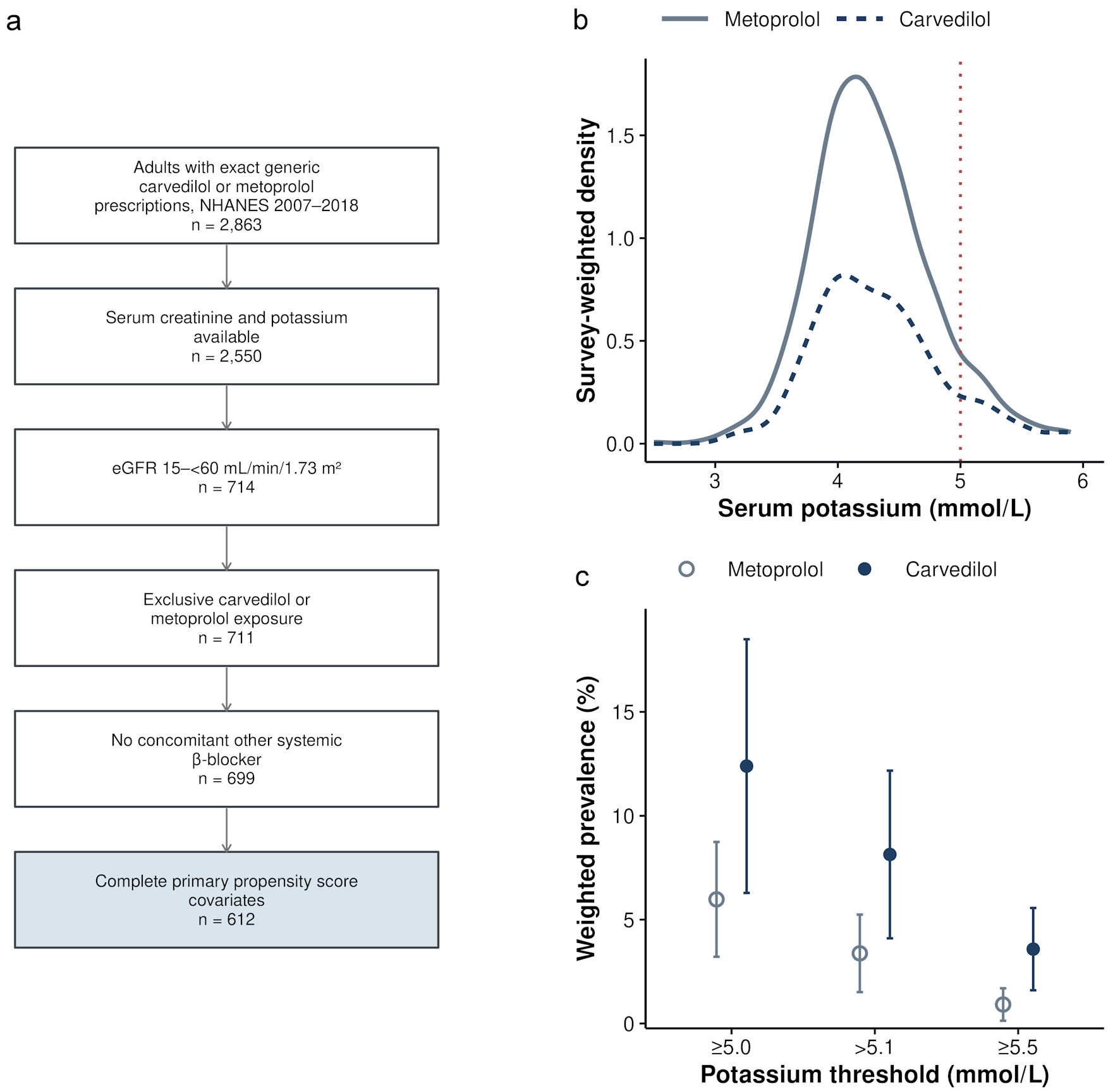 Click for large image | Figure 1. Cohort selection and serum potassium by current β-blocker use. Among 714 adults with eGFR 15 to < 60 mL/min/1.73 m2 in NHANES 2007–2018, three used both study drugs and 12 used another systemic β-blocker. Of the remaining 699, 87 had incomplete propensity-score covariates, leaving 612 for analysis (a). Serum potassium distributions (b) and the prevalence of serum potassium ≥ 5.0, > 5.1, and ≥ 5.5 mmol/L with 95% CIs (c) use NHANES examination weights before overlap weighting. The vertical line in (b) marks the primary threshold of 5.0 mmol/L. Open and filled circles in (c) indicate metoprolol and carvedilol, respectively. CI: confidence interval; eGFR: estimated glomerular filtration rate; NHANES: National Health and Nutrition Examination Survey. |
Before weighting, carvedilol users had more heart failure (52.6% vs. 24.1%), cardiovascular disease (74.4% vs. 56.9%), and diabetes (56.3% vs. 40.4%) than metoprolol users. They also more often used mineralocorticoid receptor antagonists (14.3% vs. 6.9%) and loop diuretics (49.3% vs. 29.3%) and had slightly lower mean eGFR (44.9 vs. 46.5 mL/min/1.73 m2) (Table 1). The maximum absolute SMD was 0.59 before weighting and < 0.001 after overlap weighting (Fig. 2a and Supplementary Material 3, jocmr.elmerjournals.com). Propensity-score distributions before and after overlap weighting are shown here (Supplementary Material 4, jocmr.elmerjournals.com).
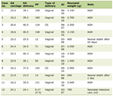 Click to view | Table 1. Baseline Characteristics by Current β-Blocker Use Before Overlap Weighting |
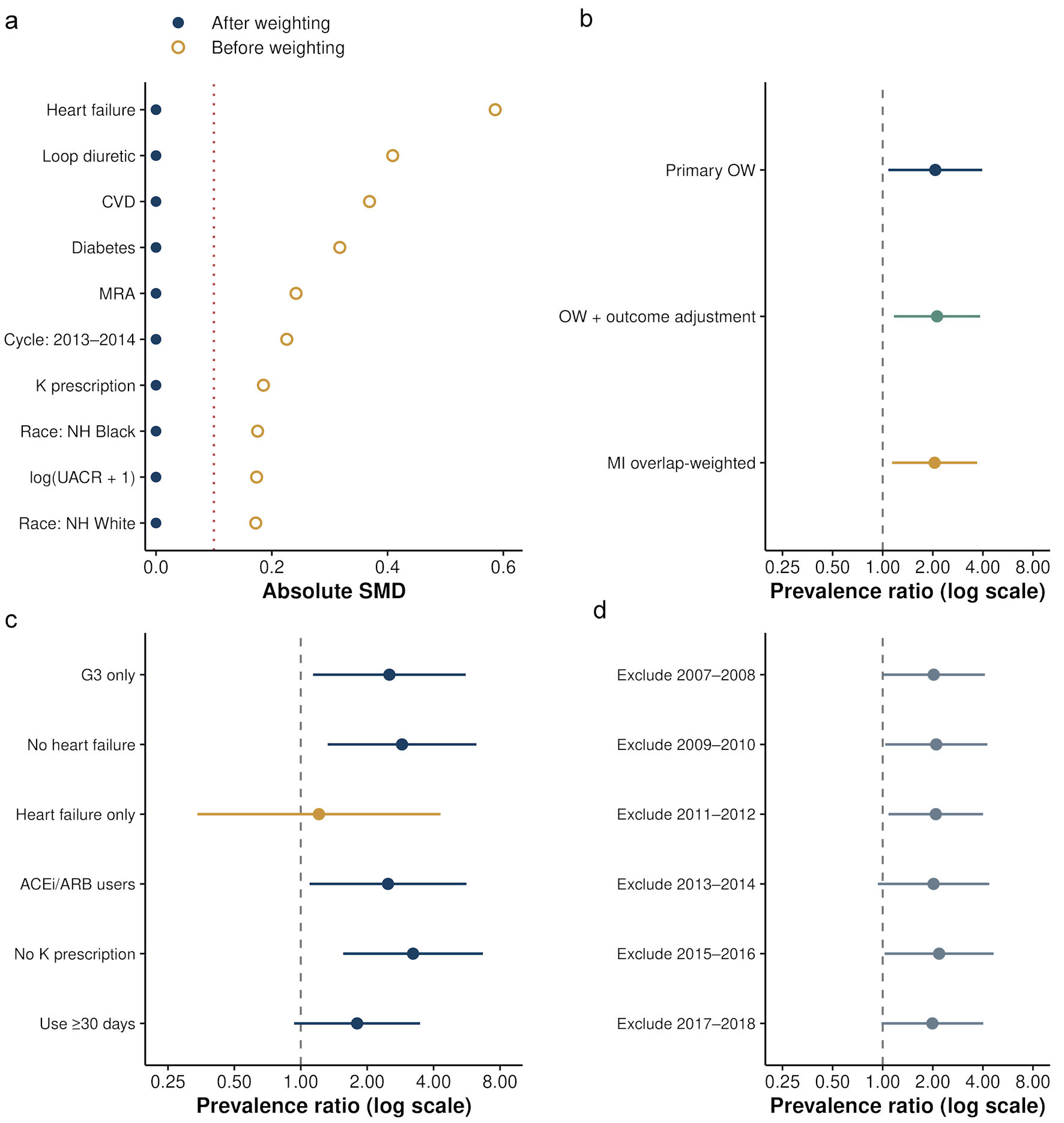 Click for large image | Figure 2. Covariate balance and sensitivity analyses of prevalent hyperkalemia. Among current carvedilol or metoprolol users with eGFR 15 to < 60 mL/min/1.73 m2 in NHANES 2007–2018, covariate balance is shown before and after propensity-score overlap weighting for the 10 terms with the greatest initial imbalance (a). The balance threshold was an absolute SMD of 0.10. PRs with 95% CIs compare carvedilol with metoprolol use for serum potassium ≥ 5.0 mmol/L in the primary analysis, the model with additional outcome adjustment and the multiple-imputation analysis (b), as well as in descriptive restrictions (c) and leave-one-cycle-out analyses (d). Propensity scores and overlap weights were re-estimated for each restriction and cycle omission. ACEi: angiotensin-converting enzyme inhibitor; ARB: angiotensin receptor blocker; CI: confidence interval; CVD: cardiovascular disease; eGFR: estimated glomerular filtration rate; G3: eGFR 30 to < 60 mL/min/1.73 m2; K: potassium; MI: multiple imputation; MRA: mineralocorticoid receptor antagonist; NH: non-Hispanic; NHANES: National Health and Nutrition Examination Survey; OW: overlap weighting; PR: prevalence ratio; SMD: standardized mean difference; UACR: urine albumin-to-creatinine ratio. |
Potassium outcomes
Before overlap weighting, survey-weighted hyperkalemia prevalence was 12.4% among carvedilol users and 6.0% among metoprolol users (Fig. 1c). Mean serum potassium was 4.33 and 4.24 mmol/L, respectively (Fig. 1b). After weighting, hyperkalemia prevalence was 13.2% (95% CI, 6.8–19.5%) with carvedilol and 6.4% (95% CI, 3.0–9.7%) with metoprolol. The corresponding PR was 2.07 (95% CI, 1.08–3.97; P = 0.029), with an absolute prevalence difference of 6.8 percentage points (95% CI, 0.1–13.5; P = 0.046) (Table 2, Fig. 2b). The data did not establish whether hyperkalemia began before or after drug initiation. The unweighted comparison had a fragility index of 6 (Fisher’s exact P = 0.012 before and P = 0.058 after reclassification).
Click to view | Table 2. Serum Potassium Outcomes by β-Blocker Use After Propensity-Score Overlap Weighting |
Additional outcome adjustment after overlap weighting gave a PR of 2.12 (95% CI, 1.17–3.85; P = 0.014) and a standardized prevalence difference of 7.0 percentage points (Table 2, Fig. 2b). The conventional survey-weighted logistic model gave a prevalence odds ratio of 2.73 (95% CI, 1.34–5.55; P = 0.006) and a standardized prevalence difference of 7.8 percentage points (Table 2). At serum potassium > 5.1 mmol/L, the PR was 2.02 (95% CI, 1.05–3.92; P = 0.036) and the prevalence difference was 4.8 percentage points. Twelve participants had serum potassium ≥ 5.5 mmol/L. At this threshold, the PR was 3.97 (95% CI, 1.44–10.93; P = 0.008) and the prevalence difference was 3.5 percentage points (Table 2 and Supplementary Material 5A, jocmr.elmerjournals.com). The overlap-weighted mean difference in serum potassium was 0.09 mmol/L (95% CI, −0.04 to 0.21; P = 0.161) (Table 2).
Sensitivity analyses
Multiple imputation produced a PR of 2.05 (95% CI, 1.14–3.69; P = 0.017) and a prevalence difference of 6.8 percentage points (Fig. 2b and Supplementary Material 6, jocmr.elmerjournals.com). In descriptive analyses by self-reported heart failure status, the PR was 2.88 (95% CI, 1.32–6.26) among participants without heart failure and 1.21 (95% CI, 0.34–4.30) among those with heart failure. The corresponding prevalence differences were 10.1 and 1.6 percentage points. Interaction P values were 0.100 for heart failure and 0.640 for renin-angiotensin system inhibitor use. The restriction PRs are shown in Figure 2c. The corresponding prevalence differences and interaction estimates are provided here (Supplementary Material 6, jocmr.elmerjournals.com).
In the 2013–2018 cycles, adding recorded prescription indications to the propensity-score model gave a PR of 2.14 (95% CI, 0.93–4.92; P = 0.072) and a prevalence difference of 8.3 percentage points (Supplementary Materials 5B, 6, jocmr.elmerjournals.com). Leave-one-cycle-out PRs ranged from 1.99 to 2.18 (Fig. 2d and Supplementary Material 6, jocmr.elmerjournals.com). Five NHANES participants reported using a fixed-dose metoprolol and thiazide combination. None met the study eligibility criteria, so including these products in the metoprolol definition yielded the same cohort and estimates (Supplementary Material 6, jocmr.elmerjournals.com). E-values for the primary PR and its lower confidence limit were 3.56 and 1.37, respectively. The corresponding E-values were 5.20 and 1.98 without heart failure and 1.71 and 1.00 with heart failure.
| Discussion | ▴Top |
Among adults with reduced kidney function, current carvedilol use was associated with approximately twice the prevalence of serum potassium ≥ 5.0 mmol/L compared with current metoprolol use after overlap weighting, corresponding to an absolute difference of 6.8 percentage points. The association was similar after additional adjustment in the outcome model and after multiple imputation. By contrast, the overlap-weighted mean potassium difference was 0.09 mmol/L. The group contrast was more apparent in the proportion with potassium at or above 5.0 mmol/L than in the mean concentration. For patients already close to a clinical threshold, even a small difference in potassium concentration could increase the proportion classified as hyperkalemic without materially changing the group mean.
As kidney function declines, renal adaptation helps preserve potassium balance, but the capacity to buffer additional disturbances becomes progressively narrower [17]. β2 adrenergic stimulation promotes potassium uptake into skeletal muscle through sodium-potassium ATPase [18], creating a potential route through which β-blockers with different receptor profiles could influence extracellular potassium when renal excretion is already constrained. In patients receiving dialysis, nonselective β-blockade with propranolol augmented the exercise-related rise in plasma potassium, whereas the response with β1-selective metoprolol was similar to exercise alone [19]. The SELECT trial also demonstrated greater β2 blockade with carvedilol than with metoprolol across the doses studied [5]. Reduced β2-mediated cellular potassium uptake is therefore a biologically coherent explanation for the higher prevalence of threshold-defined hyperkalemia observed with carvedilol. Our analysis did not measure transcellular potassium flux directly, however, so this mechanism should be viewed as an interpretation of the clinical pattern rather than a process demonstrated by the present data.
The available carvedilol-specific evidence does not provide a simple answer. In a randomized crossover study of 17 anuric hemodialysis patients, carvedilol did not augment the potassium rise during moderate exercise compared with placebo [20]. That experiment examined an acute exercise response in patients without kidney potassium excretion, whereas the present analysis captured resting potassium during routine treatment in adults with residual kidney function. The two studies therefore address different physiological questions. At a broader drug-class level, FIDELIO-DKD identified β-blocker use as an independent correlate of treatment-emergent hyperkalemia, together with higher baseline potassium, lower eGFR, and greater albuminuria [21]. Our findings extend that class-level observation by raising an agent-level question: whether β-blockers with different receptor profiles may differ in their association with potassium abnormalities.
Interpretation is also shaped by why a patient receives carvedilol rather than metoprolol. Before weighting, carvedilol users had substantially more heart failure, cardiovascular disease, diabetes, mineralocorticoid receptor antagonist use, and loop-diuretic use, together with slightly lower eGFR. These differences are clinically plausible because carvedilol is often selected in patients with greater cardiovascular disease burden. Overlap weighting achieved close balance in the measured covariates, and the point estimate remained elevated among participants without self-reported heart failure, among renin-angiotensin system inhibitor users, and after recorded prescription indications were added in the 2013–2018 subset. The CI for the indication-adjusted estimate included 1. The descriptive estimate in the heart-failure subgroup was closer to 1 and imprecise, and the interaction test did not establish whether the association differed by heart failure status. Heart-failure phenotype, severity, and left ventricular ejection fraction were unavailable for adjustment. Residual differences in these characteristics could account for part of the higher prevalence among carvedilol users. For the primary PR, the E-value was 3.56 for the point estimate and 1.37 for the lower confidence limit [16]. Less unmeasured confounding would be needed to move the lower confidence limit to 1 than to explain the point estimate. Other head-to-head studies likewise show that carvedilol and metoprolol should not be assumed to represent interchangeable clinical exposures: a large US hemodialysis cohort reported higher mortality and more intradialytic hypotension after carvedilol initiation [22], whereas a later international Dialysis Outcomes and Practice Patterns Study (DOPPS) analysis found no clear difference in mortality between the two agents [23]. These studies concern outcomes other than potassium, but they illustrate how population and indication can modify apparent between-drug differences.
The divergence between threshold-defined hyperkalemia and mean potassium is clinically relevant. A modest rightward shift among patients clustered near a treatment threshold can substantially change the number who cross that threshold while producing little change in the population mean. We observed a similar association at > 5.1 mmol/L. At ≥ 5.5 mmol/L, the relative estimate was larger and the absolute prevalence difference was smaller, at 3.5 percentage points. Only 12 participants reached this level, and the CI for the PR was correspondingly wide. This distinction matters because serum potassium has a U-shaped association with adverse outcomes across kidney function levels [24], and hyperkalemia can lead to dose reduction or discontinuation of therapies with established cardiorenal benefit. In CKD cohorts, discontinuation of renin-angiotensin-aldosterone system inhibitors after hyperkalemia has been associated with higher risks of death and cardiorenal events [25]. For patients whose potassium is already close to a clinically actionable range, the clinical relevance of this association depends on whether elevations persist on repeat testing or lead to treatment changes or clinical events. Those outcomes would inform whether monitoring should differ between the two drugs.
The inference supported by these data is limited to a difference in hyperkalemia prevalence among current users of the two drugs. The household prescription interview preceded the examination blood draw. The data cannot establish whether hyperkalemia began before or after drug initiation. Information on β-blocker dose, formulation, adherence, dosing time, and recent treatment changes was unavailable, which limits assessment of whether differences in β2 blockade contributed to the association. A single potassium measurement is susceptible to within-person variation and pseudohyperkalemia. Clinical hyperkalemia events were not assessed. A single eGFR measurement cannot establish chronicity of reduced kidney function. The analysis also did not account for acute illness, dietary potassium, or several nonprescription influences on potassium balance. Although overlap weighting addressed a broad set of measured differences, residual confounding remains possible. Precision is another constraint: 48 participants met the primary hyperkalemia definition and only 12 had potassium ≥ 5.5 mmol/L. In the unweighted comparison, six outcome reclassifications were enough to cross the 0.05 threshold in Fisher’s exact test (fragility index, 6). Finally, the estimates apply to the US noninstitutionalized population during 2007–2018, before several current cardiorenal treatment patterns became widespread.
The next step should therefore be longitudinal rather than simply a larger cross-sectional comparison. An active-comparator new-user study with potassium measured before initiation of carvedilol or metoprolol and repeatedly after treatment initiation or dose changes could separate treatment-related potassium changes from baseline susceptibility and treatment selection. Capturing dose, formulation, adherence, kidney function, heart-failure phenotype, and concurrent potassium-modifying therapies would further reduce the main uncertainties of the present analysis. Within the limits of the current design, our findings identify a pharmacologically plausible agent-level association that warrants direct longitudinal testing.
| Supplementary Material | ▴Top |
Suppl 1. Operational definitions of key study variables.
Suppl 2. β-blocker use and recorded prescription characteristics.
Suppl 3. Covariate balance and missingness before complete-case restriction.
Suppl 4. Propensity-score distributions before and after overlap weighting.
Suppl 5. Potassium-threshold and prescription-indication sensitivity analyses.
Suppl 6. Sensitivity and interaction analyses of prevalent hyperkalemia.
Acknowledgments
The authors thank the participants and staff of the NHANES and the NCHS for collecting and publicly disseminating the data used in this study.
Financial Disclosure
None to declare.
Conflict of Interest
The authors declare no conflict of interest.
Informed Consent
All participants provided informed consent as part of NHANES.
Author Contributions
BBH contributed to study conception and design, data acquisition, analysis and interpretation, drafting of the manuscript, and critical revision for important intellectual content. HX contributed to data acquisition, analysis and interpretation, drafting, and critical revision of the manuscript. Both authors approved the final manuscript and agree to be accountable for the work.
Data Availability
The NHANES datasets analyzed in this study are publicly available from the NCHS through the NHANES Questionnaires, Datasets, and Related Documentation portal (https://wwwn.cdc.gov/nchs/nhanes/). The analytic code is available from the corresponding author on reasonable request.
AI Use Declaration
During manuscript preparation, ChatGPT (OpenAI) was used for English-language editing. The authors reviewed and edited all output and take full responsibility for the final content.
Abbreviations
ACE: angiotensin-converting enzyme; ARB: angiotensin receptor blocker; BMI: body mass index; CI: confidence interval; CKD: chronic kidney disease; CKD-EPI: Chronic Kidney Disease Epidemiology Collaboration; CVD: cardiovascular disease; DOPPS: Dialysis Outcomes and Practice Patterns Study; eGFR: estimated glomerular filtration rate; HbA1c: hemoglobin A1c; IQR: interquartile range; MRA: mineralocorticoid receptor antagonist; NCHS: National Center for Health Statistics; NHANES: National Health and Nutrition Examination Survey; NSAID: nonsteroidal anti-inflammatory drug; PR: prevalence ratio; SMD: standardized mean difference; UACR: urine albumin-to-creatinine ratio
| References | ▴Top |
- Kidney Disease: Improving Global Outcomes (KDIGO) CKD Work Group. KDIGO 2024 clinical practice guideline for the evaluation and management of chronic kidney disease. Kidney Int. 2024;105(4S):S117-S314.
doi pubmed - Floege J, Frankel AH, Erickson KF, Rtveladze K, Punekar Y, Mir JN, Walters J, et al. The burden of hyperkalaemia in chronic kidney disease: a systematic literature review. Clin Kidney J. 2025;18(5):sfaf127.
doi pubmed - Fu EL, Mastrorilli J, Bykov K, Wexler DJ, Cervone A, Lin KJ, Patorno E, et al. A population-based cohort defined risk of hyperkalemia after initiating SGLT-2 inhibitors, GLP1 receptor agonists or DPP-4 inhibitors to patients with chronic kidney disease and type 2 diabetes. Kidney Int. 2024;105(3):618-628.
doi pubmed - Lundborg P. The effect of adrenergic blockade on potassium concentrations in different conditions. Acta Med Scand Suppl. 1983;672:121-126.
doi pubmed - Zebrack JS, Munger M, Macgregor J, Lombardi WL, Stoddard GP, Gilbert EM. Beta-receptor selectivity of carvedilol and metoprolol succinate in patients with heart failure (SELECT trial): a randomized dose-ranging trial. Pharmacotherapy. 2009;29(8):883-890.
doi pubmed - Hahn L, Hahn M. Carvedilol-induced hyperkalemia in a patient with chronic kidney disease. J Pharm Pract. 2015;28(1):107-111.
doi pubmed - Barold SS, Upton S. Hyperkalemia induced by the sequential administration of metoprolol and carvedilol. Case Rep Cardiol. 2018;2018:7686373.
doi pubmed - Sendor R, Sturmer T. Core concepts in pharmacoepidemiology: Confounding by indication and the role of active comparators. Pharmacoepidemiol Drug Saf. 2022;31(3):261-269.
doi pubmed - Johnson CL, Paulose-Ram R, Ogden CL, Carroll MD, Kruszon-Moran D, Dohrmann SM, Curtin LR. National health and nutrition examination survey: analytic guidelines, 1999-2010. Vital Health Stat 2. 2013;(161):1-24.
pubmed - Chen TC, Clark J, Riddles MK, Mohadjer LK, Fakhouri THI. National Health and Nutrition Examination Survey, 2015-2018: sample design and estimation procedures. Vital Health Stat 2. 2020;184:1-35.
pubmed - Inker LA, Eneanya ND, Coresh J, Tighiouart H, Wang D, Sang Y, Crews DC, et al. New creatinine- and cystatin C-based equations to estimate GFR without race. N Engl J Med. 2021;385(19):1737-1749.
doi pubmed - Li F, Thomas LE, Li F. Addressing extreme propensity scores via the overlap weights. Am J Epidemiol. 2019;188(1):250-257.
doi pubmed - Zou G. A modified poisson regression approach to prospective studies with binary data. Am J Epidemiol. 2004;159(7):702-706.
doi pubmed - van Buuren S, Groothuis-Oudshoorn K. mice: multivariate imputation by chained equations in R. J Stat Softw. 2011;45(3):1-67.
- Lumley T. Analysis of complex survey samples. J Stat Softw. 2004;9(8):1-19.
- VanderWeele TJ, Ding P. Sensitivity analysis in observational research: introducing the E-value. Ann Intern Med. 2017;167(4):268-274.
doi pubmed - Wang Y, Phelps KR, Gemoets DE, Gosmanova EO. Determinants of the serum potassium concentration in chronic kidney disease. Clin Nephrol. 2025;103(1):26-35.
doi pubmed - Palmer BF. Regulation of potassium homeostasis. Clin J Am Soc Nephrol. 2015;10(6):1050-1060.
doi pubmed - Castellino P, Bia MJ, DeFronzo RA. Adrenergic modulation of potassium metabolism in uremia. Kidney Int. 1990;37(2):793-798.
doi pubmed - Nowicki M, Szewczyk-Seifert G, Klimek D, Kokot F. Carvedilol does not modulate moderate exercise-induced hyperkalemia in hemodialysis patients. Clin Nephrol. 2002;57(5):352-358.
doi pubmed - Agarwal R, Joseph A, Anker SD, Filippatos G, Rossing P, Ruilope LM, Pitt B, et al. Hyperkalemia risk with finerenone: results from the FIDELIO-DKD trial. J Am Soc Nephrol. 2022;33(1):225-237.
doi pubmed - Assimon MM, Brookhart MA, Fine JP, Heiss G, Layton JB, Flythe JE. A comparative study of carvedilol versus metoprolol initiation and 1-year mortality among individuals receiving maintenance hemodialysis. Am J Kidney Dis. 2018;72(3):337-348.
doi pubmed - Toye C, Sood MM, Mallick R, Akbari A, Bieber B, Karaboyas A, Guedes M, et al. Comparison of beta-blocker agents and mortality in maintenance hemodialysis patients: an international cohort study. Clin Kidney J. 2024;17(5):sfae087.
doi pubmed - Kovesdy CP, Matsushita K, Sang Y, Brunskill NJ, Carrero JJ, Chodick G, Hasegawa T, et al. Serum potassium and adverse outcomes across the range of kidney function: a CKD Prognosis Consortium meta-analysis. Eur Heart J. 2018;39(17):1535-1542.
doi pubmed - Leon SJ, Whitlock R, Rigatto C, Komenda P, Bohm C, Sucha E, Bota SE, et al. Hyperkalemia-related discontinuation of renin-angiotensin-aldosterone system inhibitors and clinical outcomes in CKD: a population-based cohort study. Am J Kidney Dis. 2022;80(2):164-173.e161.
doi pubmed
This article is distributed under the terms of the Creative Commons Attribution 4.0 International License (CC BY 4.0), which permits unrestricted use, distribution, and reproduction in any medium, including commercial use, provided the original work is properly cited.
Journal of Clinical Medicine Research is published by Elmer Press Inc.