

Dietary Behavior and Risk of Depression: Effects of Ultra-Processed Food and Water Intake in a National Sample of the United States
DOI:
https://doi.org/10.14740/jocmr6448Keywords:
Depression, Ultra-processed food, Hydration, Water intake and diet, Mental health disparitiesAbstract
Background: Diet is increasingly recognized as a modifiable determinant of mental health. High intake of ultra-processed foods (UPFs) can be associated with poor psychological outcomes; however, the protective role of hydration, particularly plain water intake, remains underexplored. We aimed to evaluate the independent and combined associations of UPF and water intake with moderate-to-severe depression among the adult population of the United States (US).
Methods: We analyzed cross-sectional data from the National Health and Nutrition Examination Survey (NHANES) 2021–2023. UPF intake was proxied using the percentage of daily calories from added sugars and categorized into quartiles. Water intake (g/day) was similarly categorized into quartiles. Moderate-to-severe depression was defined as a Patient Health Questionnaire-9 (PHQ-9) score ≥ 10. Survey-weighted logistic regression models assessed associations between diet exposures and depression risk, adjusting for age, sex, and body mass index (BMI). Subgroup, sensitivity, and interaction analyses were conducted.
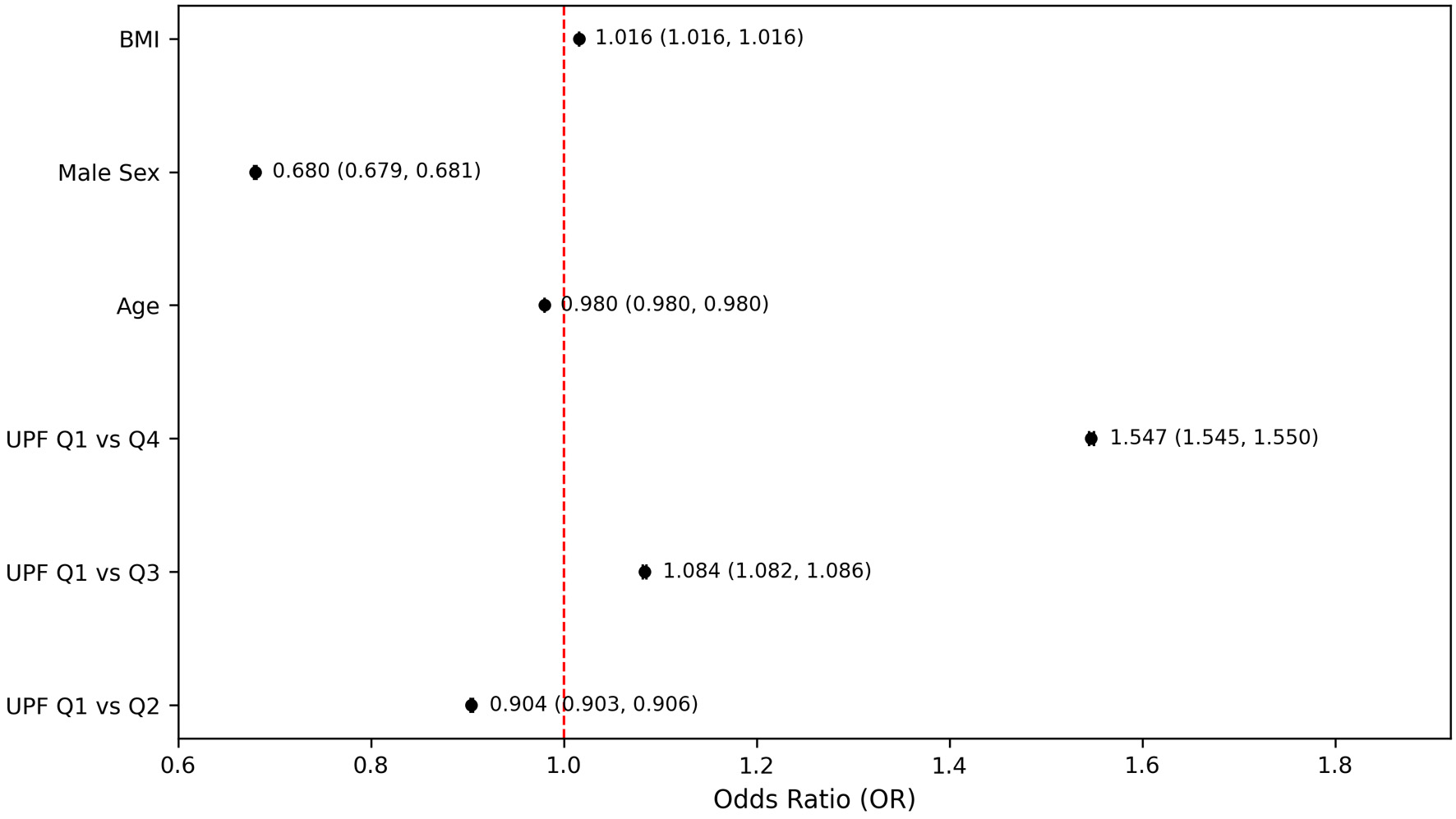
Results: Prevalence of PHQ-9–based depression in our sample was 10.9%. Participants in the highest UPF quartile had higher odds of PHQ-9–based depression when compared to the lowest (odds ratio (OR) = 1.547, 95% confidence interval (CI): 1.545–1.550, P < 0.001). Conversely, those in the highest water intake quartile had lower odds of PHQ-9–based depression (OR = 0.486, 95% CI: 0.486–0.487, P < 0.001). The UPF–water interaction was statistically significant but of minimal clinical relevance. Subgroup analyses showed more severe vulnerabilities to depression from UPF consumption among males, Black and Hispanic individuals, and those with lower educational attainment. A small but statistically significant interaction (β = –0.07, P = 0.017) indicated that water intake modestly attenuated the UPF–depression relationship. Associations persisted after exclusion of extreme BMI values.
Conclusions: Increased UPF intake is associated with higher risk of depression in the US adults while increased water intake confers a protective effect. These findings underscore the need for dietary strategies that simultaneously reduce UPF intake and promote hydration, with tailored interventions for the high-risk groups.
Published
Issue
Section
License
Copyright (c) 2026 The authors

This work is licensed under a Creative Commons Attribution 4.0 International License.