

Inverse Relationship Between Atherogenic Index of Plasma and Serum Endogenous Testosterone Levels as Predictors of Hypogonadism Risk in Male Infertility: A Laboratory-Based Cross-Sectional Study
DOI:
https://doi.org/10.14740/jocmr6717Keywords:
Endogenous testosterone, Hypogonadism risk, Male infertility, High-density lipoprotein, Low-density lipoprotein, LipoproteinsAbstract
Background: Testosterone deficiency and altered lipid profiles frequently coexist, but their clinical relevance in men evaluated for infertility requires careful interpretation. This study examined the association of serum testosterone with high-density lipoprotein (HDL) and low-density lipoprotein (LDL) cholesterol in infertile men and whether these measurements could help identify men at risk of hypogonadism who should be prioritized for hormonal testing.
Methods: This laboratory-based cross-sectional study included 351 men aged 21–63 years evaluated at Thumbay Hospital, Ajman, United Arab Emirates. Participants were categorized into four age groups and selected based on strict inclusion and exclusion criteria to eliminate confounding metabolic and chronic conditions. HDL and LDL cholesterol were measured using a Beckman Coulter analyzer, and serum testosterone was measured by electrochemiluminescence immunoassay on a Cobas e 411 analyzer. Analyses included independent-samples t-tests, chi-square tests, one-way analysis of variance (ANOVA), Pearson correlation and linear regression using SPSS version 26. Statistical significance was set at P < 0.05.
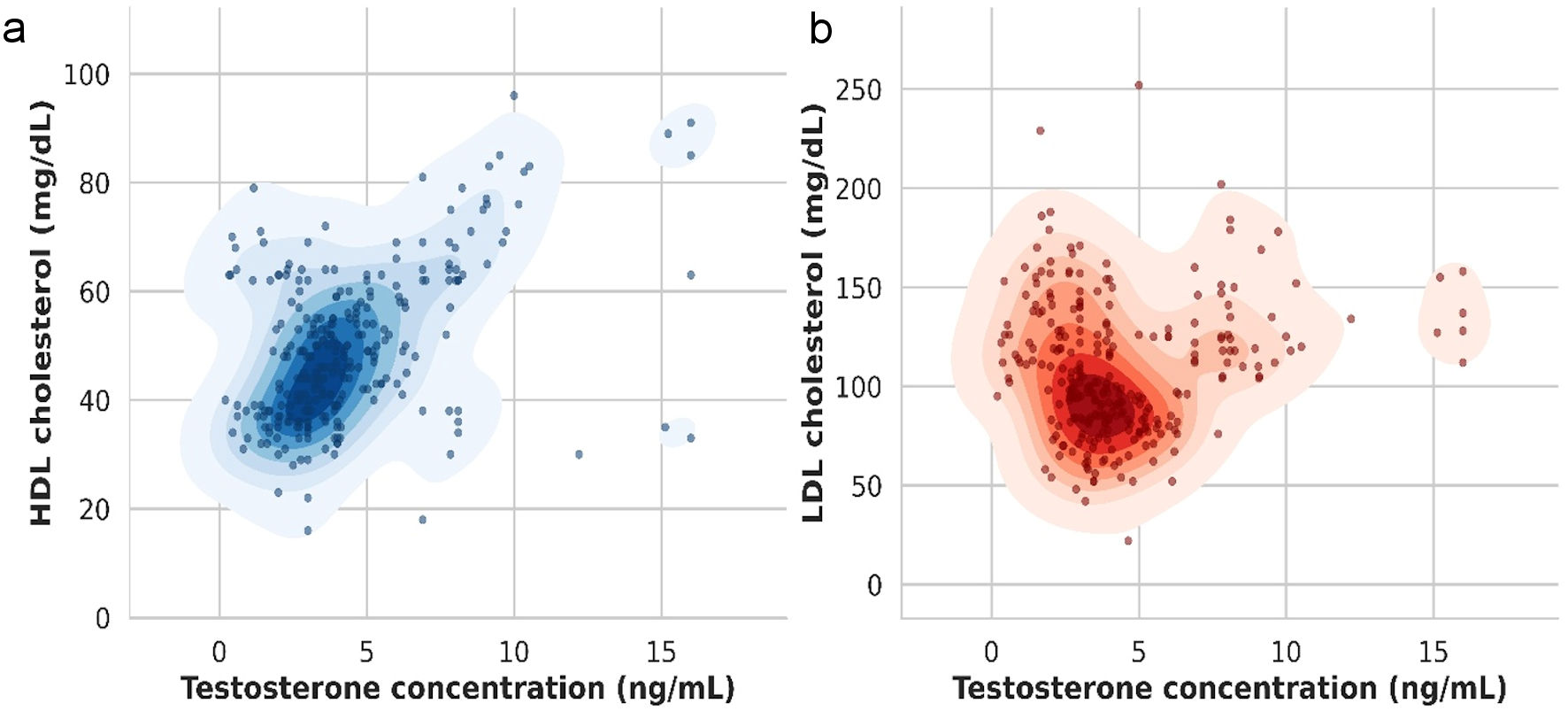
Results: Hypogonadism was identified in 17% of participants. Compared with non-hypogonadal men, hypogonadal men had significantly decreased mean HDL and increased mean LDL concentrations (P < 0.05). Serum testosterone levels differed significantly among lipoprotein categories with higher levels observed in men with high HDL and low LDL concentrations. Among hypogonadal men, decreased HDL and increased LDL levels were significantly associated with more severe testosterone deficiency, and serum testosterone levels showed a weak-to-moderate correlation: a positive correlation with HDL (r = 0.335, P = 0.0) and a negative with LDL (r = -0.361, P = 0.0).
Conclusions: Decreased HDL and increased LDL cholesterol concentrations were associated with weak-to-moderate correlations with lower serum testosterone levels in this cohort of infertile men. Lipid profile measurements should not be used in isolation to diagnose hypogonadism. Prospective studies are warranted to evaluate the clinical utility of lipid profile-based screening and clarify the temporal relationships between dyslipidemia and reduced testosterone levels.
Published
Issue
Section
License
Copyright (c) 2026 The authors

This work is licensed under a Creative Commons Attribution 4.0 International License.