


Significant Associations of Achilles Tendon Thickness With Atherosclerotic Diseases and Atherosclerotic Risk Factors in Non-Familial Hypercholesterolemia Patients: A Cross-Sectional Study
DOI:
https://doi.org/10.14740/jocmr6614Keywords:
Achilles tendon thickness, Atherosclerotic risk factors, Diabetes, Cardiovascular disease, High-density lipoproteinAbstract
Background: Achilles tendon thickness (ATT) is an important diagnostic tool for familial hypercholesterolemia (FH), a highly atherogenic genetic disorder. Although the available evidence remains limited, recent studies have reported associations between ATT and atherosclerotic diseases and their risk factors among non-FH patients. We investigated the relationships among ATT, carotid intima-media thickness (IMT), a marker of systemic atherosclerosis, and atherosclerotic risk factors, including diabetes, dyslipidemia, and atherosclerotic diseases, in non-FH patients.
Methods: This cross-sectional survey was conducted at the National Kohnodai Medical Center, Japan. Patients who underwent ultrasonographic measurements of both ATT and carotid IMT were included. Clinical data were obtained using medical records and included demographic characteristics, anthropometric measurements, blood pressure, comorbidities, and biochemical parameters.
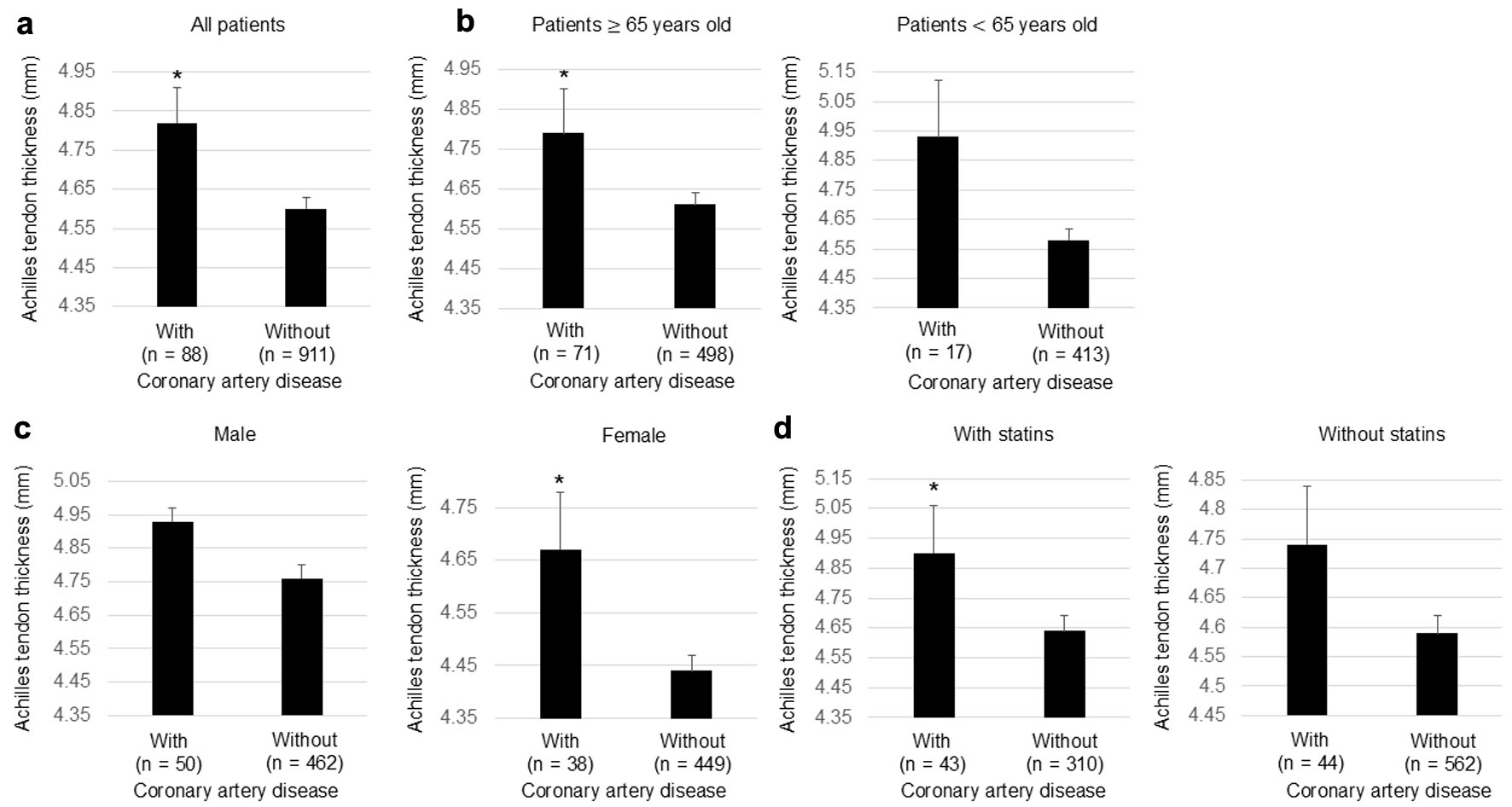
Results: A total of 1,000 patients (512 males, 488 females) were enrolled. The mean age was 65 ± 14 years, the mean body mass index (BMI) was 24.6 ± 4.9 kg/m2, and the mean ATT was 4.6 ± 0.8 mm. ATT was positively correlated with maximal carotid IMT (r = 0.088, P = 0.005), body weight (r = 0.279, P < 0.001), and BMI (r = 0.183, P < 0.001), and inversely correlated with serum levels of high-density lipoprotein-cholesterol (HDL-C) (r = −0.182, P < 0.001). In the multiple regression model that included maximal carotid IMT, BMI, HDL-C, and low-density lipoprotein-cholesterol, the correlations of ATT with maximal carotid IMT, BMI, and HDL-C remained significant; however, the correlation between ATT and maximal carotid IMT was no longer significant in the model added with age. Patients with CAD and carotid artery stenosis had significantly greater ATT than those without such diseases. Similarly, ATT values were higher in patients with diabetes, and those with diabetes and CAD had the highest ATT values.
Conclusion: ATT levels were significantly associated with BMI and dyslipidemia, and were significantly higher in non-FH patients with CAD, carotid artery stenosis, and diabetes than in non-FH patients without such diseases.
Published
Issue
Section
License
Copyright (c) 2026 The authors

This work is licensed under a Creative Commons Attribution 4.0 International License.