

Retinal Artery Occlusion and Incident Dementia in the All of Us Research Program: Detection Bias Calibration with Prespecified Negative-Control Outcomes
DOI:
https://doi.org/10.14740/jocmr6628Keywords:
Retinal artery occlusion, Cerebrovascular disease, Dementia, Negative-control outcomes, Detection biasAbstract
Background: Retinal artery occlusion (RAO) shares vascular pathophysiology with cerebrovascular disease, and its relationship to incident dementia remains unsettled. Reported associations may reflect shared vascular pathology, differential ascertainment along the intensive workup pathways that RAO patients enter, or both. No prior study has calibrated RAO–dementia estimates against prespecified negative-control outcomes spanning distinct ascertainment pathways.
Methods: Among 129,279 All of Us participants aged 50 years or older and free of prevalent dementia (controlled-tier release R2024Q3R9, OMOP common data model), strict RAO was defined by seven verified SNOMED concept identifiers (n = 339). Incident dementia required two or more codes at least 30 days apart (Wilkinson algorithm), with prespecified vascular and Alzheimer subtypes. Cox models used age as timescale with left truncation and time-varying exposure; 1:5 propensity-score matching was the primary confounder-adjusted analysis. Cataract, benign paroxysmal positional vertigo (BPPV), and inguinal hernia were prespecified negative controls for ophthalmology, neurology, and general-contact pathways.
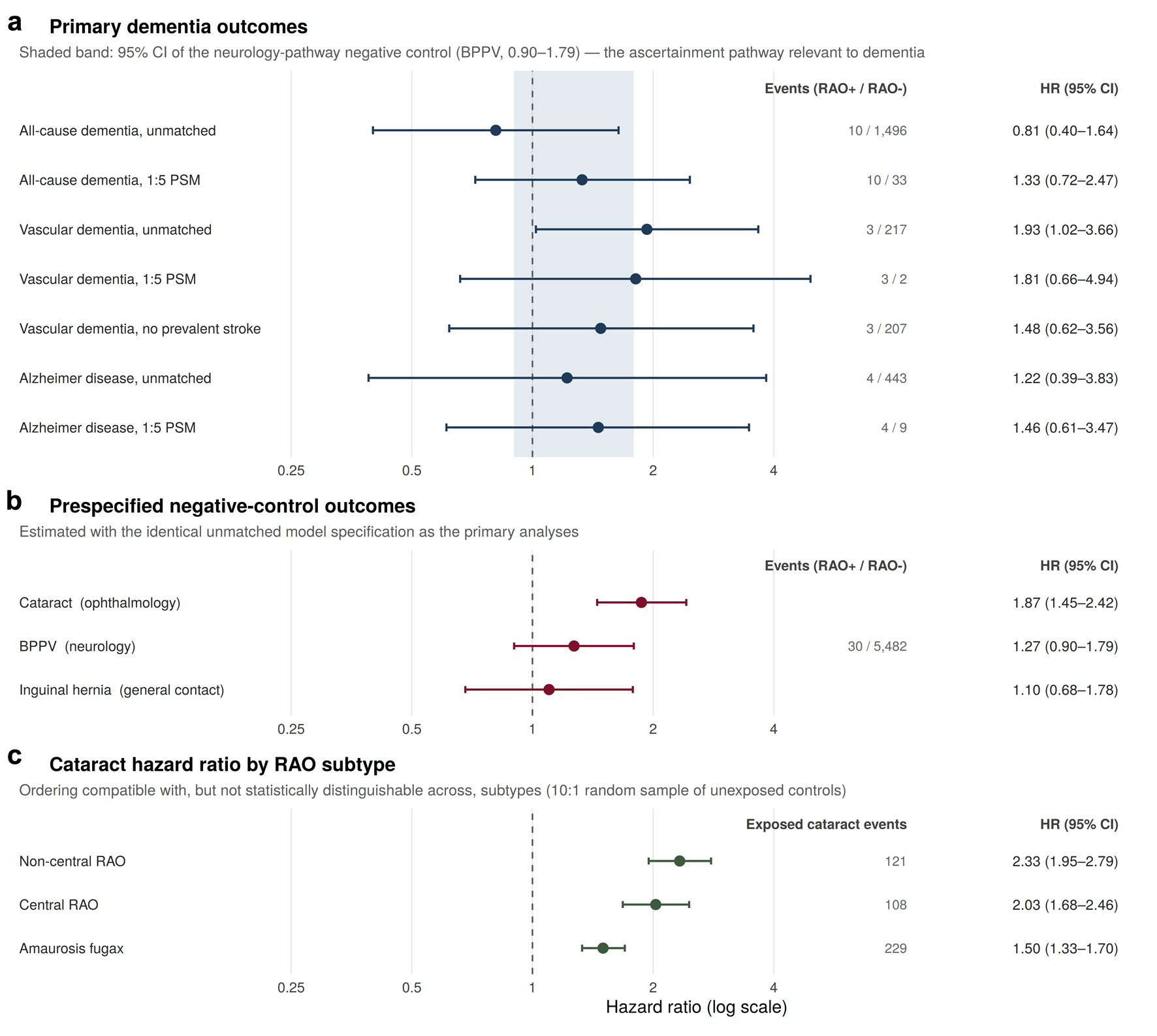
Results: There were 1,506 incident dementia events. RAO was not associated with all-cause dementia (unmatched hazard ratio (HR) 0.81, 95% confidence interval (CI) 0.40–1.64; matched HR 1.33, 95% CI 0.72–2.47; 10 exposed events). The vascular dementia estimate remained elevated but imprecise (unmatched HR 1.93, 95% CI 1.02–3.66; matched HR 1.81, 95% CI 0.66–4.94; 3 exposed events). Cataract was elevated (HR 1.87, 95% CI 1.45–2.42), whereas BPPV (HR 1.27, 95% CI 0.90–1.79) and hernia (HR 1.10, 95% CI 0.68–1.78) were not.
Conclusions: We found no evidence that RAO is independently associated with incident dementia, replicating a large European null finding in a diverse United States cohort. The cohort was underpowered to exclude clinically meaningful effects, particularly for vascular dementia. Detection bias in this dataset was demonstrably pathway-specific, but same-pathway calibration accounts for only part of the residual vascular dementia estimate.
Published
Issue
Section
License
Copyright (c) 2026 The authors

This work is licensed under a Creative Commons Attribution 4.0 International License.