


Clinical Significance of Cardio-Ankle Vascular Index in Stage A/B Heart Failure Patients With Type 2 Diabetes Mellitus
DOI:
https://doi.org/10.14740/jocmr6680Keywords:
Cardio-ankle vascular index, Stage A/B heart failure, Type 2 diabetes mellitus, Cardiac function marker, Skin autofluorescence, Sarcopenia, Glucagon-like peptide-1 receptor agonists, Brain natriuretic peptideAbstract
Background: Heart failure (HF) is a medical condition with a poor prognosis; therefore, it is important to consider treatment strategies from the pre-onset stage, i.e., at stage A/B HF. However, in addition to type 2 diabetes mellitus (T2DM) being a risk factor for HF, it has also been reported that the prognosis of HF is worse among patients with T2DM than among those without it. This cross-sectional study aimed to clarify the clinical significance of the cardio-ankle vascular index (CAVI), an indicator of arterial stiffness, in stage A/B HF patients with T2DM.
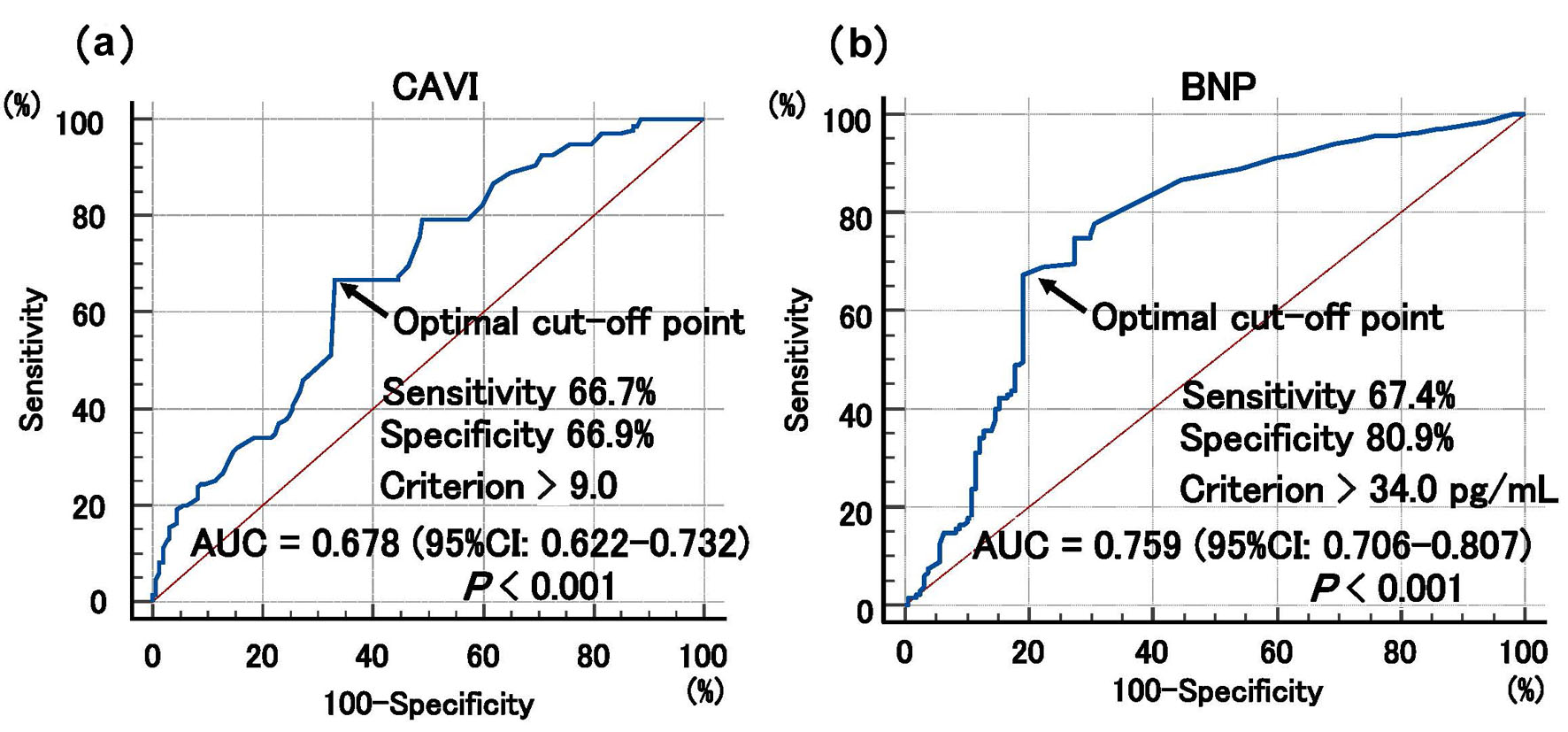
Methods: In total, 292 stage A/B HF patients (113 men and 179 women) with T2DM were enrolled, and the relationships between CAVI and various clinical parameters were evaluated. Furthermore, cut-off values of CAVI and brain natriuretic peptide (BNP) for distinguishing between stage A HF and stage B HF were determined using a receiver operating characteristic curve, and these two markers were employed in combination to distinguish stage A HF from stage B HF.
Results: CAVI was significantly associated with various parameters in this study. Among them, multiple regression analyses indicated that 11 explanatory factors (calf circumference, renin-angiotensin system inhibitors use, E/e' ratio, skin autofluorescence, subendocardial viability ratio, glucagon-like peptide-1 receptor agonists use, age, decreased estimated glomerular filtration rate, coronary artery disease, stage B HF, and sodium-glucose cotransporter 2 inhibitors use) were selected as independent variables for CAVI as the dependent variable (R2 = 0.663). However, CAVI and BNP thresholds for distinguishing stage A HF from stage B HF using the receiver operating characteristic curve were 9.0 and 34.0 pg/mL, respectively. In addition, compared to patients with low CAVI (≤ 9.0) and low BNP (≤ 34.0 pg/mL), those with high levels of both factors (CAVI > 9.0, BNP > 34.0 pg/mL) showed a 9.72-fold higher odds ratio (95% confidence interval: 3.24–19.92, P < 0.001).
Conclusion: CAVI is significantly associated with early-stage HF in T2DM patients. Combining CAVI and BNP may provide a useful screening tool for subclinical HF risk stratification, although further prospective studies are required to elucidate causal relationships.
Published
Issue
Section
License
Copyright (c) 2026 The authors

This work is licensed under a Creative Commons Attribution 4.0 International License.