

Ectopic Adipose Tissue Depots and Metabolic-Associated Fatty Liver Disease: Relationships With Vitamin D
DOI:
https://doi.org/10.14740/jocmr6709Keywords:
Metabolic-associated fatty liver disease, Epicardial adipose tissue, Perivascular adipose tissue, Extra-media thickness, Vitamin DAbstract
Background: The relationship between vitamin D status, adipose tissue dysfunction and the development of metabolic-associated fatty liver disease (MAFLD) is currently under active investigation. This study aimed to assess the associations of serum vitamin D levels with MAFLD and different ectopic adipose tissue depots, including perivascular adipose tissue (PVAT), epicardial adipose tissue (EAT), and hepatic steatosis, and to determine whether these associations persisted after adjustment for potential confounders.
Methods: This cross-sectional study included 303 patients without established atherosclerotic cardiovascular disease (mean age 55 years (40–60)). PVAT was evaluated by measuring the common carotid artery extra-media thickness (CCA EMT) using duplex ultrasound. EAT thickness was assessed by echocardiography. Hepatic steatosis was quantified by measuring the attenuation coefficient (AC) using vibration-controlled transient elastography. Serum 25-OH vitamin D levels were determined using enzyme-linked immunosorbent assay. Patients were stratified into four groups according to serum vitamin D levels. Multivariable logistic and linear regression analyses were performed to account for potential confounders.
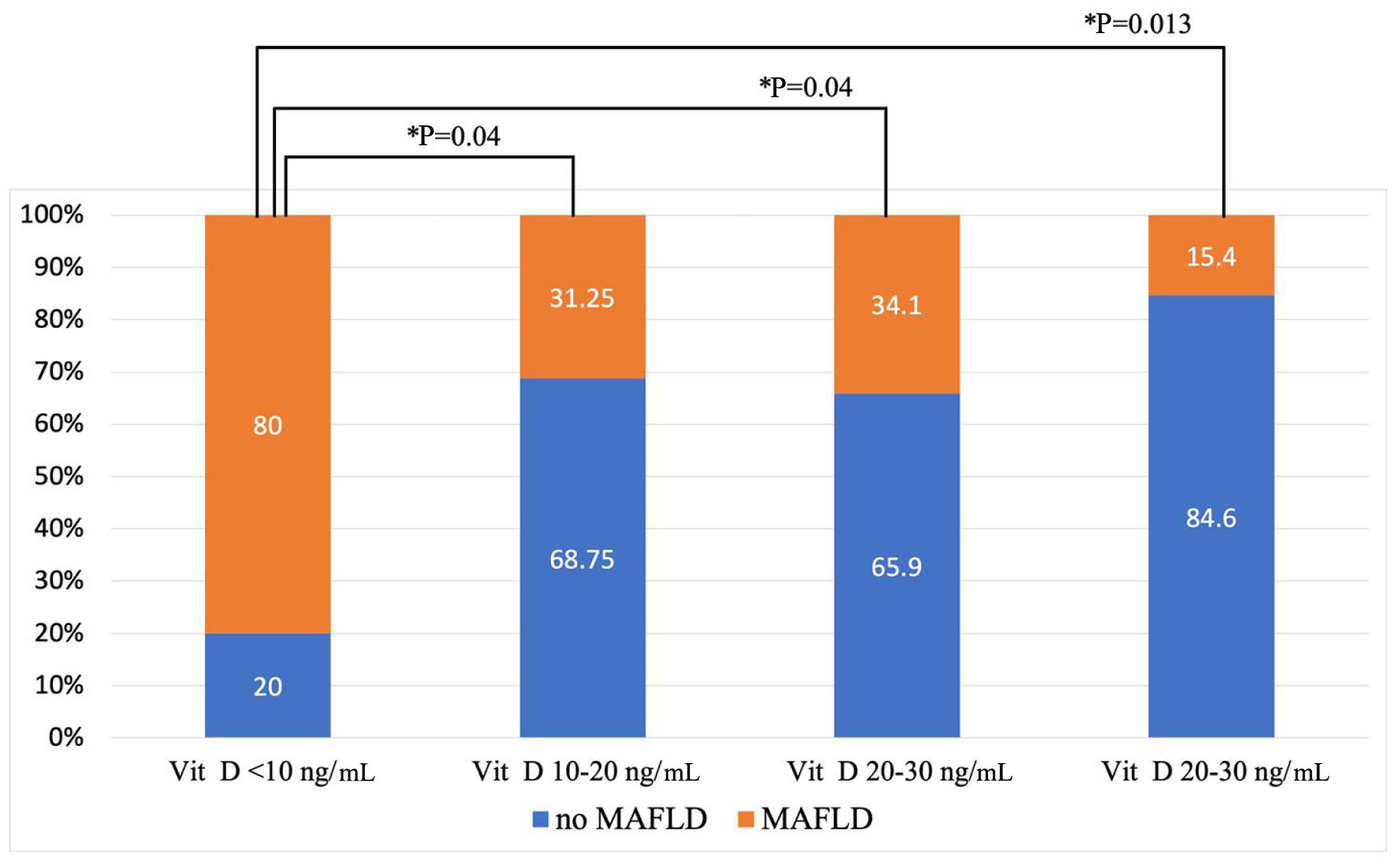
Results: Hepatic steatosis was detected in 125 (41.3%) patients, and MAFLD was detected in 110 (36.3%). Significant inverse correlations were observed between vitamin D levels and AC (r = −0.238) and MAFLD (r = −0.242) (both P < 0.05). General and abdominal obesity were significantly more prevalent in patients with severe vitamin D deficiency compared with those with vitamin D insufficiency and target levels (50% vs. 26.8% and 23%; 70% vs. 29.3% and 23.1%, respectively; P = 0.001 for both). MAFLD was also significantly more frequent in the severe deficiency group than in the deficiency, insufficiency, and target level groups (80% vs. 31.3%, 34.1%, and 15.4%; P = 0.001). In adjusted analyses, the association between 25(OH)D and MAFLD was attenuated after adjustment for body mass index but remained significant in the model including waist circumference. Compared with patients with target vitamin D levels, those with severe deficiency exhibited greater EAT thickness, CCA EMT, and AC (all P < 0.05). Higher 25(OH)D concentrations were independently associated with lower CCA EMT, AC, and EAT thickness after adjustment for age, sex, and adiposity.
Conclusion: Our findings demonstrate associations between vitamin D deficiency, ectopic adipose tissue depots, and MAFLD, suggesting that low vitamin D levels may potentially be linked to adipose tissue dysfunction and cardiometabolic remodeling.
Published
Issue
Section
License
Copyright (c) 2026 The authors

This work is licensed under a Creative Commons Attribution 4.0 International License.