

Assessment of Social Functioning in Patients With Schizophrenia and Their First-Degree Relatives
DOI:
https://doi.org/10.14740/jocmr6431Keywords:
Schizophrenia, First-degree relatives, Social functioning, Japanese version of Social Functioning Scale, Genetic involvementAbstract
Background: Impaired social functioning is one of the core symptoms of schizophrenia (SCZ). Genetic factors have also been implicated in SCZ. To contribute to the discussion on the involvement of genetic factors in SCZ, we evaluated the social functioning of first-degree relatives (FR) of patients with SCZ.
Methods: This was a non-interventional observational study. We examined social functioning using the Japanese version of the Social Functioning Scale (SFS-J) in three groups: SCZ, SCZ FR, and healthy controls (HC). The effects of the groups (SCZ, FR, and HC) on social functioning were evaluated using analysis of covariance. In addition, the cutoff value for SCZ in the SFS total score was calculated, and the trend in the proportion of individuals below the cutoff value in each group was evaluated.
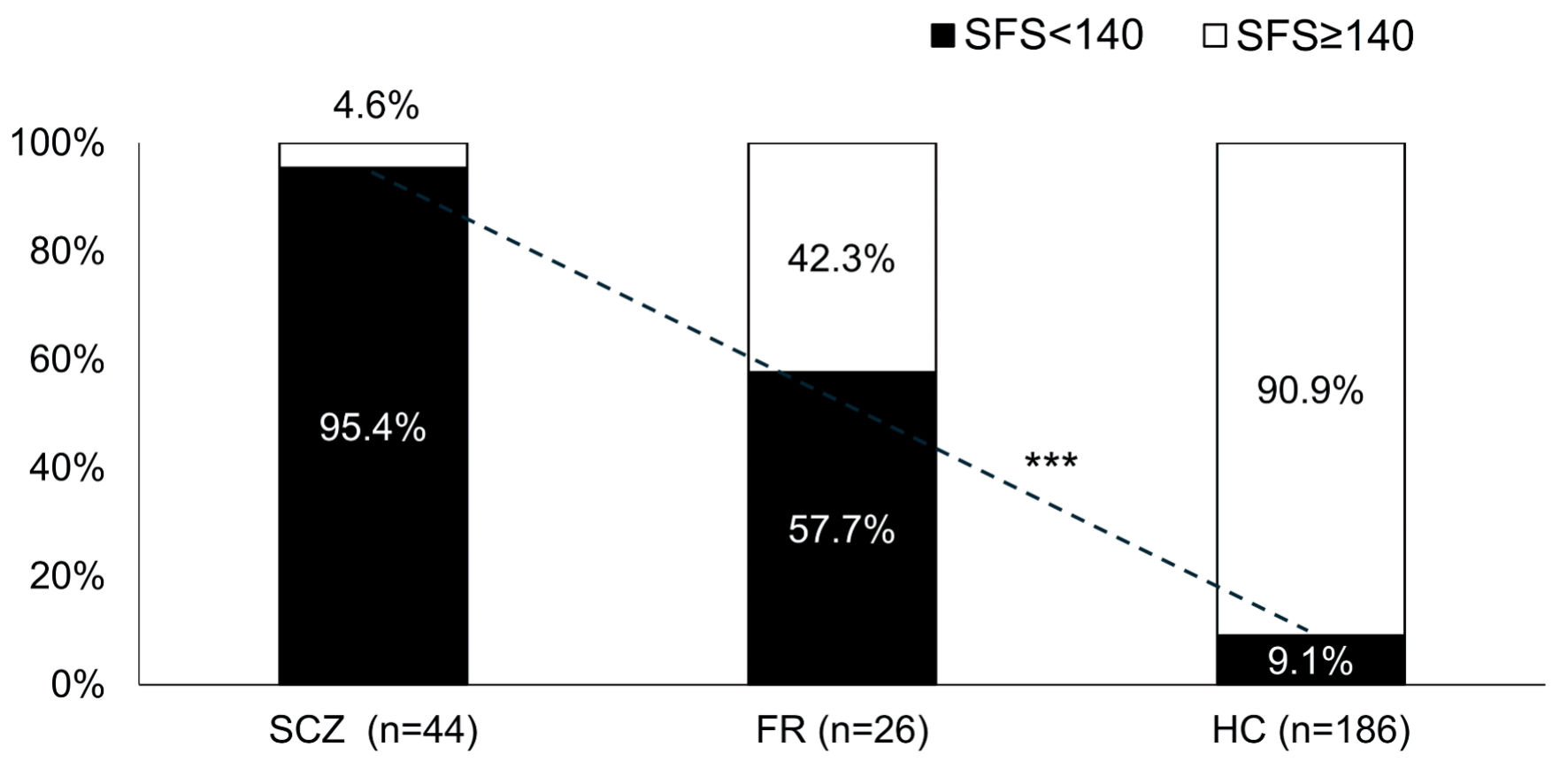
Results: Data from 256 subjects (SCZ (n = 44), FR (n = 26), and HC (n = 186)) were analyzed. Group, years of education, intelligence quotient (IQ), and sex were found to be significant factors affecting SFS total scores. The proportion of SFS scores < 140 (the cutoff value for SCZ) was 9.1% in HC, 57.7% in FR, and 95.4% in SCZ, showing a continuous increase in the proportion of SFS scores < 140 across the three groups (P < 0.0001).
Conclusions: In social functioning assessed by SFS, the score for FR was intermediate between those of SCZ and HC. The results of this study suggest that genetic factors may influence social functioning scores in SCZ and FR.
Published
Issue
Section
License
Copyright (c) 2026 The authors

This work is licensed under a Creative Commons Attribution 4.0 International License.