


A Strong Correlation Between Pleural Fluid and Serum C-Reactive Protein Levels Across a Spectrum of Pleural Effusions
DOI:
https://doi.org/10.14740/jocmr6513Keywords:
C-reactive protein, Pleural effusion, Transudative effusion, Parapneumonic effusion, Malignant effusion, Tuberculous effusion, CorrelationAbstract
Background: C-reactive protein (CRP) is a key acute-phase reactant, primarily synthesized by hepatocytes and released into the bloodstream. Both serum CRP (CRPs) and pleural fluid CRP (CRPpf) have been shown to aid in distinguishing between different types of pleural effusion (PE). As CRPpf is largely derived from CRPs, a strong correlation between their levels is expected. However, limited data exist regarding this relationship, and no previous studies have compared the strength of this correlation across different PE etiologies. This retrospective study aimed to evaluate the correlation between CRPpf and CRPs levels in various PE types and, for the first time, to compare the strength of this association between groups.
Methods: A total of 492 patients with PE were included: 210 with transudative PE (TrPE), 86 with uncomplicated parapneumonic effusion (UCPPE), 60 with complicated parapneumonic effusion (CPPE), 126 with malignant PE (MPE), and 10 with tuberculous PE (TPE). Data are presented as mean ± standard deviation.
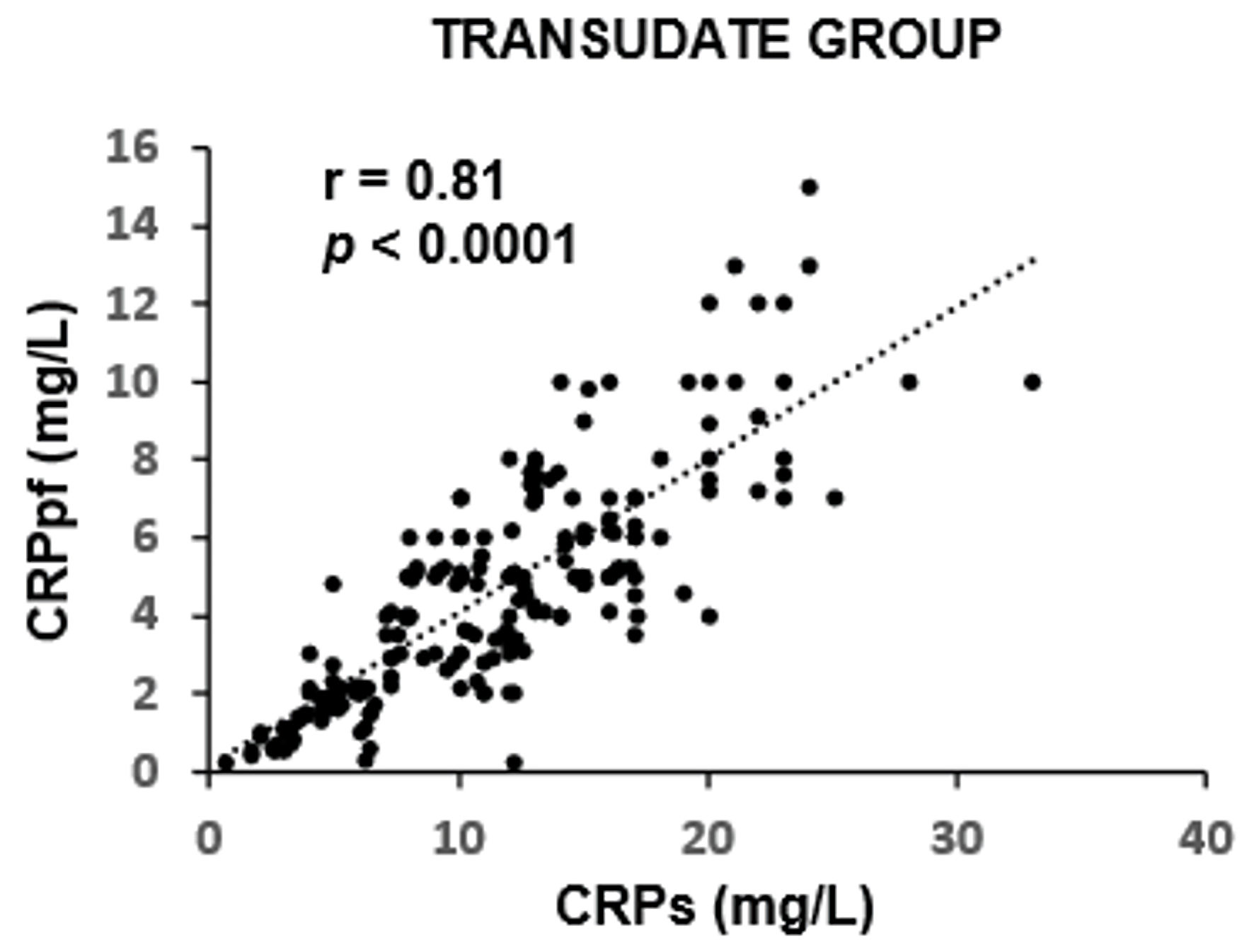
Results: Mean CRPs and CRPpf levels, respectively, were as follows: TrPE (11.3 ± 5.7 mg/L; 4.6 ± 2.8 mg/L), UCPPE (145.3 ± 67.6 mg/L; 58.5 ± 38.5 mg/L), CPPE (302.2 ± 75.6 mg/L; 112 ± 65 mg/L), MPE (56.1 ± 39.5 mg/L; 18.9 ± 13.9 mg/L), and TPE (98.7 ± 12.9 mg/L; 45.0 ± 9.4 mg/L). A statistically significant positive correlation between CRPpf and CRPs was observed in all groups: TrPE (r = 0.81, P < 0.0001), UCPPE (r = 0.90, P < 0.0001), CPPE (r = 0.57, P < 0.0001), MPE (r = 0.81, P < 0.0001), and TPE (r = 0.91, P < 0.0001). The correlation was significantly stronger in the UCPPE and TPE groups compared to the others, while the CPPE group showed the weakest correlation. Correlation strength in the TrPE and MPE groups was intermediate, but significantly greater than that in CPPE.
Conclusions: A strong and statistically significant correlation between CRPpf and CRPs levels exists across all major types of PE. The varying strength of this correlation among groups—highest in UCPPE and TPE, and lowest in CPPE—may reflect the influence of local pleural factors, such as inflammation, cellular injury, local CRP synthesis, and lymphatic drainage impairment, on pleural CRP levels.
Published
Issue
Section
License
Copyright (c) 2026 The authors

This work is licensed under a Creative Commons Attribution 4.0 International License.