Cytochrome P450 2D6 Metabolizer Phenotype Is Associated With Metoprolol Pharmacodynamics But Not With Metoprolol Discontinuation: A Retrospective Cohort Study in the All of Us Research Program
DOI:
https://doi.org/10.14740/jocmr6673Keywords:
CYP2D6, Metoprolol, Pharmacogenomics, Beta-blocker, Medication adherence, Treatment discontinuation, Heart rate, All of Us Research ProgramAbstract
Background: The 2024 Clinical Pharmacogenetics Implementation Consortium (CPIC) guideline assigns a high level of evidence to the association between cytochrome P450 2D6 (CYP2D6) metabolizer status and both metoprolol exposure and heart-rate response and recommends genotype-informed dosing for poor metabolizers. Whether this well-characterized pharmacodynamic effect translates into a patient-level tolerability consequence, differential discontinuation has not been established at population scale in a diverse cohort. The aims of this study were to estimate the association between CYP2D6 metabolizer phenotype and metoprolol discontinuation, and to test whether metabolizer status was associated with the intermediate pharmacodynamic phenotypes (attained heart rate, bradycardia, and attained dose) through which such an effect would plausibly act. Discontinuation is treated throughout as a composite behavioral and clinical endpoint and not as a direct measure of drug tolerability.
Methods: This was a retrospective cohort study that used whole-genome sequencing linked to electronic health records (EHRs) in the All of Us Research Program (Controlled Tier, Curated Data Repository v9). Adult metoprolol users who had a CYP2D6 diplotype call and at least two metoprolol dispensings were included, so that the target population is patients who continued beyond a first fill. CYP2D6 metabolizer phenotype (normal (NM, reference), intermediate (IM), poor (PM), and ultrarapid (UM)) was derived from Cyrius diplotype calls using the CPIC and Dutch Pharmacogenetics Working Group consensus activity-score system, and a collapsed reduced-metabolizer contrast (PM plus IM vs NM) was prespecified. The primary outcome, time to metoprolol discontinuation, was modeled with cause-specific Cox regression that treated death as a competing event and adjusted for age, sex, 10 genetic-ancestry principal components, indication, comorbidity, atrioventricular-nodal cotherapy, CYP2D6 inhibitor exposure, calendar year, and EHR density. The secondary pharmacodynamic outcomes were attained on-treatment heart rate, bradycardia, and attained maximum daily dose. Sensitivity analyses addressed the discontinuation definition, phenoconversion by CYP2D6 inhibitors, and heterogeneity across genetic-ancestry strata.
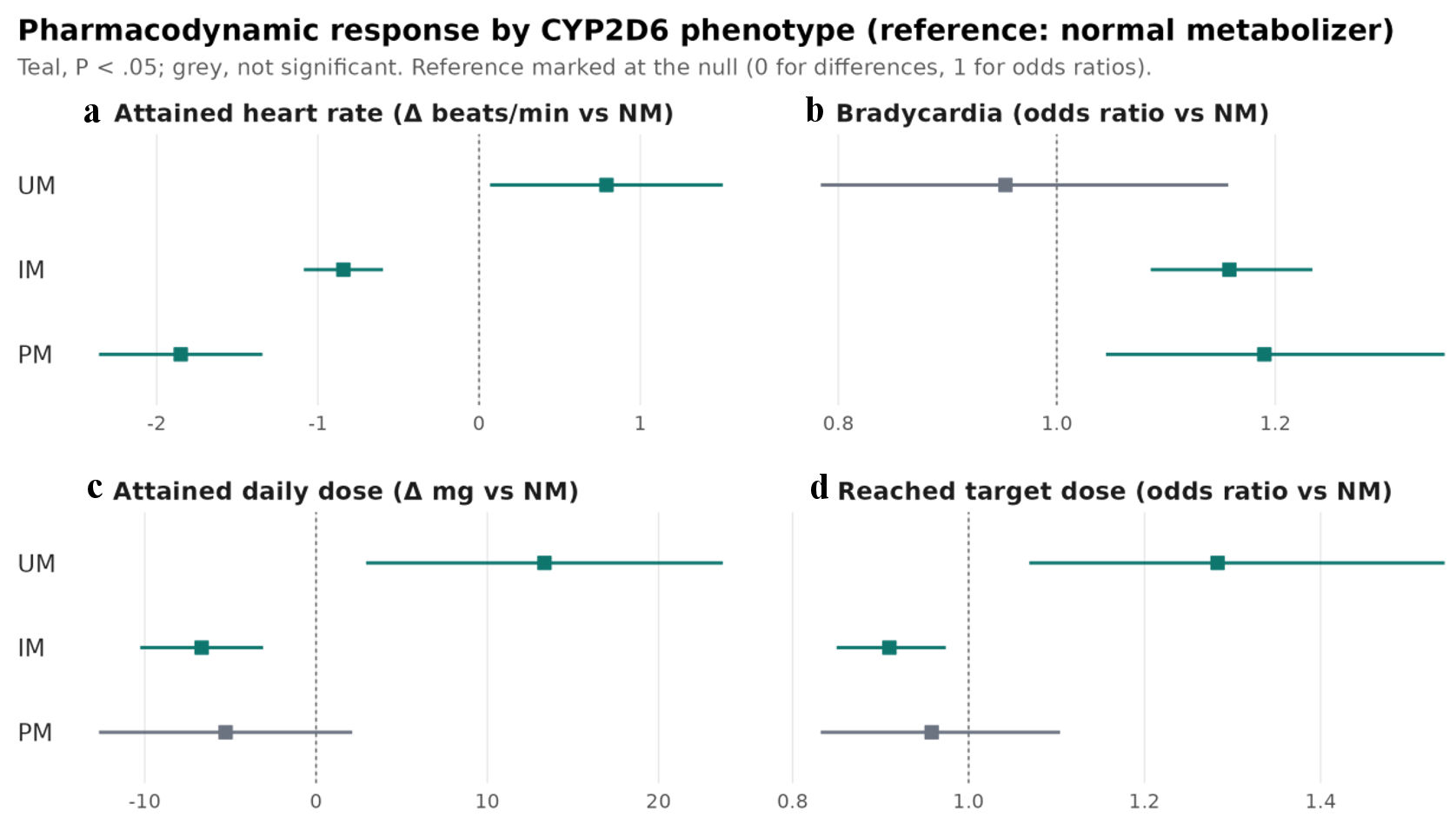
Results: Among 44,485 metoprolol users (PM, 2,470 (5.6%); IM, 16,687 (37.5%); NM, 24,123 (54.2%); UM, 1,205 (2.7%)), 29,999 (67.4%) discontinued and 629 (1.4%) died during follow-up. Metabolizer phenotype was not associated with discontinuation (PM vs NM: cause-specific hazard ratio (HR), 1.04 (95% confidence interval (CI), 0.99–1.09), P = 0.12; IM: 1.01 (0.99–1.03), P = 0.41; UM: 1.01 (0.94–1.08), P = 0.89). The reduced-metabolizer contrast was null (HR, 1.01 (0.99–1.04), P = 0.24). The PM estimate was stable across three discontinuation definitions producing event rates of 67% to 98% (HR range, 1.01–1.04). Reclassifying inhibitor-exposed NM and UM participants for phenoconversion did not change the result (effective reduced-metabolizer vs NM: HR, 1.00 (0.93–1.06), P = 0.91). In the same cohort, the attained heart rate decreased with metabolizing capacity in PM and IM and increased in UM, relative to NM (PM, −1.85 beats per minute (bpm) (−2.36 to −1.34), P < 0.001; IM, −0.84 bpm (−1.09 to −0.60), P < 0.001; UM, +0.79 bpm (0.07 to 1.51), P = 0.03); PM and IM had higher odds of bradycardia (PM, odds ratio (OR), 1.19 (1.05–1.36), P = 0.009; IM, 1.16 (1.09–1.23), P < 0.001); and IM reached a lower attained dose (−6.68 mg (−10.26 to −3.09), P < 0.001) and was less likely to reach target dose (OR, 0.91 (0.85–0.97), P = 0.006).
Conclusions: CYP2D6 metabolizer status produced the expected graded effect on metoprolol pharmacodynamics but was not associated with metoprolol discontinuation in this real-world cohort. The biological basis for pre-emptive CYP2D6-guided metoprolol dosing is supported at the level of measured physiology, yet the downstream behavioral endpoint of continuation appears to be determined by factors that outweigh the genetic signal. Because discontinuation is a composite behavioral and clinical endpoint rather than a direct measure of tolerability, these data do not exclude a genotype effect on adverse drug effects that were not directly ascertained, including symptomatic bradycardia, fatigue, dizziness, and hypotension.
Published
Issue
Section
License
Copyright (c) 2026 The authors

This work is licensed under a Creative Commons Attribution 4.0 International License.