

Targeted Quantitative Polymerase Chain Reaction Analysis of Gut Microbiota and Its Association With Feeding and Mealtime Behavior and Intestinal Permeability in Children With Autism Spectrum Disorder
DOI:
https://doi.org/10.14740/jocmr6687Keywords:
Autism spectrum disorder, Gut microbiome, Feeding and mealtime behavior, Intestinal permeability, Zonulin, Calprotectin, DysbiosisAbstract
Background: Gastrointestinal (GI) symptoms and feeding and mealtime problems are common in children with autism spectrum disorder (ASD). It is important to note that the gut microbiome is a hypothesized mechanism of action, but it is not yet known if specific bacterial profiles and markers of intestinal barrier function predict feeding problems in the target group of ASD.
Methods: This is a cross-sectional case–control study that examined 70 children with ASD (aged 3–12 years) and 70 matched neurotypical children. Autism was evaluated using the Childhood Autism Rating Scale (CARS), and mealtime behaviors were evaluated using the Brief Autism Mealtime Behavior Inventory (BAMBI). Six important bacterial taxa were quantified using real-time polymerase chain reaction (PCR), and fecal zonulin and calprotectin were quantified by enzyme-linked immunosorbent assay (ELISA).
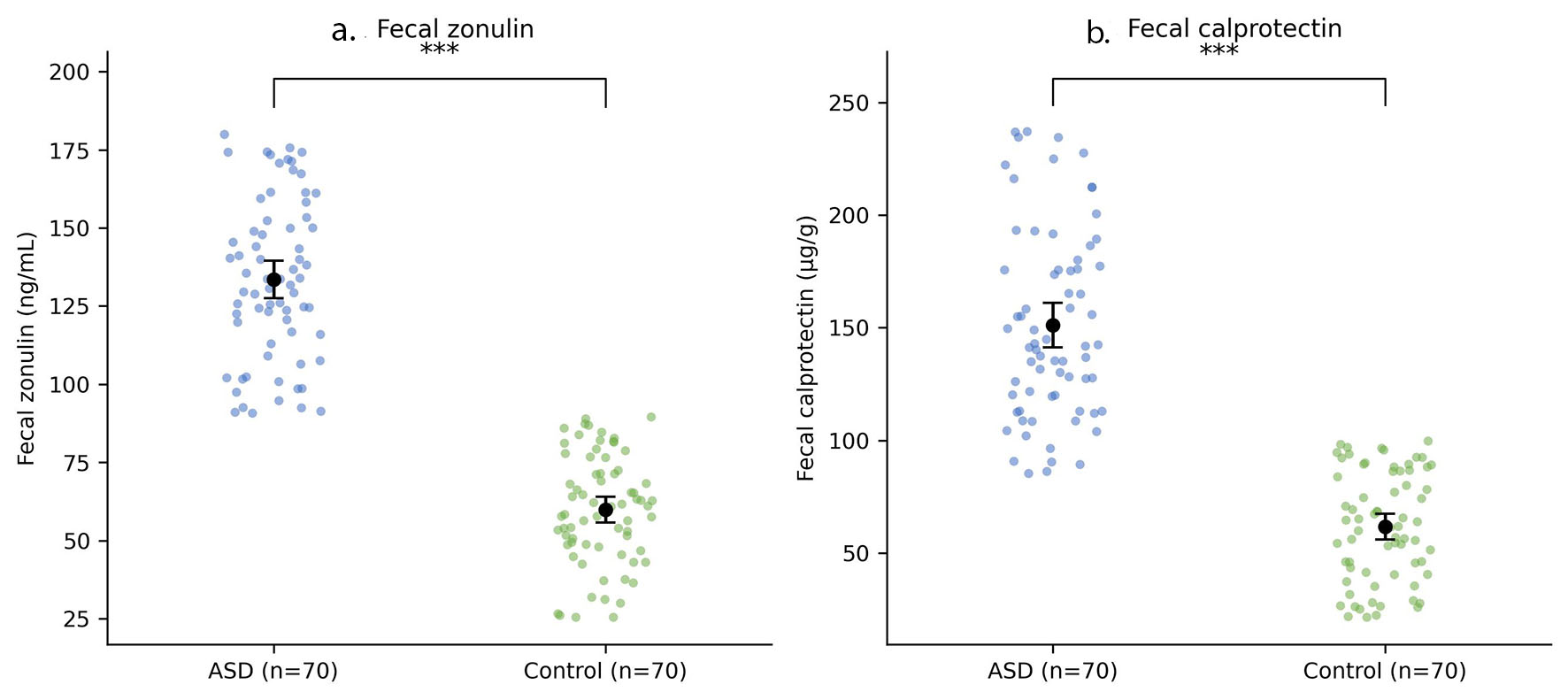
Results: Children with ASD had significantly higher levels of fecal zonulin and calprotectin than controls (both at P < 0.001) and lower abundances of beneficial taxa (Prevotella, Bifidobacterium, Lactobacillus) and higher abundances of Clostridium difficile and Bacteroidetes (all P < 0.01). The overall BAMBI scores did not differ among the groups, but within the ASD group, feeding problem severity was highly correlated with lower Bifidobacterium (r = −0.68) and higher Clostridium difficile (r = 0.74) and was not significantly correlated with autism severity, zonulin, or calprotectin.
Conclusion: Children with ASD have increased levels of gut dysbiosis and barrier dysfunction compared to their non-autistic peers, but the severity of their feeding and mealtime problems tracked the degree of gut microbial imbalance rather than the severity of their ASD symptoms in general. This suggests that feeding behavior is a characteristic that has been under-recognized as a component of the ASD phenotype and is related to the microbiome; if confirmed in longitudinal studies, these microbial associations could represent a candidate target for future gut-directed intervention research.
Published
Issue
Section
License
Copyright (c) 2026 The authors

This work is licensed under a Creative Commons Attribution 4.0 International License.