

Efficacy of Melatonin in Metabolic Dysfunction-Associated Steatotic Liver Disease: A Systematic Review and Meta-Analysis
DOI:
https://doi.org/10.14740/jocmr6688Keywords:
Metabolic dysfunction-associated steatotic liver disease, Fatty liver, Hepatic fibrosis, MelatoninAbstract
Background: Metabolic dysfunction-associated steatotic liver disease (MASLD) represents the leading cause of chronic liver disease globally. Oxidative stress, inflammation, and hepatocellular necrosis play central roles in its pathogenesis. Emerging evidence highlights melatonin as a promising therapeutic agent for MASLD. This systematic review and meta-analysis aimed to evaluate the efficacy of melatonin in MASLD management.
Methods: A comprehensive literature search was conducted across PubMed, Embase, Cochrane Library, and Web of Science from inception through December 2025 for randomized and non-randomized controlled clinical trials comparing melatonin supplementation with placebo, no treatment, or an active comparator in adults with MASLD. Dichotomous outcomes were pooled as risk ratios (RRs) using the Mantel–Haenszel method and continuous outcomes as mean differences (MDs) using the inverse-variance method, both under random-effects models. In every trial the control arm received the same background management as the melatonin arm (placebo, essential phospholipids, statin therapy, or lifestyle advice) without melatonin; no trial compared melatonin with an active pharmacological comparator.
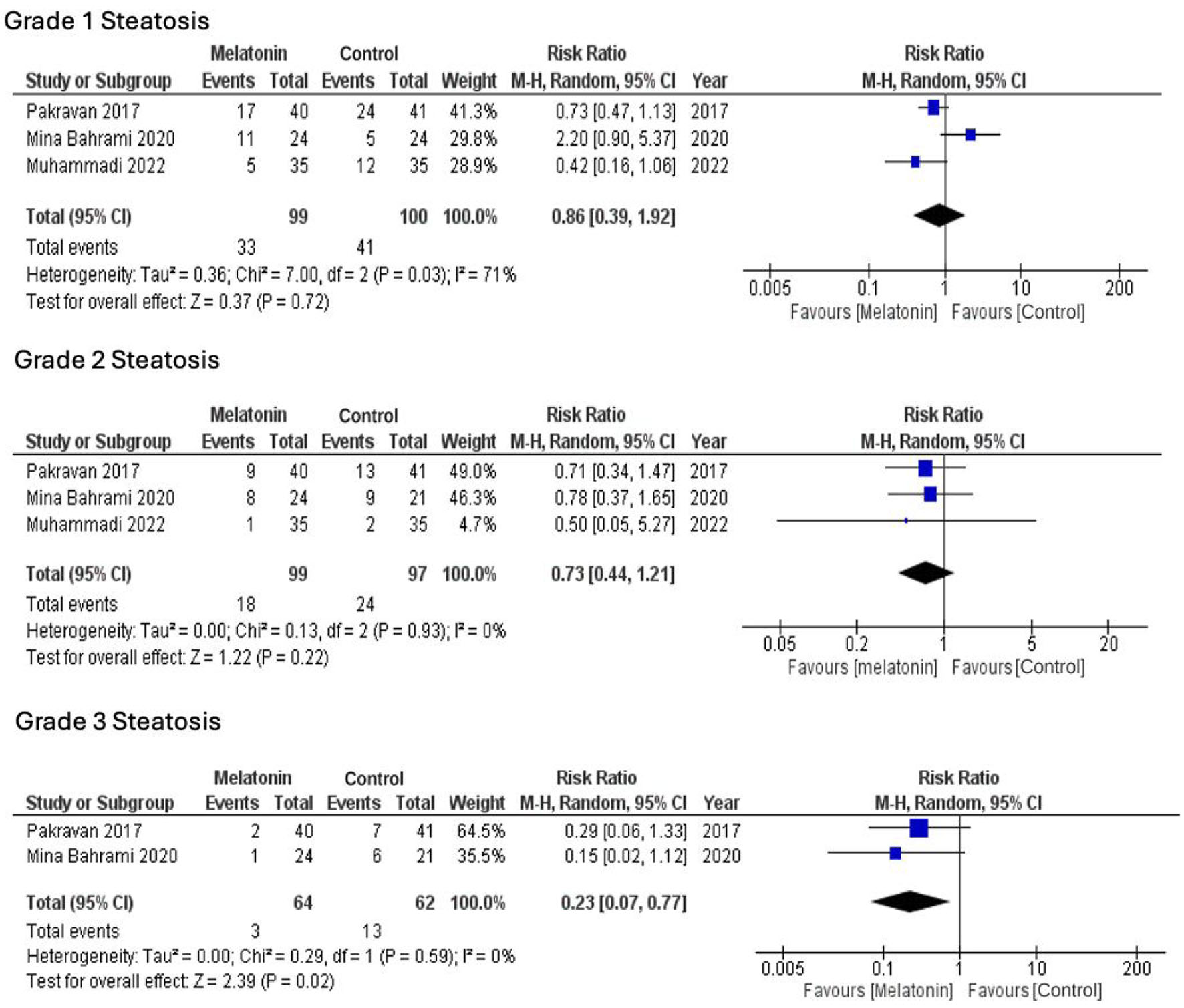
Results: Eleven controlled trials (nine randomized, two non-randomized; 548 participants: 300 melatonin, 248 control) were included. In the primary analyses, melatonin was associated with reductions in total cholesterol (MD: −16.80 mg/dL, 95% confidence interval (CI): −29.13 to −4.47, P = 0.008; I2 = 76%) and low-density lipoprotein (LDL) cholesterol (MD: −52.4 mg/dL, 95% CI: −100.52 to −4.27, P = 0.03; I2 = 96%), in interleukin-1 (IL-1), interleukin-6 (IL-6), and tumor necrosis factor-alpha (TNF-α), and in body weight and waist circumference, and with a lower proportion of participants with grade III steatosis at follow-up (RR: 0.23, 95% CI: 0.07–0.77; two trials). No significant differences were found for grade I or II steatosis, alanine aminotransferase (ALT), aspartate aminotransferase (AST), gamma-glutamyl transferase (GGT), alkaline phosphatase (ALP), triglycerides, high-density lipoprotein (HDL), fasting blood sugar, systolic/diastolic blood pressure, or high-sensitivity C-reactive protein (hs-CRP). Reductions in ALT, AST, GGT, and triglycerides were observed only in exploratory sensitivity analyses after exclusion of individual trials. Heterogeneity was high (I2 > 75%) for several outcomes, and nine of the 11 trials were placebo-controlled.
Conclusion: Melatonin supplementation was associated with modest improvements in total and LDL cholesterol, selected inflammatory markers, and anthropometric measures, but not in liver enzymes or grade I–II steatosis. Given the small number of trials, the inclusion of non-randomized designs, high heterogeneity, heterogeneous comparators, and the exploratory nature of the sensitivity analyses, these findings are preliminary. Melatonin may merit evaluation as an adjunctive therapy in MASLD, but larger, well-designed randomized trials with standardized comparators and systematic safety reporting are required.
Downloads
Published
Issue
Section
License
Copyright (c) 2026 The authors

This work is licensed under a Creative Commons Attribution 4.0 International License.