

Management of Free-Floating Thrombus in the Aortic Arch: A Narrative Review of Antithrombotic, Open Surgical, and Endovascular Strategies
DOI:
https://doi.org/10.14740/jocmr6754Keywords:
Aortic arch, Free-floating thrombus, Anticoagulation, Thrombectomy, Endovascular repair, Ischemic stroke, EmbolismAbstract
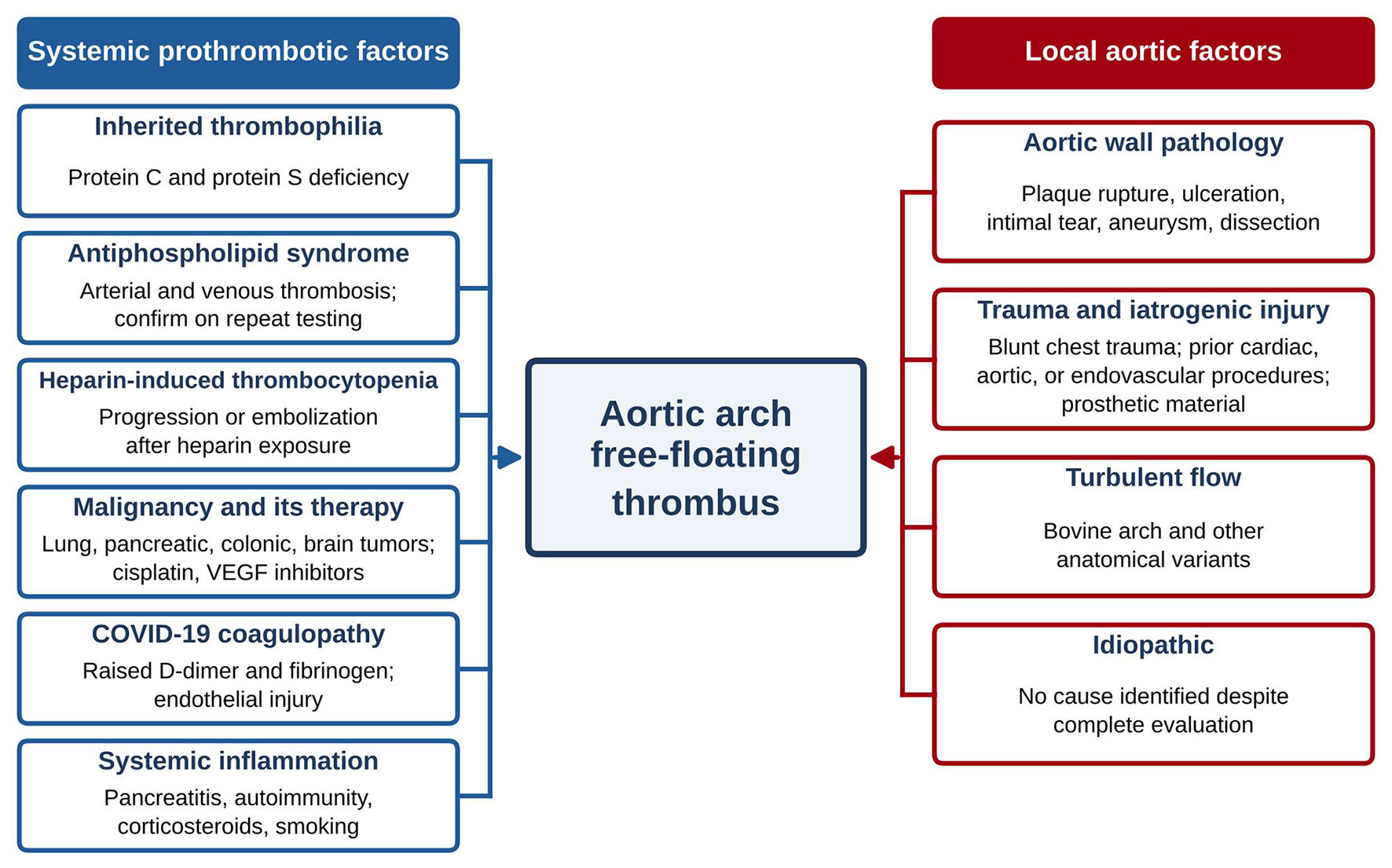
Free-floating thrombus (FFT) of the aortic arch (AAFT) is an uncommon but high-risk source of ischemic stroke and systemic embolism, and its optimal management remains undefined. We reviewed case reports, case series, observational cohorts, systematic reviews, and guidelines on the etiology, diagnosis, presentation, and management of AAFT, following the Scale for the Assessment of Narrative Review Articles (SANRA). Arch-specific evidence was prioritized and reported separately from primary aortic mural thrombus (PAMT) and non-arch thoracic data, which were used only as supplementary evidence. AAFT arises from local aortic wall pathology, trauma or procedures, and systemic prothrombotic states, including antiphospholipid syndrome (APS), malignancy, heparin-induced thrombocytopenia (HIT), and coronavirus disease 2019 (COVID-19)-associated coagulopathy, although some cases remain idiopathic. Computed tomography angiography (CTA) is the principal diagnostic and surveillance modality, complemented by transesophageal and suprasternal echocardiography. Arch-specific series are small (10–23 patients). Anticoagulation resolved the thrombus in 2 of 3, 8 of 10, and 11 of 23 patients in three arch series. In the arch subgroup of a pooled review (n = 64), persistence or recurrence occurred in 10 of 36 anticoagulated versus 0 of 28 surgically treated patients, and deaths in two versus one; allocation was non-random, therefore, these data do not establish the superiority of either strategy. Evidence on endovascular repair of AAFT is limited to case reports, and pooled complication rates favoring endovascular over open repair derive mainly from non-arch lesions. Major bleeding occurred in 2 of 10 patients receiving an anticoagulant combined with dual antiplatelet therapy (DAPT). Management should be individualized according to clinical presentation, underlying cause, thrombus characteristics, bleeding and operative risk, and technical feasibility. We summarize, with their level of evidence (LOE), the elements of initial risk assessment, early clinical and imaging reassessment, and escalation triggers, with multidisciplinary reconsideration of source control for persistent or progressive thrombus or recurrent embolization. Prospective multicenter studies using standardized definitions are needed.
Published
Issue
Section
License
Copyright (c) 2026 The authors

This work is licensed under a Creative Commons Attribution 4.0 International License.