


Development and Validation of an XGBoost-Based Machine Learning Model With Nomogram for Predicting Diabetic Peripheral Neuropathy Risk in Type 2 Diabetes Patients
DOI:
https://doi.org/10.14740/jocmr6642Keywords:
Type 2 diabetes mellitus, Diabetic peripheral neuropathy, Machine learning, XGBoost, Random forest, Risk stratification model, Nomogram, SHAPAbstract
Background: The study aimed to develop risk stratification models for diabetic peripheral neuropathy (DPN) in patients with type 2 diabetes mellitus (T2DM) using multiple machine learning algorithms, identify the optimal model, and visualize it through a nomogram, thereby providing a clinical decision-support tool for the early identification of high-risk individuals.
Methods: A retrospective analysis was conducted on 180 inpatients diagnosed with T2DM at the Endocrinology Department of our hospital from January 2021 to September 2024, including 88 patients with DPN (48.9%) and 92 patients without DPN (51.1%). All enrolled participants were randomly divided into a training cohort (n = 126) and an internal validation cohort (n = 54) at a 7:3 stratified ratio. Collected clinical variables covered demographic profiles (age, gender, diabetes duration), anthropometric indicators (body mass index (BMI)), and multiple laboratory biomarkers. Five predictive algorithms were adopted for model construction, namely logistic regression (LR), random forest (RF), extreme gradient boosting (XGBoost), support vector machine (SVM), and decision tree (DT). Model predictive efficacy was comprehensively assessed using receiver operating characteristic (ROC) curves, calibration curves, decision curve analysis (DCA), and SHapley Additive exPlanations (SHAP) interpretability analysis. A visual nomogram was finally developed based on the best-performing model.
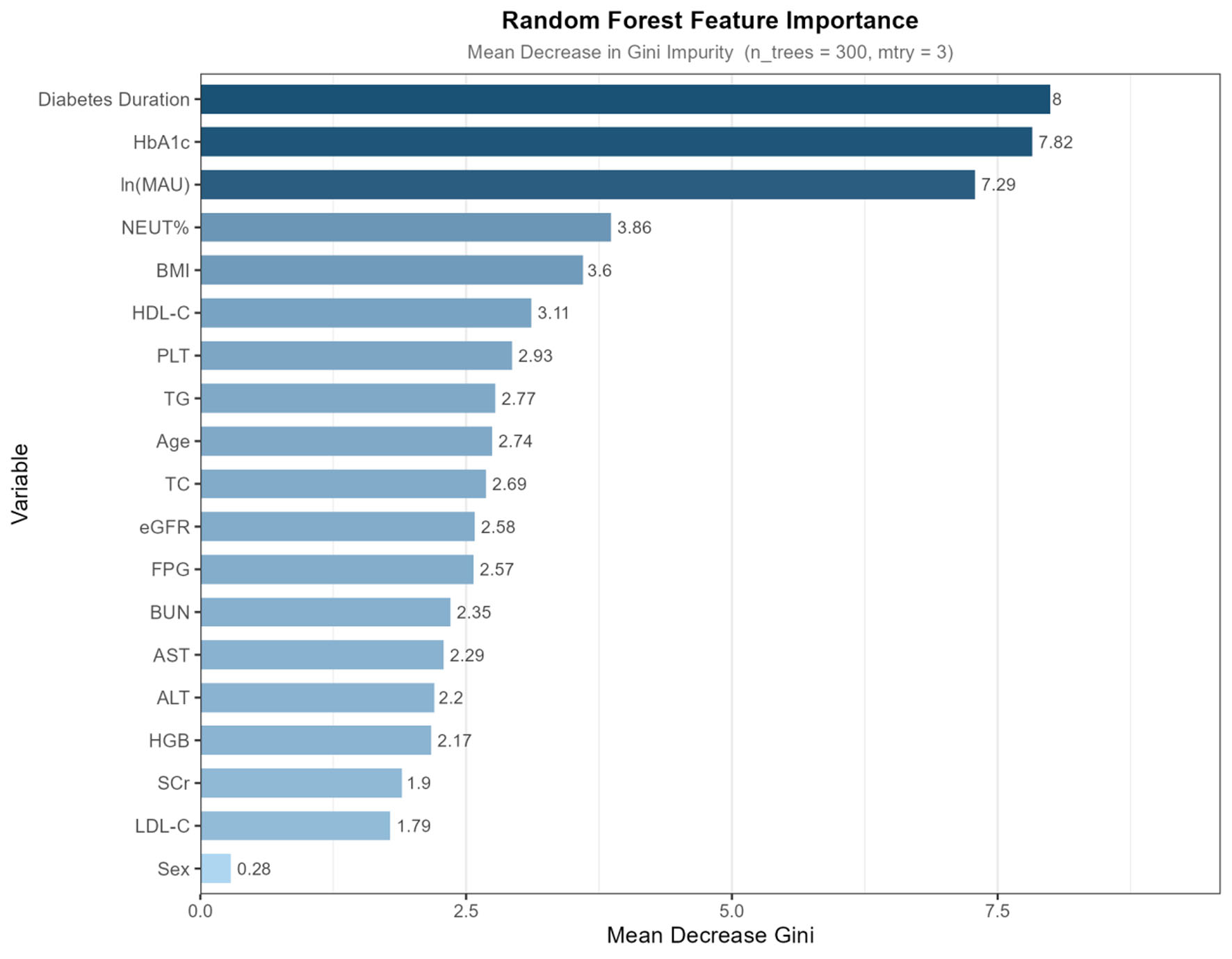
Results: Multivariate regression analysis screened out six independent predictive factors for DPN occurrence, including diabetes duration, glycated hemoglobin (HbA1c), microalbuminuria (MAU), low-density lipoprotein cholesterol (LDL-C), neutrophil percentage (NEUT%), and BMI (all P < 0.05). Among all established models, the XGBoost algorithm yielded the best predictive outcomes in internal validation, with an area under the curve (AUC) of 0.903 (95% confidence interval (CI): 0.816–0.986), accuracy of 85.2%, sensitivity of 84.6%, and specificity of 85.7%. Its predictive efficacy was numerically superior to that of RF (AUC = 0.808), LR (AUC = 0.838), SVM (AUC = 0.884), and DT (AUC = 0.814). SHAP analysis further identified diabetes duration, HbA1c, and MAU as the most influential predictors for DPN risk. The nomogram established based on these core variables achieved a validation AUC of 0.85, with favorable calibration efficiency (Hosmer-Lemeshow P = 0.512) and positive net clinical benefit across a wide range of threshold probabilities.
Conclusion: The XGBoost-based model shows favorable preliminary performance for cross-sectional DPN risk stratification in T2DM patients based on internal hold-out validation, outperforming traditional statistical approaches. Combined with SHAP interpretability and nomogram visualization, this model provides an exploratory clinical tool for early identification of potential high-risk individuals, requiring further external validation before clinical application.
Published
Issue
Section
License
Copyright (c) 2026 The authors

This work is licensed under a Creative Commons Attribution 4.0 International License.