

Neurophysin I in Community-Acquired Pneumonia: Prognostic Value and Association With Renal Function
DOI:
https://doi.org/10.14740/jocmr6658Keywords:
Oxytocin, NP-I, Inflammation, Infection, CAP, Death, ComplicationAbstract
Background: Neurophysin I (NP-I) is an accurate biomarker for the evaluation of oxytocin (OXT), a hypothalamic hormone with putative anti-inflammatory effects. We aimed to assess whether NP-I measured at the time of diagnosis in patients with community-acquired pneumonia (CAP) could predict adverse outcomes.
Methods: This was a secondary analysis of the prospective STEP Trial (NCT00973154). Blood samples were collected at inclusion for routine laboratory testing, and demographic data and Pneumonia Severity Index (PSI) scores were recorded. Adult patients hospitalized with CAP who had normal serum sodium levels at inclusion and an available blood aliquot for NP-I measurement were included. For the purpose of this exploratory analysis across disease severity, patients were selected to achieve approximately equal numbers in low–intermediate (PSI I–III) and high-risk (PSI IV–V) groups, with similar distributions of age, sex, and body mass index (BMI).
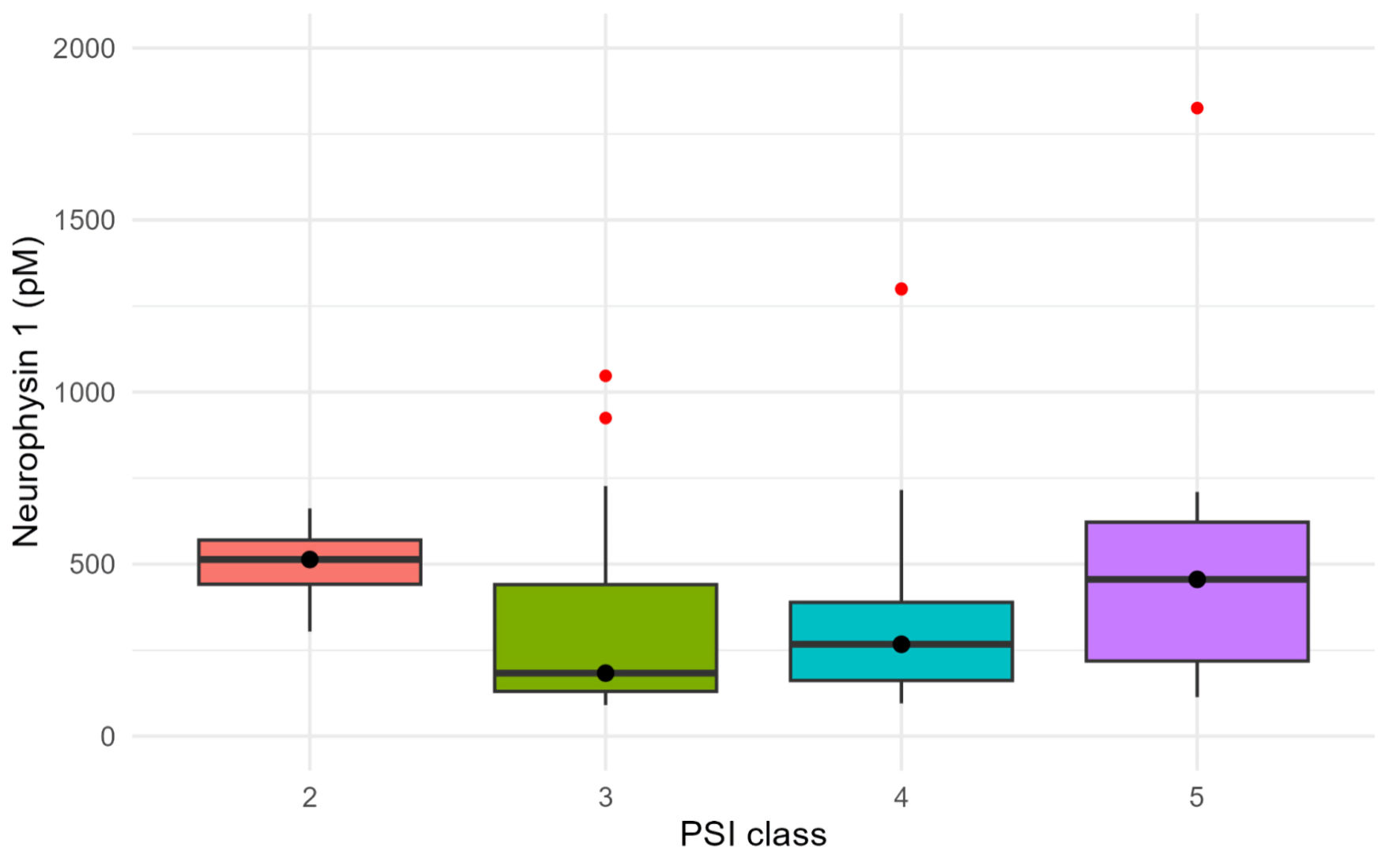
Results: Sixty-five patients were included (male-to-female ratio, 38/27 (58.5%:41.5%), median age 79 (76–83) years). NP-I levels did not differ between low–intermediate and high-risk groups (P = 0.441), between patients with and without CAP-related complications (336 (190–607) vs. 225 (147–539) pM, P = 0.326), or between survivors and non-survivors (199 (121–429) vs. 304 (174–604) pM, P = 0.259). In univariable logistic regression analysis, PSI was significantly associated with in-hospital mortality (odds ratio (OR), 1.027; 95% CI, 1.008–1.049; P = 0.006), but adding NP-I did not improve predictive performance (DeLong’s test P = 0.509 vs. PSI alone). Patients with impaired renal function (n = 28) had higher NP-I levels than those with preserved renal function (n = 37) (446 (278–685) vs. 182 (124–403) pM, P < 0.001) and NP-I was inversely associated with estimated glomerular filtration rate (eGFR) in multivariable analysis adjusted for age and sex (β = −9.06, P = 0.038).
Conclusions: NP-I is elevated in patients with impaired renal function, likely reflecting reduced renal clearance. NP-I measured shortly after CAP diagnosis appears to provide no prognostic information for adverse outcomes.
Published
Issue
Section
License
Copyright (c) 2026 The authors

This work is licensed under a Creative Commons Attribution 4.0 International License.