


Red Blood Cell Alloimmunization in Transfused Chronic Kidney Disease: A 2021–2026 Scoping Review
DOI:
https://doi.org/10.14740/jocmr6718Keywords:
Alloantibodies, Alloimmunization, CKD, Red blood cell, TransfusionAbstract
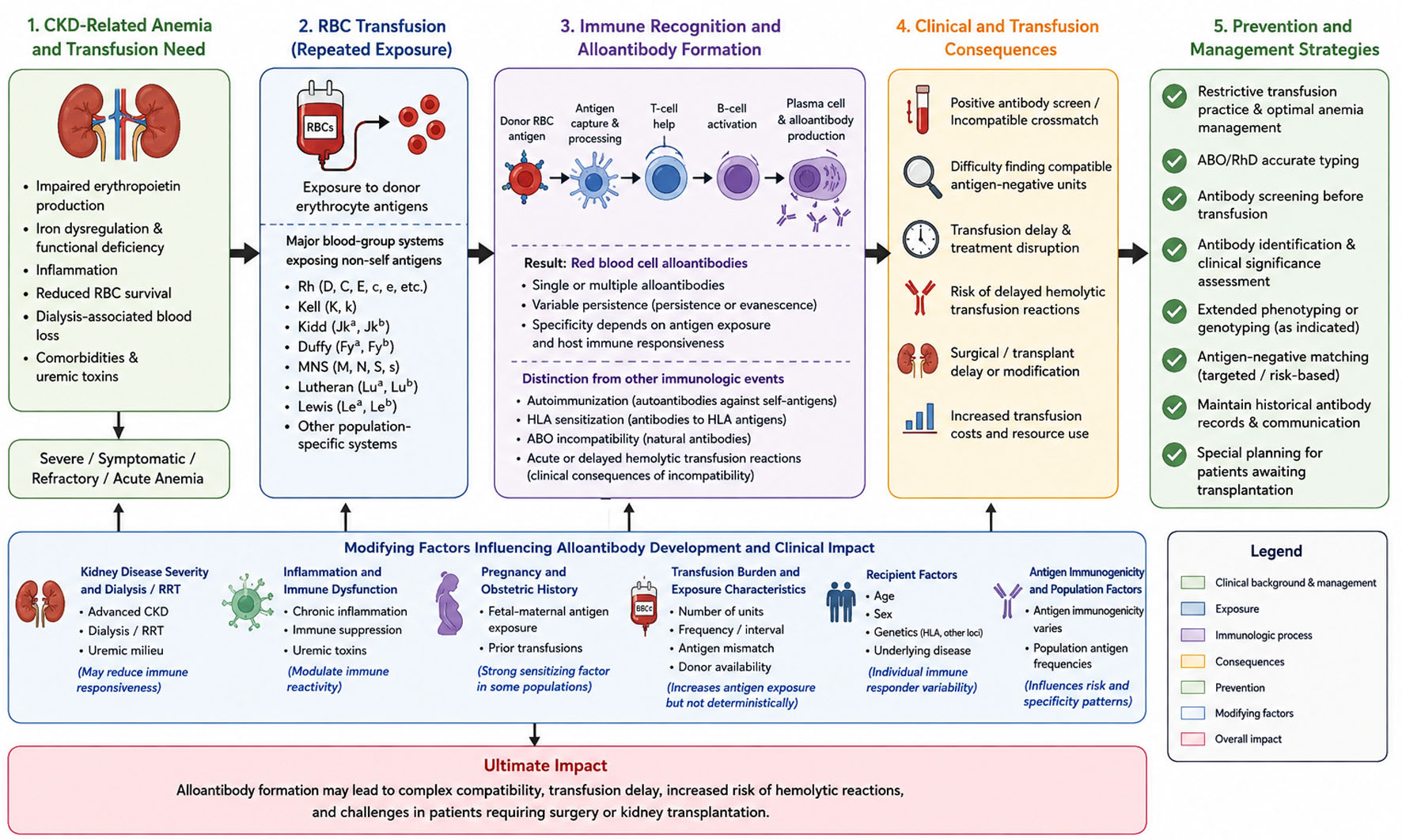
Red blood cell (RBC) alloantibodies can complicate transfusion and kidney transplantation. We mapped studies published during 2021–2026 reporting RBC alloimmunization among transfused patients with chronic kidney disease (CKD). This scoping review used JBI guidance and the PRISMA-ScR reporting framework. Searches of Scopus, Web of Science Core Collection, and PubMed/MEDLINE identified 41 records; 35 were unique, 19 underwent topic screening, and six studies were included. Eligibility was limited to English-language human journal articles published in 2021–2026. The search-export audit, rather than independent platform-specific search logs, defined the operational search date. Heterogeneous evidence was mapped descriptively by study role. Two dedicated CKD cohorts detected RBC alloantibodies in 14/235 (5.9%) and 10/141 (7.1%) patients. Two mixed-cohort CKD subgroups reported 0/25 and two antibody-positive patients (6.3% of the subgroup), respectively. Antibody specificity varied: Rh antibodies were reported in Burkina Faso, while anti-K was prominent in Uganda. A renal-failure determinant study found an association between renal replacement therapy and lower first-time alloimmunization (adjusted relative rate 0.62, 95% confidence interval (CI) 0.45–0.88); causality cannot be inferred. A transplant case illustrated difficulties obtaining compatible RBC units. The published CKD-specific evidence is limited and methodologically heterogeneous; publication years do not necessarily reflect the periods of patient data collection. Established transfusion practice supports maintaining antibody histories and supplying antigen-negative RBCs when clinically significant antibodies are known, but CKD-specific comparative effectiveness evidence is lacking. The included studies do not support universal prophylactic extended matching or genotyping.
Published
Issue
Section
License
Copyright (c) 2026 The authors

This work is licensed under a Creative Commons Attribution 4.0 International License.