


Subclinical Cardiac Dysfunction in Prediabetes: A Systematic Review and Meta-Analysis of Echocardiographic Functional and Structural Measures
DOI:
https://doi.org/10.14740/jocmr6732Keywords:
Prediabetes, Impaired fasting glucose, Impaired glucose tolerance, Diastolic dysfunction, Global longitudinal strain, Subclinical cardiac dysfunction, EchocardiographyAbstract
Background: Prediabetes is associated with a higher risk of cardiovascular disease and heart failure; however, there is insufficient knowledge regarding subclinical cardiac changes measured using echocardiography in these patients. This systematic review and meta-analysis aimed to compare cardiac structure and function in adults with prediabetes and those with normoglycemia.
Methods: Four databases were searched from their inception until March 31, 2026 for observational studies that compared echocardiographic outcomes between adults with prediabetes and normoglycemia. Selection, data extraction, and methodological quality assessment were conducted independently by two reviewers. DerSimonian–Laird random-effects meta-analysis was used to calculate pooled mean differences (MDs) for E/e', e', E/A, left atrial volume index (LAVI), global longitudinal strain (GLS), and ejection fraction (EF), and standardized mean differences (SMDs) for left ventricular mass index (LVMI). Certainty of evidence was rated using GRADE.
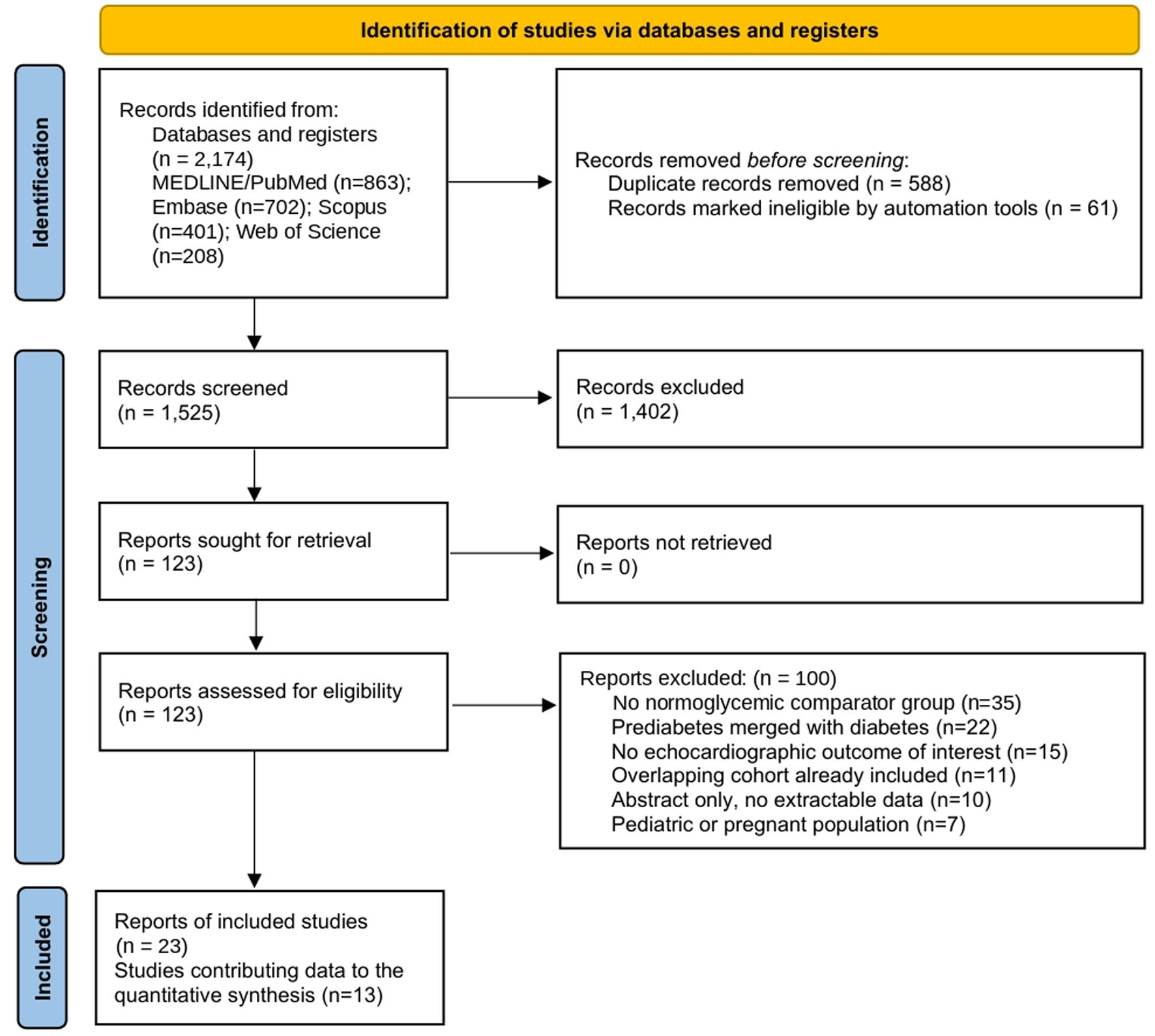
Results: Twenty-three reports were included, 13 of which contributed to the meta-analyses. More than 20,000 participants were involved; however, because of population overlap, they cannot be considered a unique pooled cohort. Prediabetes was associated with higher E/e' (MD 0.72, 95% confidence interval (CI) 0.40 to 1.05; I2 = 39%), lower E/A (MD −0.20, 95% CI −0.31 to −0.09; I2 = 81%), and lower absolute GLS (MD −0.90%, 95% CI −1.53 to −0.27; I2 = 90%), although the GLS difference was not statistically significant after Hartung–Knapp–Sidik–Jonkman adjustment. LVMI (SMD 0.19, 95% CI −0.02 to 0.39), LAVI (MD 2.12 mL/m2, 95% CI −0.59 to 4.83), and EF (MD −0.44%, 95% CI −0.89 to 0.01) did not differ significantly. Certainty of evidence was very low for all outcomes, and publication bias could not be assessed.
Conclusions: Prediabetes was associated with small group-level differences in diastolic and longitudinal deformation indices of uncertain clinical relevance, rather than an established cardiac phenotype. Very low certainty, substantial heterogeneity, residual confounding, and cross-sectional data preclude causal inference. Prospective studies with standardized glycemic classification and echocardiographic acquisition are needed to clarify the prognostic importance and reversibility of these differences.
Published
Issue
Section
License
Copyright (c) 2026 The authors

This work is licensed under a Creative Commons Attribution 4.0 International License.