

Urate-Lowering Effect of Dotinurad During Concomitant Sodium-Glucose Cotransporter 2 Inhibitor Therapy for Chronic Kidney Disease: A Retrospective Study
DOI:
https://doi.org/10.14740/jocmr6733Keywords:
Chronic kidney disease, Dotinurad, Sodium-glucose cotransporter 2 inhibitor, Hyperuricemia, Urate transporter 1Abstract
Background: Dotinurad is a selective urate transporter 1 (URAT1) inhibitor that effectively lowers serum urate (UA) levels in patients with chronic kidney disease (CKD) and hyperuricemia. Sodium-glucose cotransporter 2 (SGLT2) inhibitors are increasingly used in this population and also influence renal urate handling. However, whether dotinurad maintains its urate-lowering efficacy during concomitant SGLT2 inhibitor therapy remains unknown.
Methods: This retrospective single-center cohort study enrolled 44 patients with CKD and hyperuricemia who started dotinurad therapy. Patients were classified according to concomitant SGLT2 inhibitor use (SGLT2 inhibitor group, n = 13; non-SGLT2 inhibitor group, n = 31). The primary outcome was the change in serum UA level from baseline to 12 months. Secondary outcomes included longitudinal changes in serum UA, estimated glomerular filtration rate (eGFR), and eGFR slope.
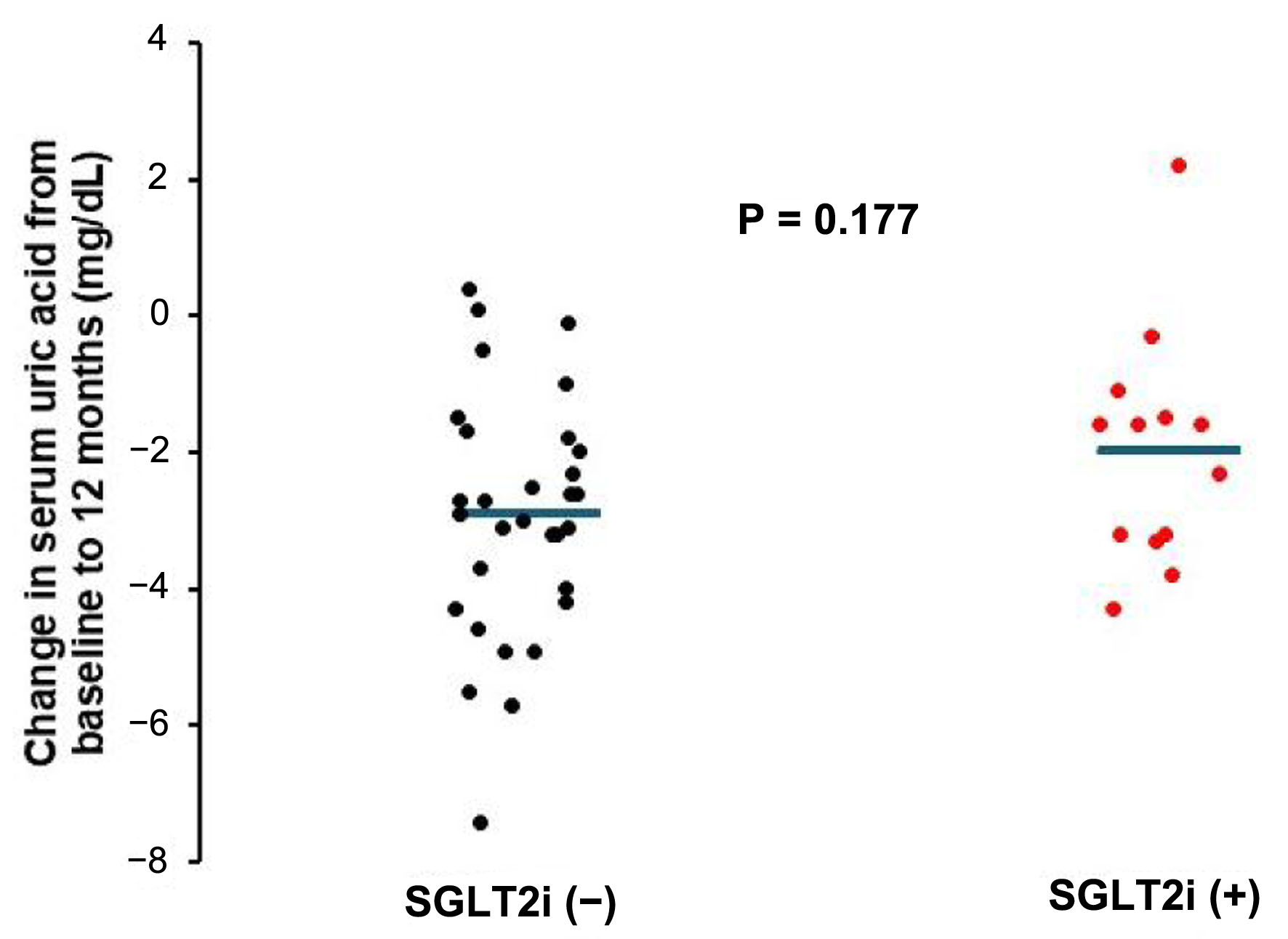
Results: Dotinurad significantly reduced serum UA levels in both groups. The mean changes at 12 months were −1.97 ± 1.71 and −2.94 ± 1.78 mg/dL in the SGLT2 inhibitor and non-SGLT2 inhibitor groups, respectively, with no significant between-group difference (P = 0.177). Serum UA levels remained significantly lower throughout the 12-month follow-up in both groups. After adjusting for baseline serum UA level, sex, and diabetes mellitus, the between-group difference in the serum UA level at 12 months was −0.026 mg/dL (95% confidence interval, −1.130 to 1.079; P = 0.963). No significant between-group differences were observed in longitudinal changes in eGFR or eGFR slope (P = 0.837).
Conclusions: Dotinurad was associated with reductions in serum urate levels in patients with CKD and hyperuricemia, both with and without concomitant SGLT2 inhibitor therapy. Both groups showed similar magnitudes of serum urate level reduction and changes in eGFR slope. However, these findings should be interpreted cautiously because of the small sample size and potential confounding.
Published
Issue
Section
License
Copyright (c) 2026 The authors

This work is licensed under a Creative Commons Attribution 4.0 International License.