

Serum Serotonin and Noninvasive Portal Hypertension Indices in Relation to Esophageal Variceal Severity in Cirrhosis: An Exploratory Cross-Sectional Study
DOI:
https://doi.org/10.14740/jocmr6742Keywords:
Liver cirrhosis, Esophageal and gastric varices, Serotonin, Child-Pugh score, Portal hypertension, Platelet count to spleen diameter ratioAbstract
Background: Esophageal varices are a life-threatening consequence of portal hypertension in liver cirrhosis, and upper gastrointestinal endoscopy, the reference standard for detecting them, is invasive and resource-intensive. Serum serotonin, over 90% of which is stored in circulating platelets, has been proposed as a candidate biochemical correlate of portal hypertensive and fibrotic change, but its relationship to variceal severity alongside established noninvasive indices has not been well characterized. This study aimed to determine the association of serum serotonin, Child-Pugh class, portal vein diameter, and platelet count to spleen diameter ratio (PSR) with endoscopically graded esophageal variceal severity in patients with liver cirrhosis, and to explore the diagnostic performance of these markers for identifying high-grade varices.
Methods: In this exploratory cross-sectional study, 140 participants were enrolled into five prespecified groups of fixed size: non-hepatic controls (n = 40), cirrhosis without varices (n = 40), and grade 1 (n = 20), grade 2 (n = 20), and grade 3 (n = 20) esophageal varices confirmed endoscopically. Serum serotonin was measured by enzyme-linked immunosorbent assay (ELISA). Group comparisons used one-way ANOVA or the Kruskal-Wallis test according to the normality of model residuals, and the chi-square or Fisher-Freeman-Halton exact test for categorical variables. Spearman correlation and multivariable ordinal logistic regression identified independent predictors of variceal grade among the 60 participants with varices, and receiver operating characteristic (ROC) analysis assessed diagnostic performance for grade 2/3 varices among the 99 cirrhotic participants with complete data, with bootstrap correction of cutoff-based estimates for optimism and pairwise DeLong comparison of AUCs; a Firth-penalized model was fitted as a sensitivity analysis.
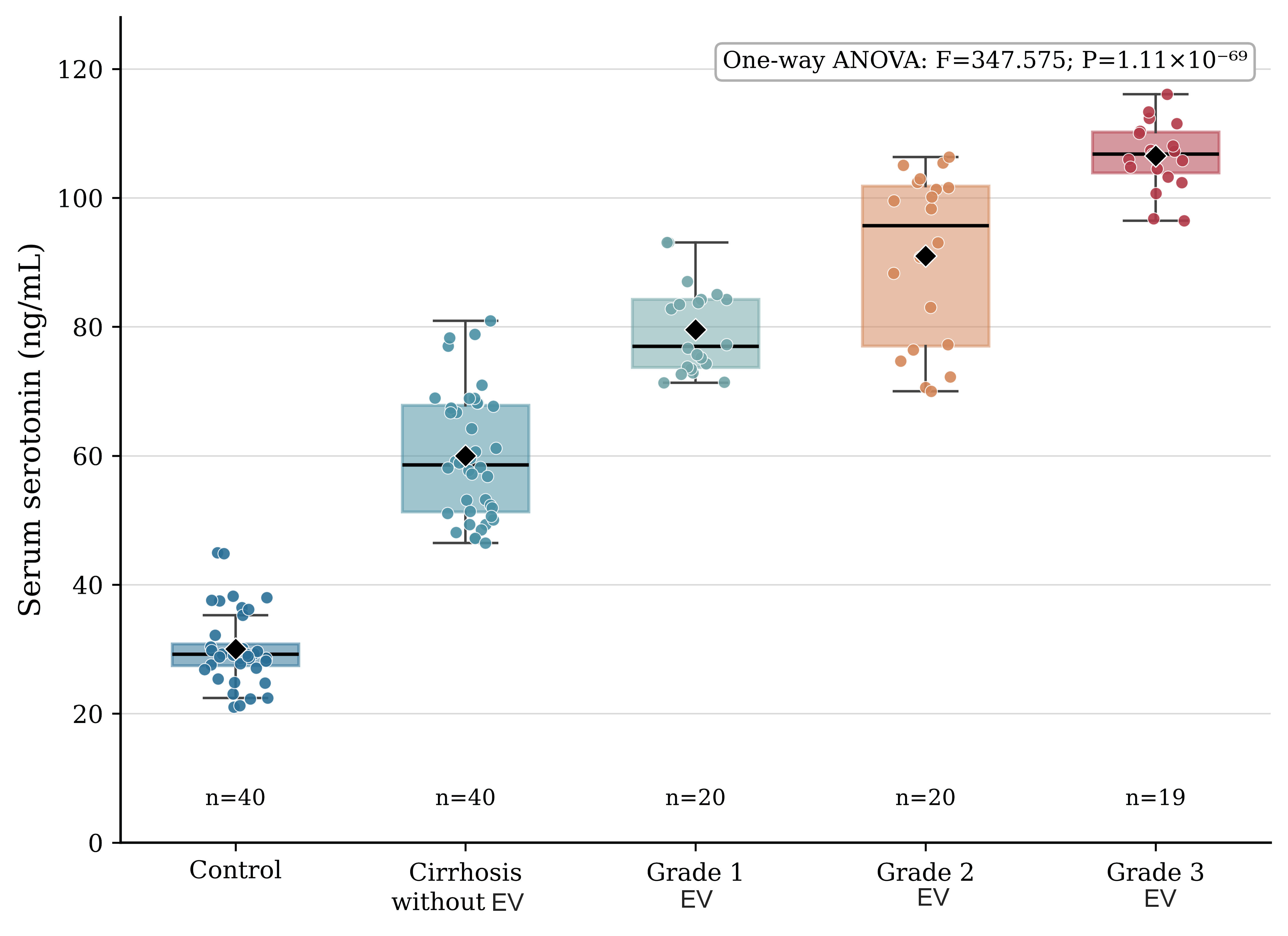
Results: Serum serotonin rose progressively across groups, from 30.0 ± 5.6 ng/mL in controls to 106.5 ± 5.2 ng/mL in grade 3 varices (F = 347.575, P < 0.001), and was, together with portal vein diameter, an independent predictor of variceal grade after adjustment (adjusted odds ratio (OR) of 7.48 per 10 ng/mL, P = 0.0009; portal vein diameter adjusted OR of 1.70 per 0.1 mm, P = 0.0002; exploratory model, n = 59). Apparent areas under the curve (AUCs) for grade 2/3 varices were 0.944 (95% confidence interval (CI), 0.895–0.980) for serotonin, 0.923 (0.864–0.974) for portal vein diameter, 0.764 for PSR, and 0.746 for Child-Pugh class; serotonin and portal vein diameter did not differ significantly (DeLong P = 0.553), whereas each exceeded PSR and Child-Pugh class (all P ≤ 0.004). Both associations persisted in the penalized model, and optimism correction changed the accuracy estimates only slightly.
Conclusions: In this exploratory study, serum serotonin tracked with esophageal variceal severity and, alongside portal vein diameter, was independently associated with variceal grade, with discrimination comparable to that of portal vein diameter. Because the sample was enriched by design and cutoffs were derived and tested in the same cohort, these findings are hypothesis-generating and require validation in unselected surveillance cohorts before clinical use.
Published
Issue
Section
License
Copyright (c) 2026 The authors

This work is licensed under a Creative Commons Attribution 4.0 International License.