


Machine Learning-Based Model to Classify Emergency Severity Index Levels 1-3 in Febrile Patients With Tachycardia: Thailand Triage Prediction System
DOI:
https://doi.org/10.14740/jocmr6371Keywords:
Triage, Patient acuity, Severity of Illness Index, Fever, Tachycardia, Machine learningAbstract
Background: Febrile patients with tachycardia present diverse profiles that complicate triage. Although the Emergency Severity Index (ESI) is widely used in Thailand, inter-rater variability limits consistency. Machine learning (ML) may enhance reliability using routinely collected triage data. The objectives were to develop and evaluate ML models predicting ESI levels 1-3 in febrile tachycardic adults and identify the best model for clinical use.
Methods: This diagnostic prediction study analyzed adults with fever (≥ 37.6 °C) and pulse rate > 100 beats per minute in the triage area of Lampang Hospital, Thailand, during June - August 2024. Patients with complete data were included, whereas referrals and expert-disagreement cases were excluded. Expert-assigned ESI levels were the outcome. Thirteen routinely collected triage variables were evaluated as candidate predictors. The dataset (n = 500) was randomly split 80:20 into development and testing sets. Random forest, extreme gradient boosting (XGBoost), and gradient boosting machine models were developed using five-fold cross-validation with class-weighting for imbalance correction. Performance was assessed using area under the receiver operating characteristic curve (AuROC), calibration, and confusion matrices, with attention to clinically relevant misclassification.
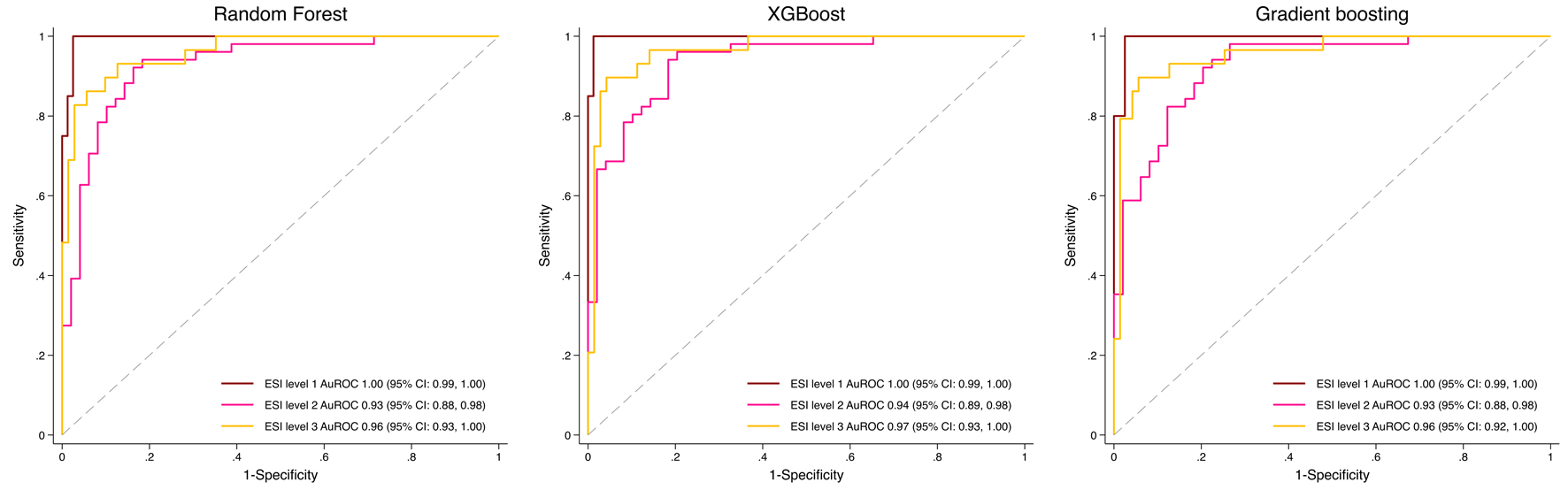
Results: XGBoost demonstrated the best discrimination with AuROC values of 1.00 (confidence interval (CI): 0.99 - 1.00), 0.94 (CI: 0.89 - 0.98), and 0.97 (CI: 0.93 - 1.00) for ESI levels 1-3 in the test set. Calibration showed the lowest Brier scores, and misclassification was minimal, supporting strong predictive consistency across categories.
Conclusions: XGBoost was selected for integration into the Smart ER system as the Thailand Triage Prediction System (TTPS), providing real-time prediction to enhance triage accuracy, support decision-making, and improve workflow.
Published
Issue
Section
License
Copyright (c) 2025 The authors

This work is licensed under a Creative Commons Attribution-NonCommercial 4.0 International License.