

The MAGENTA Model for Individual Prediction of In-Hospital Mortality in Chronic Obstructive Pulmonary Disease With Acute Exacerbation: An External Validation Study
DOI:
https://doi.org/10.14740/jocmr6512Keywords:
COPD exacerbation, In-hospital mortality, MAGENTA model, External validationAbstract
Background: The MAGENTA score identifies acute exacerbation of chronic obstructive pulmonary disease (AECOPD) patients at high risk of in-hospital mortality to guide monitoring and treatment, yet its generalizability requires confirmation. This study aimed to externally validate the performance of the MAGENTA model.
Methods: We conducted a temporal external validation using retrospective data from 938 admission records of patients hospitalized in general wards and intensive care units at a tertiary center in Thailand (2018–2019). The model, which utilizes mean arterial pressure, age, blood urea nitrogen, endotracheal intubation, sodium, temperature, and albumin, was evaluated regarding all-cause in-hospital mortality.
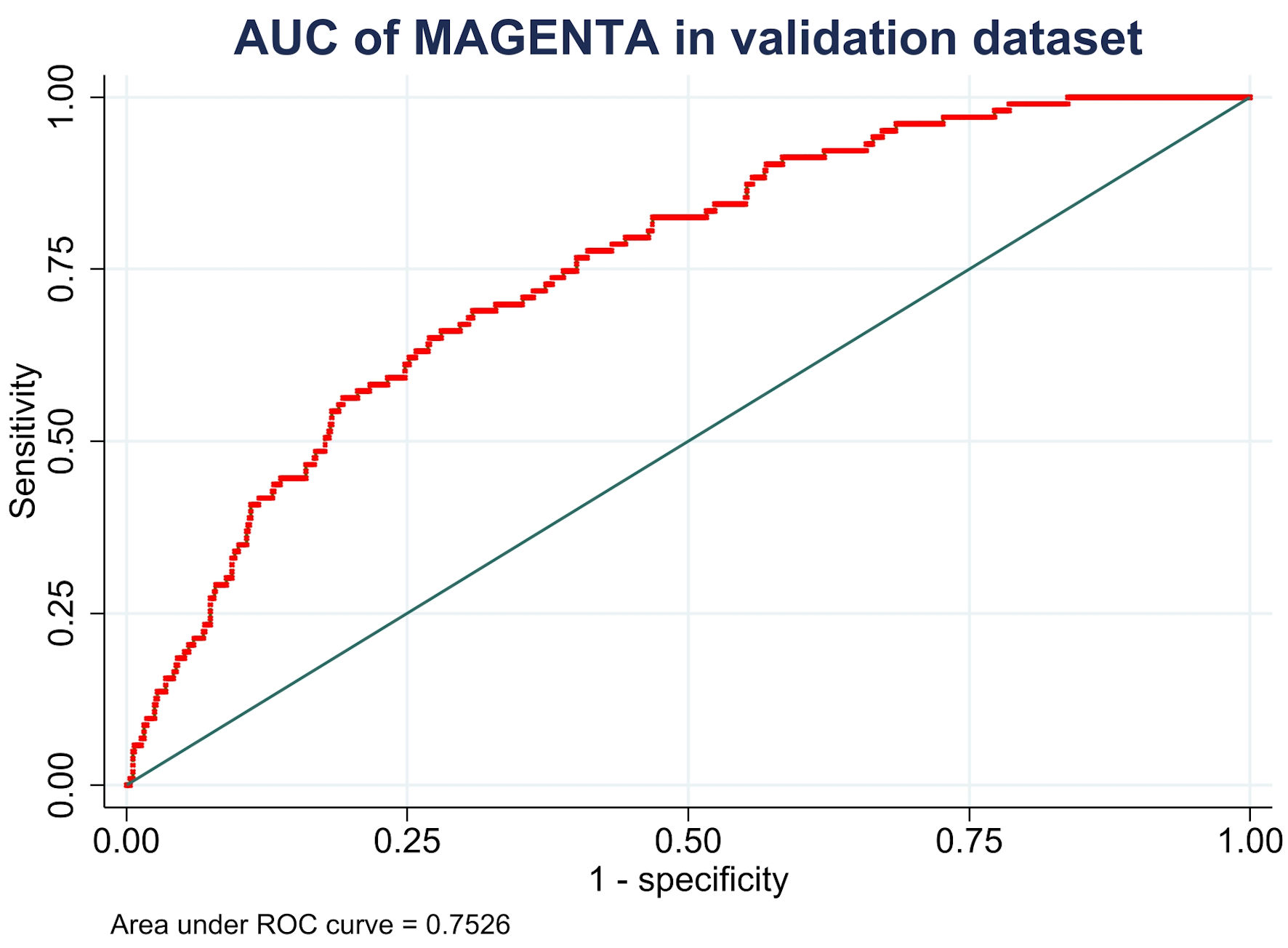
Results: The validation cohort had an 11.2% mortality rate with moderate case-mix differences compared to the development set. The model demonstrated acceptable discrimination with an area under the curve (AUC) of 0.75 (95% confidence interval (CI), 0.70–0.80), though lower than the AUC in the original derivation. Calibration analysis revealed systematic overprediction (expected-to-observed (E:O) ratio of 1.335) and overfitting (slope of 0.536), particularly when the predicted risk exceeded 20%. Importantly, recalibration of the intercept and slope substantially improved the agreement between predicted and observed risks.
Conclusions: While the MAGENTA model offers acceptable discriminative ability for stratifying AECOPD mortality risk, local recalibration is recommended to address overestimation in high-risk patients.
Published
Issue
Section
License
Copyright (c) 2026 The authors

This work is licensed under a Creative Commons Attribution 4.0 International License.